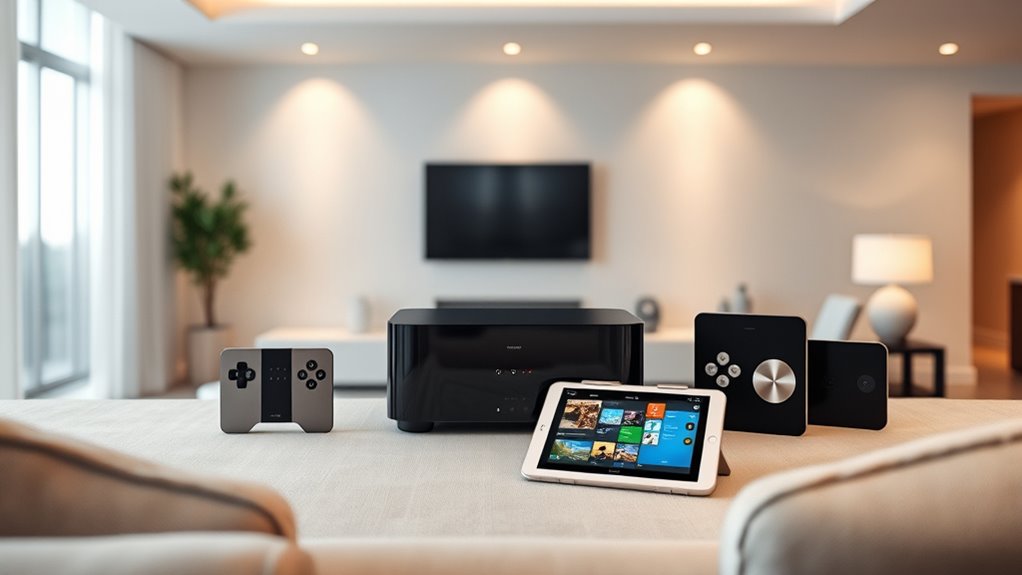

For those seeking a truly integrated smart home experience, premium home automation hubs offer advanced features, extensive device support, and robust connectivity. The Homey Pro stands out as the overall best pick for its versatility and extensive protocol support, while the Philips Hue Bridge Pro excels in smart lighting with advanced encryption. The main tradeoffs in this category often come down to cost versus compatibility and ease of setup. Continue reading for a detailed comparison that will help you choose the right hub for your needs.
Complete the kit


Key Takeaways
- The Homey Pro leads with broad protocol support, making it ideal for complex smart homes.
- The Philips Hue Bridge Pro is the best choice for advanced lighting control and security.
- Many premium hubs face tradeoffs between ease of use and extensive device compatibility.
- Zigbee, Z-Wave, and Matter support are key factors influencing future-proofing and device integration.
- Higher-priced hubs often offer better app interfaces and automation flexibility, but require more setup effort.
| Lutron Caseta Deluxe Smart Dimmer Switch Kit, 2 Switches, 2 Wall Plates, 2 Pico Remotes, and Smart Hub |  | Best Overall for Reliable, Local Control | Number of Switches: 2 | Wall Plates: 2 | Pico Remotes: 2 | VIEW ON AMAZON | See Our Full Breakdown |
| Philips Hue Bridge Pro, Smart Lighting Hub with Advanced Encryption and Support for 150+ Lights |  | Best for Large-Scale, Advanced Lighting Automation | Processor: Quad-core Cortex-A35 1.7 GHz | Memory: 4 GB DDR4 SDRAM | Supported Lights: 150+ | VIEW ON AMAZON | See Our Full Breakdown |
| Samsung SmartThings Hub 3rd Generation |  | Best for Versatile Protocol Support and Broad Compatibility | Model: GP-U999SJVLGDA | Protocols: Zigbee, Z-Wave, Cloud-to-Cloud | Color: White | VIEW ON AMAZON | See Our Full Breakdown |
| Homey Bridge | Smart Home Hub for Home Automation with Z-Wave Plus, Zigbee, Wi-Fi, BLE & Infrared |  | Best for Protocol Versatility and Voice Control Integration | Connectivity: Z-Wave Plus, Zigbee, Wi-Fi, BLE, Infrared | Compatibility: Amazon Alexa, Google Assistant, Siri Shortcuts | Includes: 3 months Homey Premium | VIEW ON AMAZON | See Our Full Breakdown |
| Aqara Smart Home Hub M3 with Matter, Zigbee, Thread, Wi-Fi, PoE, IR, Apple HomeKit, Alexa, SmartThings, Home Assistant |  | Best for Advanced Protocol Support and Local Automation | Protocols Supported: Zigbee, Thread, Matter | Device Capacity: 127 Zigbee, 127 Thread | Connectivity: Wi-Fi 2.4/5 GHz, PoE, USB-C | VIEW ON AMAZON | See Our Full Breakdown |
| AduroSmart ERIA Smart Home Hub/Gateway |  | Best ZigBee-Centric Hub for Seamless Compatibility | Compatibility: ZigBee devices including lights, sensors, plugs, thermostats, locks | App Compatibility: ERIA App, Alexa, Google Assistant, Apple Shortcuts | Note: Does not work with Z-Wave devices | VIEW ON AMAZON | See Our Full Breakdown |
| Homey Pro (Early 2023) Smart Home Hub for Home Automation |  | Best All-in-One Protocol Support for Power Users | Protocols Supported: Z-Wave Plus, Zigbee, Wi-Fi, BLE, Infrared, Matter, Thread | Compatibility: Siri, Alexa, Google Home | Device Compatibility: Over 50,000 devices from 1,000+ brands | VIEW ON AMAZON | See Our Full Breakdown |
More Details on Our Top Picks
Lutron Caseta Deluxe Smart Dimmer Switch Kit, 2 Switches, 2 Wall Plates, 2 Pico Remotes, and Smart Hub
This kit stands out for offering dependable smart lighting control without relying on Wi-Fi, making it ideal for homes where internet stability is a concern. The included smart hub communicates locally, ensuring quick responses and minimal lag, unlike cloud-dependent options like the Homey Bridge. Installation is straightforward, taking about 15 minutes, and compatibility with major platforms like Alexa, Apple HomeKit, and Google Home broadens its appeal. Flicker-free dimming for LEDs enhances mood and ambiance, but the 150W limit could restrict high-wattage fixtures. Its lack of a neutral wire requirement makes it suitable for many older homes, yet some wiring setups might still find this incompatible.
Pros:- Reliable performance independent of Wi-Fi connectivity
- Simple installation process in about 15 minutes
- Compatibility with major smart home platforms
Cons:- Limited to 150W dimming capacity, restricting high-wattage fixtures
- No neutral wire needed may not suit all wiring configurations
Best for: Homeowners seeking a reliable, local-control hub that integrates seamlessly with popular voice assistants and lighting fixtures.
Not ideal for: Tech enthusiasts wanting high wattage handling or those with complex wiring that requires neutral wires.
- Number of Switches:2
- Wall Plates:2
- Pico Remotes:2
- Smart Hub:Yes
- Neutral Required:No
- Dimming Capacity:150W
- Battery Life of Pico:10 years
- Installation Time:15 minutes
Our verdict“This pick makes the most sense for users prioritizing dependable lighting automation with easy setup and broad platform support.”
Philips Hue Bridge Pro, Smart Lighting Hub with Advanced Encryption and Support for 150+ Lights
The Philips Hue Bridge Pro excels for users managing extensive lighting setups, supporting over 150 lights and more than 50 accessories, which surpasses many competitors like the Lutron system. Its quad-core processor ensures quick response times and smooth automation, particularly useful when coordinating complex scenes. Integrated motion sensing via Hue MotionAware adds automation layers, though it requires compatible Hue devices, and setup can be intricate for those unfamiliar with Hue ecosystems. Its security features bolster privacy, but the lack of clear pricing details could be a barrier for budget-conscious buyers. Overall, this hub is well-suited for serious smart lighting enthusiasts seeking scalability and reliability.
Pros:- Supports over 150 lights and 50 accessories for extensive setups
- Fast processing speeds enable quick automation responses
- Includes motion sensing automation for enhanced scene control
- Strong security with Zigbee Trust Center
Cons:- Setup complexity may challenge new users
- Requires compatible Hue devices for full motion sensing features
Best for: Homeowners or commercial projects needing large, sophisticated lighting networks with advanced automation features.
Not ideal for: Casual users with small lighting setups or those unfamiliar with Hue’s ecosystem and who prefer simple installations.
- Processor:Quad-core Cortex-A35 1.7 GHz
- Memory:4 GB DDR4 SDRAM
- Supported Lights:150+
- Supported Accessories:50+
- Motion Sensing:Hue MotionAware
- Security:Zigbee Trust Center
Our verdict“Best suited for those needing large, scalable lighting automation with robust processing and security features.”
Samsung SmartThings Hub 3rd Generation
The SmartThings Hub 3rd Gen offers compatibility across Zigbee, Z-Wave, and cloud-to-cloud integrations, making it a flexible choice for users with diverse device ecosystems. Compared with the Homey Bridge, which emphasizes protocol variety and privacy, the SmartThings hub focuses on broad device support and automation via a straightforward app interface. However, its setup can be complex, especially for users managing multiple protocols and devices, and it requires compatible devices to maximize functionality. While it supports voice assistants like Alexa and Google Home, some users find the configuration process demanding. This hub appeals most to those with existing smart devices seeking a unified control point.
Pros:- Supports multiple protocols including Zigbee and Z-Wave
- Enables automation and remote control via a single app
- Compatible with Alexa and Google Assistant
Cons:- Setup can be intricate, especially for multi-protocol networks
- Requires compatible devices for full benefits
Best for: Homeowners with mixed device ecosystems who want flexible, protocol-agnostic automation in a single hub.
Not ideal for: Beginners or users seeking a plug-and-play experience without complex setup requirements.
- Model:GP-U999SJVLGDA
- Protocols:Zigbee, Z-Wave, Cloud-to-Cloud
- Color:White
Our verdict“Ideal for tech-savvy users managing diverse smart home devices across multiple protocols.”
Homey Bridge | Smart Home Hub for Home Automation with Z-Wave Plus, Zigbee, Wi-Fi, BLE & Infrared
The Homey Bridge offers impressive protocol support, combining Z-Wave Plus, Zigbee, Wi-Fi, BLE, and Infrared in a single device, surpassing many competitors like the Aqara M3 in connectivity options. Its ability to integrate with Alexa, Google Assistant, and Siri Shortcuts provides flexible voice control. The inclusion of a 3-month trial of Homey Premium enhances device management, but the subscription model may deter some users managing numerous devices. Its privacy-centric design and local automation focus appeal to those wary of cloud reliance. However, some features depend on additional device purchases, and the need for a stable Wi-Fi connection can be a limitation for certain setups. This hub is best for advanced users seeking broad protocol support combined with privacy features.
Pros:- Supports Z-Wave Plus, Zigbee, Wi-Fi, BLE, and Infrared
- Enables voice control via multiple assistants
- No data profiling, privacy-focused design
- Includes a free 3-month Homey Premium subscription
Cons:- Subscription required for managing more than five devices
- Additional device purchases may be needed for full feature access
Best for: Power users wanting a highly versatile, protocol-agnostic hub with integrated voice control and privacy focus.
Not ideal for: Casual users or those on a tight budget who prefer simple, out-of-the-box solutions without subscriptions.
- Connectivity:Z-Wave Plus, Zigbee, Wi-Fi, BLE, Infrared
- Compatibility:Amazon Alexa, Google Assistant, Siri Shortcuts
- Includes:3 months Homey Premium
Our verdict“Best suited for users seeking a highly adaptable, privacy-conscious hub with extensive connectivity options.”
Aqara Smart Home Hub M3 with Matter, Zigbee, Thread, Wi-Fi, PoE, IR, Apple HomeKit, Alexa, SmartThings, Home Assistant
The Aqara M3 stands out for its support of Matter, Zigbee, and Thread, making it a strong choice for users with future-proof smart home setups that prioritize local control. Its local automation capabilities and 8GB encrypted storage help protect privacy while enabling fast responses without cloud dependence, unlike cloud-heavy hubs. The device’s versatility with connectivity options like PoE and USB-C allows flexible placement, but the need to be within 6 to 19 feet of the router for optimal Wi-Fi performance could pose challenges in larger or complex homes. Its IR blaster adds control over non-smart devices, yet compatibility and setup require careful planning. This hub is ideal for tech-savvy enthusiasts aiming for scalable, privacy-focused automation.
Pros:- Supports Zigbee, Thread, and Matter for extensive device compatibility
- Local automation with encrypted storage enhances privacy
- Flexible placement options with PoE and USB-C
- Includes IR blaster for controlling traditional devices
Cons:- Requires placement within 6-19 feet of router for optimal Wi-Fi
- PoE power adapter not included
- IR functionality varies depending on app and device compatibility
Best for: Advanced users integrating multiple protocols with a focus on local automation and future-proof standards like Matter.
Not ideal for: Casual users or those with larger homes where placement options are limited or Wi-Fi stability is uncertain.
- Protocols Supported:Zigbee, Thread, Matter
- Device Capacity:127 Zigbee, 127 Thread
- Connectivity:Wi-Fi 2.4/5 GHz, PoE, USB-C
- Storage:8GB encrypted local storage
- IR Blaster:Yes
- Security:WPA3 Wi-Fi security
Our verdict“This hub suits experienced users seeking robust, privacy-focused, multi-protocol automation with future-ready standards.”
AduroSmart ERIA Smart Home Hub/Gateway
The AduroSmart ERIA Smart Home Hub shines for users who rely heavily on ZigBee devices, offering broad compatibility with lights, sensors, plugs, thermostats, and locks. Compared with the Homey Pro, which supports a wider array of protocols including Z-Wave, Zigbee, and Matter, the ERIA is more streamlined but strictly ZigBee-focused, making it ideal for those committed to this ecosystem. Its support for popular voice assistants like Alexa and Google Assistant makes it easy to control devices hands-free. However, the lack of Z-Wave support limits its flexibility if your existing system leans on Z-Wave devices. This hub is a solid choice for homeowners who prioritize straightforward ZigBee integration without the complexity of multiple protocols, but it isn’t suitable if you need broader protocol support or advanced automation features.
Pros:- Supports a wide range of ZigBee-compatible smart home devices
- Compatible with Alexa, Google Assistant, and Apple Shortcuts for voice control
- Enables remote management and automation via the ERIA app
Cons:- Does not support Z-Wave devices, limiting ecosystem flexibility
- Requires compatible ZigBee devices for full functionality
- Limited to ZigBee ecosystem, restricting future expansion
Best for: Homeowners with a large ZigBee device collection seeking easy, reliable voice control and remote management.
Not ideal for: Users with Z-Wave devices or a mixed protocol setup needing broader compatibility and advanced automation options.
- Compatibility:ZigBee devices including lights, sensors, plugs, thermostats, locks
- App Compatibility:ERIA App, Alexa, Google Assistant, Apple Shortcuts
- Note:Does not work with Z-Wave devices
Our verdict“This hub makes the most sense for ZigBee enthusiasts prioritizing straightforward device control without the need for multiple protocols.”
Homey Pro (Early 2023) Smart Home Hub for Home Automation
The Homey Pro stands out for its support of over 50,000 devices spanning multiple protocols, including Z-Wave Plus, Zigbee, Wi-Fi, BLE, Infrared, Matter, and Thread. This makes it an excellent choice for users with diverse device ecosystems or those who plan to expand their smart homes over time. Unlike the AduroSmart ERIA, which focuses solely on ZigBee, the Homey Pro offers a truly versatile platform capable of integrating nearly every major protocol, reducing the need for multiple hubs. Its local processing ensures privacy and reliability, even during internet outages. The tradeoff is that initial setup and configuration can be complex, especially for beginners unfamiliar with smart home systems, and the extensive protocol support might be overkill for simple setups. Overall, it’s a robust hub for tech-savvy users seeking maximum flexibility and future-proofing.
Pros:- Supports an extensive array of protocols including Z-Wave Plus, Zigbee, Wi-Fi, BLE, Infrared, Matter, and Thread
- Local processing enhances privacy and reduces reliance on cloud services
- Compatible with Siri, Alexa, and Google Home for voice control
- Able to manage over 50,000 devices from 1,000+ brands
Cons:- Requires careful setup and configuration, which can be daunting for newcomers
- May be more complex than needed for simple or small smart home setups
Best for: Smart home enthusiasts and tech-savvy homeowners who want to integrate a broad range of devices across multiple protocols.
Not ideal for: Beginners or those seeking a plug-and-play experience with minimal setup, due to its complexity.
- Protocols Supported:Z-Wave Plus, Zigbee, Wi-Fi, BLE, Infrared, Matter, Thread
- Compatibility:Siri, Alexa, Google Home
- Device Compatibility:Over 50,000 devices from 1,000+ brands
- Local Processing:Yes
- Energy Savings Features:Automation for energy efficiency
Our verdict“This hub is ideal for experienced users who want the most flexible, all-in-one platform capable of handling virtually any smart home device.”

How We Picked
To determine the best premium home automation hubs, I focused on key factors that influence real-world usability and value. Performance and protocol support were primary, as a hub’s ability to seamlessly connect multiple device standards is critical for a cohesive smart home. Build quality and ease of setup played significant roles, along with ecosystem compatibility—especially support for emerging standards like Matter. I also considered software stability, user interface design, and ongoing firmware updates, since these affect long-term reliability. The ranking reflects a balance of these factors, prioritizing versatility and future-proofing over purely feature-rich but niche options.Factors to Consider When Choosing Premium Home Automation Hubs
Choosing the right premium home automation hub involves more than just feature lists. It’s essential to consider your existing devices, future expansion plans, and how much effort you’re willing to invest in setup and maintenance. A well-chosen hub should integrate seamlessly into your daily routines, support multiple protocols, and offer reliable software updates. Understanding these broader considerations helps prevent costly mistakes and ensures your smart home remains flexible and scalable over time.Protocol Support and Compatibility
Look for a hub that supports multiple protocols like Zigbee, Z-Wave, and Matter, as this ensures compatibility with a wide range of devices. While some hubs focus on specific ecosystems, a versatile hub future-proofs your setup and reduces the need for multiple controllers. Be cautious of hubs that only support proprietary protocols or a limited device lineup, which can restrict your options and complicate expansion.
Ease of Setup and User Interface
Premium hubs vary greatly in their setup complexity. Some offer straightforward apps with guided setups, while others require more technical knowledge. A clean, intuitive interface minimizes frustration and allows for quick automation creation. Consider whether the manufacturer offers good documentation, customer support, and regular firmware updates, as these impact long-term usability.
Ecosystem and Integration
Think about your preferred ecosystem—Apple HomeKit, Google Assistant, or Alexa—and choose a hub that integrates naturally with it. Compatibility with popular voice assistants and automation platforms can streamline your experience. Also, check if the hub supports local processing, which improves response times and privacy, especially in smart home setups with security-sensitive devices.
Future-proofing and Firmware Updates
Technology evolves fast, so selecting a hub with active development, regular firmware updates, and support for emerging standards like Matter is wise. A hub that is not updated regularly risks becoming obsolete or insecure. Investing in a device from a reputable manufacturer often ensures ongoing improvements and better security features.
Price and Value
Higher price tags usually reflect better build quality, broader protocol support, and more sophisticated automation features. However, evaluate whether the added capabilities align with your needs. For some, a mid-priced hub with excellent compatibility might offer better value than a premium model with unnecessary extras. Balance your budget against your long-term smart home goals.
Frequently Asked Questions
Will a premium hub support all my existing smart home devices?
Most premium hubs support a wide range of devices, especially if they include protocols like Zigbee, Z-Wave, and Matter. However, compatibility is not universal, so it’s wise to verify specific device support before purchasing. Some brands may have limitations, but generally, a versatile hub will cover most mainstream smart home products, providing a cohesive experience.
Is it worth paying extra for a hub with Matter support?
Absolutely. Matter is designed to unify device standards, making future integrations smoother and more reliable. Investing in a hub that supports Matter now helps future-proof your setup, reducing the need for multiple controllers and simplifying device management. Although early adoption might come with some teething issues, it’s a smart step toward a more flexible smart home ecosystem.
How much setup complexity should I expect with a premium hub?
Setup complexity varies widely. Some premium hubs feature streamlined apps with guided procedures, making installation straightforward even for non-technical users. Others may require more advanced network configuration or firmware updates. Consider your comfort level with technology and choose a hub that matches your skills to avoid frustration and ensure a smooth setup process.
Can I expand my smart home with a premium hub later down the line?
Most premium hubs are designed to be scalable, allowing you to add new devices over time. Protocol support and compatibility with standards like Zigbee, Z-Wave, and Matter are key to future expansion. However, some hubs might have device limits or ecosystem restrictions, so check the specifications and ecosystem compatibility before making your choice to ensure long-term growth.
Is investing in a premium hub worth it for a small smart home setup?
For smaller setups, a premium hub might be more than you need, especially if device support is limited or ease of use is a priority. However, if you want a more integrated, reliable, and expandable system, investing in a premium hub can provide better performance and future-proofing. It’s important to balance your current needs with your long-term plans when evaluating value.
Conclusion
If you seek the best overall experience and maximum device compatibility, the Homey Pro is the top recommendation, especially for complex setups. The Philips Hue Bridge Pro suits those focused on lighting automation with advanced security features. For users just starting or with simpler needs, a mid-tier hub might suffice, but for future growth, investing in a hub with Matter support and broad protocol compatibility offers the most value. Your ideal choice depends on your current devices, technical comfort, and long-term smart home vision.