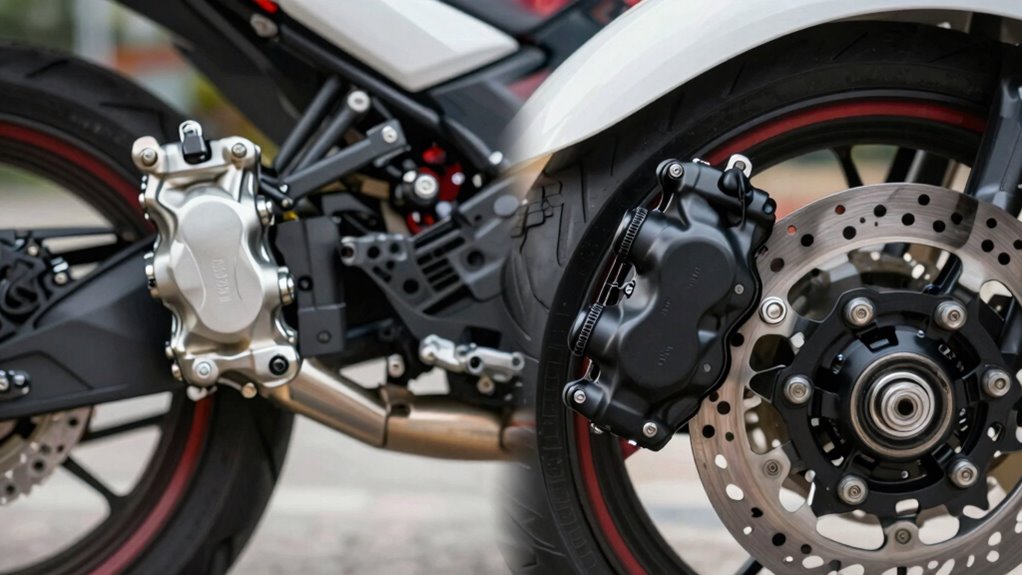

When you first try 2-piston brakes, you’ll notice a softer, more responsive pedal that feels lighter and easier to modulate, ideal for relaxed riding. On the other hand, 4-piston brakes deliver a firmer, more progressive feel, giving you stronger stopping power and better control on long descents. The difference in pedal feel is immediate, but as you ride longer, you’ll also notice how each handles heat and sustained use—there’s more to explore beyond the surface.
Key Takeaways
- 2-piston brakes feel softer and more immediate, offering lighter and more responsive pedal feel.
- 4-piston brakes provide a firmer, more progressive pedal with better initial engagement.
- You’ll notice 2-piston brakes are easier to modulate for precise control.
- 4-piston brakes resist heat build-up, maintaining performance during long descents.
- Expect 4-piston brakes to deliver consistent feel and braking power over extended use.
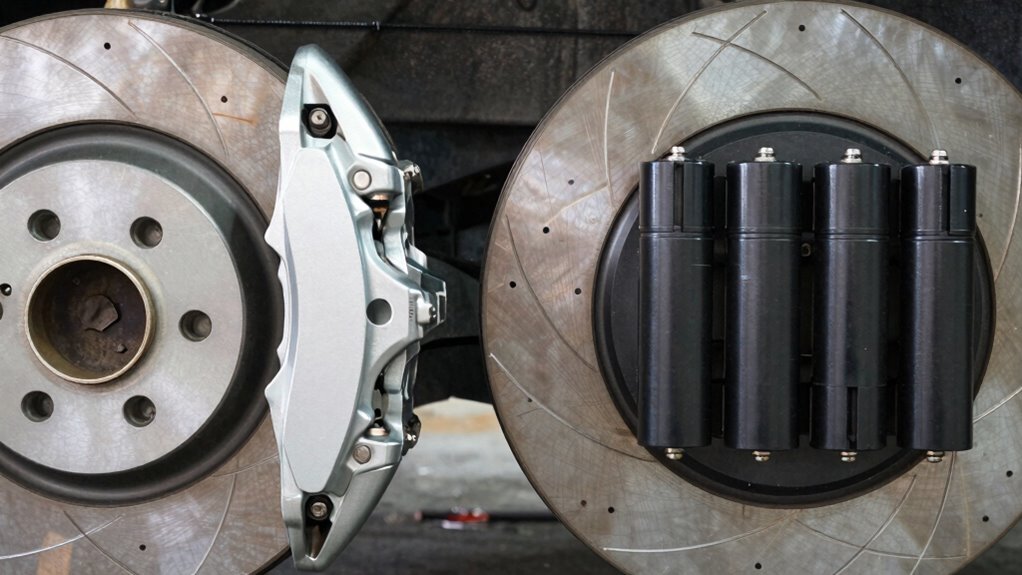
Beyond raw power, pedal feel plays a significant role in your riding experience. You’ll notice that 2-piston brakes often have a softer, more immediate response. The pedal or lever feels lighter and more responsive, making it easier to modulate braking pressure precisely. This can be advantageous for riders who prefer a more intuitive, natural feel or are less focused on aggressive stopping. In contrast, 4-piston brakes tend to have a firmer, more progressive pedal feel. They require a bit more initial force but offer finer control as you apply more pressure. This progressive response helps you gauge your braking intensity better, especially when descending or riding technical terrain. Additionally, brake system design impacts how well each setup handles heat dissipation during extended use, influencing performance under demanding conditions. Another aspect to consider is how each system responds under repeated use. With 4-piston brakes, you’ll often experience more consistent braking performance because the larger calipers better resist heat build-up and fade. This means your pedal feel remains stable even after prolonged downhill sections. Conversely, 2-piston brakes may become softer or less effective when hot, which can impact your confidence on long descents.
Frequently Asked Questions
Do 4-Piston Brakes Always Outperform 2-Piston Brakes?
4-piston brakes generally outperform 2-piston brakes in braking efficiency because their piston design provides more even pressure distribution and better heat dissipation. You’ll notice improved stopping power, especially during aggressive driving or downhill braking. However, this doesn’t mean 2-piston brakes are always inferior; for everyday use, they can be sufficient. Your choice depends on your driving style, vehicle setup, and how much braking performance you need.
Are 4-Piston Brakes More Expensive to Maintain?
You might worry that 4-piston brakes cost more to maintain, and you’re right—initially, they do. Their complex design and higher-performance materials lead to increased maintenance costs compared to 2-piston brakes. But if you’re after superior stopping power, that investment pays off in safety and durability. Keep in mind, the cost comparison varies based on your driving habits and brake quality, so weigh the benefits against the expenses carefully.
Which Brake Type Is Better for Daily Driving?
For daily driving, 2-piston brakes often suit you better because they offer reliable braking efficiency and a softer pedal feel that’s easier to modulate during regular use. They provide sufficient stopping power for everyday needs and are generally more cost-effective and easier to maintain. If you prefer smooth, predictable braking with less aggressive pedal feedback, a 2-piston setup is a practical choice for your routine driving.
How Does Brake Pad Wear Differ Between the Two?
Think of brake pad wear as a dance—graceful yet revealing. With 2-piston brakes, you’ll notice a more uniform wear pattern, leading to longer brake pad longevity. Conversely, 4-piston brakes often experience more concentrated wear, especially on the inner edges, due to their intense clamping force. These wear pattern differences mean maintenance needs may vary, but overall, 2-piston setups tend to preserve brake pad life better over time.
Can 2-Piston Brakes Handle High-Performance Driving?
Yes, 2-piston brakes can handle high-performance driving, but you might notice more brake fade over time. They generally provide decent pedal feel, but under extreme conditions, the reduced braking power can become apparent. While they perform well for spirited driving, for serious high-performance use, 4-piston brakes often offer better heat dissipation and consistent pedal feel, helping you maintain control during intense driving sessions.
Conclusion
Think of your braking system as a team of rowers. With 2 pistons, it’s like a small crew, steady but requiring more effort to stop quickly. A 4-piston setup is a larger, more synchronized team, pulling harder and stopping faster with less strain. Upgrading is like adding rowers to your boat—smoother, more powerful, and ready to handle the race ahead. Choose based on how much you want your ride to stop on a dime.