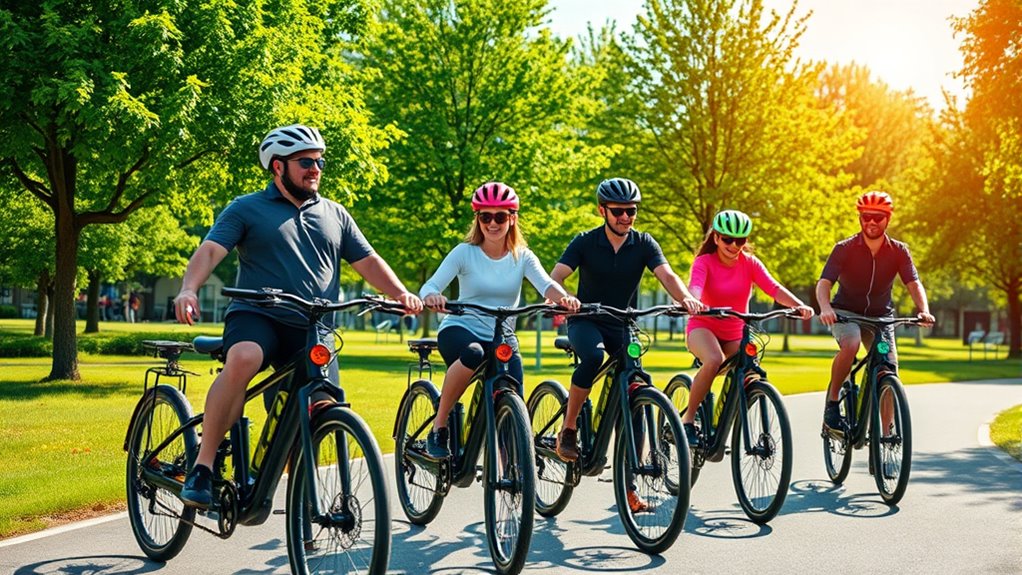
E-bike classes help you understand how your bike’s motor assist works, its top speed, and where you can ride legally. Class 1 bikes provide pedalar-only assist up to 20 mph, while Class 2 bikes include a throttle option also capped at 20 mph. Class 3 bikes boost pedal assist up to 28 mph, often with more advanced sensors. Knowing these differences helps you choose the right bike and ride within regulations—more details ahead.

Get sports gear delivered free — and shop member deals
- Fast, free delivery on millions of items
- Access to Prime Big Deal Days deals on October 6–7
- Prime Video, Amazon Music and more included
Key Takeaways
- E-bike classes categorize bikes based on motor assist type and maximum speed, mainly Class 1, 2, and 3.
- Class 1 bikes offer pedal assist only, stopping at 20 mph, for a natural riding experience.
- Class 2 bikes include a throttle for motor power without pedaling, also limited to 20 mph.
- Class 3 bikes provide pedal assist up to 28 mph, often with more advanced sensors for higher speeds.
- Understanding each class helps riders choose compliant bikes suited to their riding style and local regulations.

Have you ever wondered what the different e-bike classes mean and how they affect your riding experience? Understanding these classifications can make a big difference in how you ride, where you ride, and what rules you need to follow. E-bike classes are primarily based on the level of motor assist they provide and how that assist is activated.
Most e-bikes are equipped with a motor assist system that kicks in when you start pedaling. This system works in tandem with a pedal sensor, which detects when you’re pedaling and how much effort you’re putting in. The pedal sensor is a vital component because it determines when the motor should engage and to what extent. For example, some bikes use cadence sensors, which activate the motor based on whether you’re pedaling at a certain rate, regardless of how hard you’re pedaling. Others use torque sensors, which measure the force you’re applying to the pedals and adjust motor output accordingly. This means your riding experience can vary depending on the type of sensor and assist level.
Most e-bikes use pedal sensors—cadence or torque—to control motor assistance based on pedaling effort.
In general, e-bike classes are categorized to help riders understand how much assistance they can expect and where they’re legally permitted to ride. Class 1 e-bikes provide pedal-assist only, activating the motor when you pedal and stopping at 20 mph. These bikes often feature a pedal sensor that guarantees the motor only assists when you’re actively pedaling, giving a more natural riding feel. Class 2 bikes also have a throttle, allowing you to engage the motor without pedaling, but they still typically cut off at 20 mph. Class 3 bikes, sometimes called speed pedelecs, offer pedal assist up to 28 mph and often include more advanced sensors and motor controls to handle higher speeds safely. Additionally, the use of pedal sensors can significantly influence how natural and responsive the ride feels, especially at higher assist levels.
Your choice among these classes depends on your riding style and local laws. If you prefer a more traditional cycling experience with assistance only when you’re pedaling, Class 1 bikes with pedal sensors are usually ideal. They provide a smooth, intuitive ride, mimicking the feel of a regular bike but with an extra boost. Conversely, if you want the convenience of a throttle and more speed, Class 2 or Class 3 options might suit you better, but you’ll need to be aware of varying regulations depending on where you ride.
Ultimately, understanding how the motor assist works, especially with the aid of pedal sensors, can help you select the right e-bike for your needs. It influences how natural your ride feels, how much effort you need to put in, and where you’re legally allowed to enjoy your e-bike. So, next time you’re shopping or riding, pay attention to how the assist kicks in—it’s a key part of the experience.
As an affiliate, we earn on qualifying purchases.
Frequently Asked Questions
Are E-Bike Classes Recognized Worldwide?
E-bike classes aren’t recognized worldwide, as different countries set their own rules for e-bike use, affecting e bike maintenance and riding safety. You should always check local regulations before riding, ensuring you’re compliant and safe. Proper e bike maintenance is key to safe riding, no matter where you are. By understanding local laws, you can enjoy your ride while prioritizing safety and staying within legal boundaries.
Can I Switch Between E-Bike Classes?
Yes, you can switch between e-bike classes, but it depends on your bike’s motor assist settings and battery capacity. Some e-bikes allow you to change the level of motor assist, effectively shifting your ride between classes. Keep in mind, switching classes may be limited by local regulations, and higher assist levels drain your battery faster. Always check your bike’s capabilities and local laws before making adjustments.
Do E-Bike Class Rules Vary by State or Country?
Yes, e-bike class rules vary by state or country due to regulatory differences and classification standards. You need to check local laws because what applies in one area might not in another, especially regarding speed limits, helmet requirements, or where you can ride. Staying informed about these variations helps you ride legally and safely, ensuring you comply with all regulations specific to your location.
Are There Age Restrictions for Different E-Bike Classes?
Yes, age restrictions vary by e-bike class and location. Typically, you must be at least 14 or 16 years old to ride certain e-bike classes, especially those with higher speeds or power. Some areas require rider certifications or safety training for younger riders. Always check local regulations to make certain you meet age restrictions and understand any certification requirements, so you ride legally and safely.
How Do E-Bike Classes Affect Insurance Policies?
Think of e-bike classes as different lanes on a busy road—you need the right coverage to stay safe. Your e-bike class affects your insurance premiums and liability coverage because higher classes often mean higher risks. Insurers may charge more or require additional coverage for certain classes. Knowing your e-bike class helps you choose the right policy, ensuring you’re protected and avoiding surprises if an accident occurs.
Conclusion
Now that you know the ins and outs of e-bike classes, you’re practically a superhero on wheels! Imagine zooming through streets with the speed of a rocket and the agility of a mountain goat—all while feeling like you’re riding a bike, not a spaceship. With this knowledge, you’re ready to conquer any trail or city block. Get out there, embrace your newfound e-bike power, and turn every ride into an epic adventure you’ll never forget!
NFL season / tailgating Picks
team gear
As an affiliate, we earn on qualifying purchases.