Choosing the right recovery tool can make the difference between consistent training and burnout. After analyzing the market, the Hyperice Normatec 3 Full-Leg Compression Boots stand out as the best overall choice for serious cyclists due to their superior wave-action technology and precise fit. For those prioritizing portability without sacrificing power, the Anaconda Wireless Leg Compression Boots offer a strong alternative with a cordless design that fits easily into a gym bag. However, the main tradeoff in this category is often between pressure intensity and comfort; higher-end units provide deeper, more effective massage but require careful sizing, while budget options may lack the dynamic sequencing needed for deep tissue relief. Continue reading to see how these and other models stack up against each other in terms of build quality, usability, and value.

Get sports gear delivered free with Prime
- Fast, free delivery on millions of items
- Prime Video, Amazon Music and more included
- Member-only deals all year
Complete the kit


Key Takeaways
- The Hyperice Normatec 3 remains the benchmark for dynamic sequencing, offering a distinct advantage over static airbags found in budget models.
- Cordless designs like the Anaconda Wireless and QUINEAR Cordless are emerging as critical for cyclists who travel or lack outlet access post-ride.
- Heat integration is a polarizing feature; while models with heated knees or calves offer added comfort, they often increase battery drain or require bulky cords.
- Fit precision is the most common failure point in mid-range boots, with many ‘one-size-fits-most’ options failing to secure around the calf or thigh correctly.
- Budget options under $100 often lack sequential compression, offering only static squeeze that is less effective for flushing metabolic waste than wave-like patterns.
| Leg Compression Massager with Heat for Calves and Feet |  | Best for Heated Foot-and-Calf Recovery | Air chambers: 3 per leg | Massage modes: 6 | Intensity levels: 12 | VIEW LATEST PRICE | See Our Full Breakdown |
| FIT KING Cordless Air Compression Recovery Boots, Medium |  | Best for Cordless, Adjustable Full-Leg Sessions | Size: Medium | Chambers: 5 per leg sleeve | Pressure range: 50–150 mmHg | VIEW LATEST PRICE | See Our Full Breakdown |
| Anaconda Wireless Leg Compression Boots, Medium |  | Best for High-Pressure Cordless Recovery | Size: Medium | Maximum compression: Up to 200 mmHg | Compression zones: 4: foot, calf, knee, and thigh | VIEW LATEST PRICE | See Our Full Breakdown |
| Hyperice Normatec 3 Full-Leg Compression Boots, Standard Size |  | Best Premium App-Connected Pick | Product type: Full-leg compression boots | Compression levels: 7 | Treatment zones: 5 overlapping zones | VIEW LATEST PRICE | See Our Full Breakdown |
| Full-Leg Compression Massager with 5 Zones, 10 Air Chambers, and 12 Pressure Levels |  | Best for Detailed Zone and Pressure Control | Massage zones: 5: foot, lower calf, upper calf, knee, and thigh | Air chambers: 10 | Massage modes: 6 | VIEW LATEST PRICE | See Our Full Breakdown |
| Leg Compression Massager with Heated Knee, 6 Modes and 12 Intensity Levels |  | Best for Adjustable Heat | Air chambers: 4 independent chambers | Modes: 6 | Intensity levels: 12 | VIEW LATEST PRICE | See Our Full Breakdown |
| FIT KING Leg and Foot Compression Massager for Feet and Calves |  | Best for Foot-and-Calf Focus | Massage areas: Feet and calves | Massage modes: 2 | Intensity levels: 3 | VIEW LATEST PRICE | See Our Full Breakdown |
| MUSUGY Full-Leg Sequential Compression Massager, Medium |  | Best for Pressure Adaptation | Size: Medium | Air chambers: 5: foot, lower calf, upper calf, knees, and thighs | Pressure levels: 9 | VIEW LATEST PRICE | See Our Full Breakdown |
| Air Compression Leg Massager Boots with Heat, 6 Modes and 9 Intensity Levels, Medium |  | Best for Stronger Adjustable Pressure | Air chambers: 5 | Coverage: Feet through thighs | Massage modes: 6: 3 full-length and 3 targeted | VIEW LATEST PRICE | See Our Full Breakdown |
| QUINEAR Air Compression Recovery Boots for Athletes |  | Best Value Full-Leg Pick | Air chambers: 4 | Coverage: Foot, calf, and thigh | Pressure intensities: 8 | VIEW LATEST PRICE | See Our Full Breakdown |
| MUSUGY Leg Compression Massager with Heat |  | Best for Heat Therapy Integration | Massage Modes: 6 | Compression Levels: 9 | Pressure Range: 60–140 mmHg | VIEW LATEST PRICE | See Our Full Breakdown |
| JZBRAIN Full-Leg Compression Massager Boots, Small |  | Best for Petite Cyclists | Fit Height: 5’1″ – 5’6″ | Inseam Range: 26″ – 30.5″ | Max Thigh Circumference: 26 inches | VIEW LATEST PRICE | See Our Full Breakdown |
| QUINEAR Cordless Compression Boots for Leg Recovery |  | Best for Travel and Mobility | Power Source: Rechargeable Battery (Cordless) | Battery Life: 2–4 hours per charge | Charging Time: 120 minutes | VIEW LATEST PRICE | See Our Full Breakdown |
| CINCOM Air Compression Boots for Leg and Foot Massage |  | Best Budget Entry Point | Coverage Area: Feet and Lower Legs | Technology: 360° air pressure and sequential compression | Modes: 3 | VIEW LATEST PRICE | See Our Full Breakdown |
| compression boots for cyclist | Pressure range | Air chambers | Massage modes | Warranty |
|---|---|---|---|---|
| Leg Compression Massager with | — | 3 per leg | 6 | — |
| FIT KING Cordless Air Compress | 50–150 mmHg | — | — | 24 months |
| Anaconda Wireless Leg Compress | — | — | 3 | — |
| Hyperice Normatec 3 Full-Leg C | — | — | — | — |
| Full-Leg Compression Massager | 60–240 mmHg | 10 | 6 | — |
| Leg Compression Massager with | — | 4 independent chambers | — | — |
| FIT KING Leg and Foot Compress | — | — | 2 | 24 months |
| MUSUGY Full-Leg Sequential Com | 40–120 mmHg | 5: foot, lower calf, upper calf, knees, and thighs | — | 12 months |
| Air Compression Leg Massager B | 60–200 mmHg | 5 | 6: 3 full-length and 3 targeted | 1 year |
| QUINEAR Air Compression Recove | 50–120 mmHg | 4 | 3: sequence, circulation, and combination | 24 months |
| MUSUGY Leg Compression Massage | 60–140 mmHg | — | 6 | — |
| JZBRAIN Full-Leg Compression M | 80–130 mmHg | 5 independently controlled | — | 12 months |
| QUINEAR Cordless Compression B | 50–150 mmHg | — | — | 2 years |
| CINCOM Air Compression Boots f | — | — | — | — |
More Details on Our Top Picks
Leg Compression Massager with Heat for Calves and Feet
For cyclists whose post-ride routine centers on tired feet and calves, this model pairs air compression with adjustable heat rather than covering the full leg. Its three chambers per leg, six modes, and 12 intensity levels give riders room to tailor a shorter, gentler session or a firmer one. The 10-, 20-, and 30-minute timers also make sessions easy to fit around recovery time, while pressure sensors and memory help retain preferred settings. Compared with the FIT KING Cordless Air Compression Recovery Boots, it gives up thigh coverage and cordless use but adds heat and a simpler lower-leg focus. The tradeoff is meaningful: cyclists seeking whole-leg compression should choose a full-leg option, and fit may vary, so check the size guide before buying.
Pros:- Combines adjustable heat with air compression for feet and lower legs.
- Six modes and 12 intensity levels allow a broad range of session settings.
- Pressure sensors, memory, and pause function support adjustable, repeatable use.
- Three timer choices and a backlit handheld controller simplify session setup.
Cons:- Coverage stops at the lower legs, unlike full-leg options such as FIT KING’s cordless boots.
- Fit varies, so buyers should consult the size guide before ordering.
- The description does not specify cordless operation or battery life.
Best for: Cyclists who mainly want heat and compression for tired feet and calves after rides, and who have checked the sizing guide.
Not ideal for: Riders seeking thigh or knee coverage, cordless use, or a fit that does not depend on checking a size guide.
- Air chambers:3 per leg
- Massage modes:6
- Intensity levels:12
- Heat settings:Off, 113°F, 122°F, 131°F
- Timer settings:10, 20, or 30 minutes
- Material and design:Waterproof nylon; zippered boots
- Controller:Backlit LCD handheld controller
- Additional features:Pressure sensors, pause function, memory function
Our verdict“Choose this if heat and foot-to-calf coverage matter more than thigh compression or cordless portability.”
FIT KING Cordless Air Compression Recovery Boots, Medium
The FIT KING is the strongest fit here for cyclists who want full-leg compression without an external hose setup. Five chambers per sleeve cover foot to thigh, while built-in controls keep operation on the boots themselves. Riders can choose among 11 pressure levels, three modes, and sessions from 15 to 60 minutes; synchronized or independent operation also lets each leg run together or separately. Compared with the Anaconda Wireless Leg Compression Boots, FIT KING offers more pressure settings and a longer maximum session duration, though Anaconda lists a higher maximum pressure. The main compromise is battery runtime: both boots are rated for up to three hours, versus up to six hours when using one. Medium sizing also narrows the audience, so this is less suitable for riders whose measurements fall outside that fit.
Pros:- Cordless design and built-in controls avoid external hoses and separate control placement.
- Five chambers cover the leg from foot to thigh.
- Eleven pressure levels, three modes, and 15–60-minute sessions allow flexible setup.
- Independent or synchronized operation and an included travel bag support different use routines.
Cons:- Battery life is listed as up to three hours for both boots, shorter than when operating one boot.
- Medium sizing may not fit every cyclist.
- The maximum pressure listed is lower than Anaconda’s stated maximum of 200 mmHg.
Best for: Cyclists who want portable, full-leg compression with on-boot controls and enough adjustment for varied recovery sessions.
Not ideal for: Riders who need a non-medium fit, expect extended cordless use of both boots, or prefer a simpler lower-leg-only setup.
- Size:Medium
- Chambers:5 per leg sleeve
- Pressure range:50–150 mmHg
- Pressure levels:11
- Modes:Sequence, Circulation, Combination
- Session duration:15–60 minutes
- Battery:2,600 mAh per boot; up to 3 hours for both legs or 6 hours for one leg
- Design and extras:Cordless with built-in controls, smart sync, pressure sensors, and travel bag
- Warranty:24 months
Our verdict“Pick FIT KING for adjustable, cordless full-leg sessions, provided the medium fit and shared-boot battery runtime work for you.”
Anaconda Wireless Leg Compression Boots, Medium
Anaconda stands out for cyclists who want wireless, full-leg compression with a high stated pressure ceiling. Its four zones cover the foot, calf, knee, and thigh, and the simple controller avoids requiring an app. That makes it a more direct choice than the app-connected Hyperice Normatec 3 for riders who would rather keep setup straightforward and use the boots away from an outlet. Anaconda lists up to 200 mmHg, above the FIT KING’s stated 50–150 mmHg range, but offers only three modes and up to four hours of battery life. The pressure figure alone does not tell every cyclist which setting will suit them, and the Medium size limits fit. Choose it for portable, zone-spanning sessions; skip it if you need a broader size choice or app-based customization.
Pros:- Wireless design supports sessions away from an outlet.
- Four zones cover the foot, calf, knee, and thigh.
- Up to 200 mmHg offers a higher stated pressure ceiling than the FIT KING boots.
- Simple controller requires no app, and a travel bag is included.
Cons:- Battery life is listed as up to four hours per charge.
- Only three massage modes are specified.
- The listed size is Medium, which may not suit every rider.
Best for: Cyclists seeking cordless compression from foot to thigh, a high listed pressure ceiling, and simple controls without app setup.
Not ideal for: Riders who need sizing beyond Medium, want extensive mode choices, or prefer app-based customization and a connected system.
- Size:Medium
- Maximum compression:Up to 200 mmHg
- Compression zones:4: foot, calf, knee, and thigh
- Massage modes:3
- Battery life:Up to 4 hours
- Controls:Simple controller; no app required
- Included accessory:Portable travel bag
Our verdict“Choose Anaconda if you want wireless full-leg coverage and simple controls, and its Medium fit suits you.”
Hyperice Normatec 3 Full-Leg Compression Boots, Standard Size
The Normatec 3 is the premium-minded choice for cyclists who value app-connected customization and overlapping compression zones over cordless convenience. It has five treatment zones, seven intensity levels, and ZoneBoost for extra attention to selected areas; Bluetooth adds access to Hyperice app features. Compared with the simpler, app-free Anaconda Wireless Leg Compression Boots, this system puts more emphasis on connected customization, while Anaconda is explicitly wireless and lists a maximum pressure figure. The Normatec 3’s described lighter system and intuitive interface may appeal to riders who want a more guided setup, but the provided details do not list battery operation or a pressure range. Fit is a firm constraint: Standard is specified for a 31–35-inch inseam and thigh circumference up to 30 inches. Check those measurements before choosing it.
Pros:- Five overlapping treatment zones include ZoneBoost for focused attention.
- Seven intensity levels provide adjustable sessions.
- Bluetooth connects the boots to additional Hyperice app features and customization.
- The system is described as lighter with an intuitive interface.
Cons:- Standard sizing is limited to a 31–35-inch inseam and thigh circumference up to 30 inches.
- The supplied specifications do not state a pressure range or battery life.
- Compared with Anaconda, cordless use is not specified.
Best for: Cyclists who want app-connected customization, overlapping full-leg zones, and whose inseam and thigh measurements fit the Standard size.
Not ideal for: Riders who need cordless portability, fall outside the listed Standard measurements, or want a clearly specified pressure range before buying.
- Product type:Full-leg compression boots
- Compression levels:7
- Treatment zones:5 overlapping zones
- Zone feature:ZoneBoost
- App connectivity:Bluetooth
- Inseam fit:31–35 inches
- Maximum thigh circumference:30 inches
- Size:Standard
Our verdict“Choose the Normatec 3 for app-connected zone customization if its Standard fit works and cordless use is not a requirement.”
Full-Leg Compression Massager with 5 Zones, 10 Air Chambers, and 12 Pressure Levels
This full-leg system suits cyclists who want fine-grained adjustments across the whole leg without needing heat. Ten air chambers serve five zones from foot to thigh, while six modes, 12 pressure levels, and three timers give riders several ways to shape a session. Pressure sensors, memory, and pause functions add useful control when a preferred setup needs to be retained or temporarily held. Compared with the Hyperice Normatec 3, this model specifies more pressure levels and a 60–240 mmHg range, while the Normatec adds Bluetooth app connectivity and overlapping zones. The tradeoff is that this unit has no heating control, and the zip-up boot design is less convenient for anyone who dislikes changing into recovery gear. It is a strong match for riders prioritizing adjustable compression over heat or wireless use.
Pros:- Five zones and 10 chambers cover the leg from foot through thigh.
- Six modes and 12 pressure levels offer extensive session adjustment.
- Pressure sensors, memory, and pause functions support fit adjustment and repeatable use.
- Three timers and an included storage bag help with session planning and storage.
Cons:- There is no heating control, unlike the heated foot-and-calf massager in this lineup.
- The zip-up boots require wearing a dedicated compression system.
- Cordless operation is not specified.
Best for: Cyclists who want adjustable foot-to-thigh compression, multiple pressure settings, and repeatable sessions without needing heat.
Not ideal for: Riders who want heated recovery, cordless operation, or do not want to wear zip-up compression boots.
- Massage zones:5: foot, lower calf, upper calf, knee, and thigh
- Air chambers:10
- Massage modes:6
- Pressure levels:12
- Pressure range:60–240 mmHg
- Timers:3
- Materials:Nylon body with polyester edging
- Controller:Backlit LED handheld controller
- Heating and storage:No heating control; portable nylon storage bag included
Our verdict“Pick this model if zone coverage and pressure control matter more than heat or cordless convenience.”
Leg Compression Massager with Heated Knee, 6 Modes and 12 Intensity Levels
For cyclists who want compression plus warmth after a cold ride, this model pairs four-chamber sequential pressure for the feet, calves, and thighs with heat across six zones. Its 12 intensity levels and four temperature settings offer more adjustment than the FIT KING Leg and Foot Compression Massager, which focuses on feet and calves and has no heat. The handheld backlit controller, memory function, and three timer choices make it easier to set a repeatable recovery session.
The key limitation is the knee: it receives heat only, not compression, so riders seeking pressure across the whole leg should look at the MUSUGY Full-Leg Sequential Compression Massager instead. This unit is also corded, and the fit depends on checking cuff and circumference measurements before buying. I’d choose it for flexible settings and warmth, not for cordless use or knee compression.
Pros:- Sequential compression covers the feet, calves, and thighs.
- Twelve intensity levels and four heat settings provide a broad range of adjustments.
- Handheld backlit LCD controller includes a memory function.
- Adjustable cuffs and straps plus a storage bag support setup and storage.
Cons:- The knee area provides heat only, with no compression.
- Corded operation requires a nearby power outlet.
- Sizing and leg circumference limits need checking before purchase.
Best for: Cyclists who want adjustable compression for feet through thighs and separate heat for post-ride comfort, with access to a power outlet.
Not ideal for: Riders who want compression at the knee, a cordless setup, or a boot that fits without checking circumference limits.
- Air chambers:4 independent chambers
- Modes:6
- Intensity levels:12
- Heating zones:6
- Temperature settings:Off, 113°F, 122°F, 131°F
- Timer settings:10, 20, or 30 minutes
- Knee function:Heat only; no compression
- Power and controls:Corded power adapter; handheld backlit LCD controller with memory function
Our verdict“Choose this model if adjustable heat and compression matter more than cordless operation or knee pressure.”
FIT KING Leg and Foot Compression Massager for Feet and Calves
This FIT KING is the most focused option here for cyclists who mainly want attention on tired feet and calves. Its kneading and stroking motions cover those two areas, while adjustable wraps and included extensions accommodate calf circumferences up to 28.5 inches. Compared with the QUINEAR Air Compression Recovery Boots, it gives up thigh coverage and a wider pressure-selection range, but its simpler two-mode, three-intensity setup may suit riders who do not need full-leg sessions.
That narrower coverage is also the tradeoff: there is no thigh massage or heat, so it is less suited to riders seeking a full-leg recovery routine or warmth after cold-weather training. Buyers should measure both feet and calves against the stated fit range before ordering. I’d pick it over the full-leg options only when lower-leg coverage and adjustable sizing are the priorities.
Pros:- Treats both feet and calves with kneading and stroking motions.
- Two modes and three intensity levels offer straightforward adjustments.
- Included extensions accommodate calf circumferences up to 28.5 inches.
- Portable storage bag and 24-month warranty are included.
Cons:- Does not massage the thighs.
- Has no heat function.
- Fit requires checking foot size and calf circumference.
Best for: Road cyclists who want a portable foot-and-calf massager and whose measurements fit the listed ranges.
Not ideal for: Riders seeking thigh coverage, heat, or a full-leg sequential compression session.
- Massage areas:Feet and calves
- Massage modes:2
- Intensity levels:3
- Massage techniques:10
- Maximum calf circumference:28.5 inches with extensions
- Foot size range:8–12 inches
- Power:DC 12 V / 1 A adapter
- Warranty:24 months
Our verdict“Pick this FIT KING when your recovery needs center on feet and calves rather than whole-leg coverage.”
MUSUGY Full-Leg Sequential Compression Massager, Medium
The MUSUGY stands out for its five-chamber, foot-to-thigh sequence and a pressure sensor that adjusts air output across the chambers. For cyclists who want the pressure to adapt through a full-leg session, that feature sets it apart from the QUINEAR Air Compression Recovery Boots, which also cover the foot, calf, and thigh but use four chambers. MUSUGY adds nine pressure levels, six modes, and three session lengths, including zone-specific programs for targeting selected areas.
Fit is the main hurdle. This medium version calls for an inseam of at least 36 inches, a thigh circumference up to 31 inches, and a calf circumference up to 22 inches. Those limits make it a less flexible choice than the FIT KING Leg and Foot Compression Massager with extensions, though FIT KING lacks thigh coverage. I’d shortlist MUSUGY when its measurements match and full-leg adjustment matters more than a broad fit range.
Pros:- Five chambers sequence compression from the foot through the thigh.
- Pressure sensor adjusts air output across chambers.
- Six modes include full-leg sequences and zone-specific programs.
- Reinforced nylon sleeves have double-stitched seams.
Cons:- The medium fit requires an inseam of at least 36 inches.
- Thigh and calf circumference limits may exclude some riders.
- The 12-month warranty is shorter than the 24-month coverage listed for FIT KING and QUINEAR.
Best for: Cyclists with a 36-inch-or-longer inseam who want sensor-adjusted, full-leg sequential compression and targeted modes.
Not ideal for: Riders with shorter inseams, thighs over 31 inches, or calves over 22 inches.
- Size:Medium
- Air chambers:5: foot, lower calf, upper calf, knees, and thighs
- Pressure levels:9
- Pressure range:40–120 mmHg
- Modes:6: 3 full-leg sequential and 3 zone-specific
- Timers:15, 20, or 25 minutes
- Fit range:Inseam 36 inches or longer; thigh up to 31 inches; calf up to 22 inches
- Warranty:12 months
Our verdict“Choose MUSUGY if its specific fit range suits you and sensor-adjusted pressure across the full leg is a priority.”
Air Compression Leg Massager Boots with Heat, 6 Modes and 9 Intensity Levels, Medium
These medium boots suit cyclists who want full-leg compression with a higher stated pressure ceiling than the MUSUGY and QUINEAR options in this group. Five chambers cycle from the feet to the thighs, and the listed range runs from 60 to 200 mmHg across nine levels. Sensors adapt pressure to leg size, while three heat settings can be switched off independently, so riders can use compression without warmth or combine both.
Compared with the Leg Compression Massager with Heated Knee, this model offers compression through the full-leg boot rather than heat-only treatment at the knee, but it lists fewer pressure levels and provides less detail about timer options. Its medium sizing may also rule out riders outside that fit. The higher maximum pressure will not be a benefit for everyone; I’d choose it when a broader pressure range is the draw, not simply because the maximum is larger.
Pros:- Five chambers cover the feet through the thighs.
- Sensors adapt pressure to leg size.
- Nine levels span a stated 60–200 mmHg range.
- Heat has three settings and can be turned off independently.
Cons:- Medium sizing may not fit every rider.
- Powered operation is required.
- The supplied specifications do not list timer settings.
Best for: Cyclists who fit the medium size and want full-leg compression, independently controlled heat, and a pressure range up to 200 mmHg.
Not ideal for: Riders who need a non-medium fit, cordless operation, or detailed session-timer options.
- Air chambers:5
- Coverage:Feet through thighs
- Massage modes:6: 3 full-length and 3 targeted
- Pressure intensity levels:9
- Pressure range:60–200 mmHg
- Heat settings:3 (H1/H2/H3); heat can be turned off
- Fit:Medium
- Warranty:1 year
Our verdict“Choose these boots if you fit the medium size and want a full-leg system with independently controlled heat and a higher pressure ceiling.”
QUINEAR Air Compression Recovery Boots for Athletes
QUINEAR offers the core setup many cyclists need for post-ride leg sessions: four sequential air chambers covering the foot, calf, and thigh, with eight pressure intensities and three massage modes. Its 50–120 mmHg range is more restrained than the Air Compression Leg Massager Boots with Heat, which lists a ceiling of 200 mmHg, but it gives buyers clear control over session length with 20-, 25-, or 30-minute timers. A pressure sensor and carry bag add practical touches without making the feature set complicated.
Compared with the FIT KING Leg and Foot Compression Massager, QUINEAR reaches the thigh and offers more pressure settings, though it requires zipping into full boots rather than wrapping only the lower legs. It also lacks heat, and its pressure range may feel limited to riders specifically seeking higher settings. I’d choose it as a straightforward full-leg option when mode and timer choice matter more than warmth or a higher pressure ceiling.
Pros:- Four chambers cover the foot, calf, and thigh.
- Three modes and eight pressure intensities provide useful session adjustments.
- Three timer settings range from 20 to 30 minutes.
- Includes a pressure sensor, carry bag, and 24-month warranty.
Cons:- No heat function is listed.
- The pressure range tops out at 120 mmHg, below the Air Compression Leg Massager Boots with Heat.
- The boots need to be zipped on for use.
Best for: Cyclists who want straightforward, full-leg compression with multiple modes and session lengths, without paying for heat features they may not use.
Not ideal for: Riders who want heat, pressure settings above 120 mmHg, or a quick lower-leg wrap instead of full boots.
- Air chambers:4
- Coverage:Foot, calf, and thigh
- Pressure intensities:8
- Pressure range:50–120 mmHg
- Massage modes:3: sequence, circulation, and combination
- Timer settings:20, 25, or 30 minutes
- Controls:Digital controller with pressure sensor
- Warranty:24 months
Our verdict“Choose QUINEAR for clear, adjustable full-leg sessions if heat and a higher pressure ceiling are not priorities.”
MUSUGY Leg Compression Massager with Heat
This unit distinguishes itself by integrating heat therapy directly into the compression zones, a feature often missing in budget-friendly options. While the QUINEAR Cordless Boots excel in mobility and smart sensors, the MUSUGY focuses on thermal relaxation, offering three specific temperature settings for the soles, calves, and thighs. For cyclists who value the soothing effect of warmth on tight muscles post-ride, this dual-action approach provides a more holistic recovery than pure air compression alone. The sensor-guided air compression adapts to leg shape, though users with significantly muscular calves may find the tapered fit restrictive compared to the more generous circumference allowances of the QUINEAR. It is a solid choice for stationary recovery at home, but lacks the portability of cordless competitors.
Pros:- Integrated heat zones in soles, calves, and thighs aid muscle relaxation.
- Sensor-guided air compression adjusts air volume to individual leg shape.
- Nine compression levels and six modes offer varied treatment intensity.
- Adjustable wraps allow for customization across different leg sizes.
Cons:- Tapered calf design may not accommodate wide or highly muscular legs.
- Corded design limits mobility compared to battery-powered alternatives.
- Heat function increases power consumption and setup complexity.
Best for: Cyclists who prioritize muscle warmth and relaxation alongside compression, typically using the device at home or in a gym locker.
Not ideal for: Travelers or those with very wide or muscular calves who need a flexible fit and cordless freedom.
- Massage Modes:6
- Compression Levels:9
- Pressure Range:60–140 mmHg
- Heat Settings:Off, 113°F, 122°F, 131°F
- Heat Zones:Soles, Calves, Thighs
- Design:Two-part wrap with zip-up foot/calf and adjustable thigh straps
- Technology:Sensor-guided air volume adjustment
Our verdict“Choose this if you want the therapeutic benefits of heat combined with compression, and you primarily use the device in a fixed location.”
JZBRAIN Full-Leg Compression Massager Boots, Small
Most compression boots suffer from a ‘one-size-fits-most’ design that often leaves smaller riders feeling loose and ineffective. The JZBRAIN Small addresses this gap by engineering a specific fit for inseams between 26 and 30.5 inches and thighs up to 26 inches. This targeted sizing ensures that the five independently controlled air chambers make proper contact, delivering consistent pressure rather than just inflating around empty space. Compared to the MUSUGY Leg Compression Massager with Heat, which uses adjustable straps to accommodate various sizes, the JZBRAIN’s tailored construction offers superior compression efficiency for petite frames. However, this specificity means it is unusable for taller riders, and the lack of heat features puts it behind thermal-equipped models for those seeking extra muscle warmth.
Pros:- Specifically designed for petite frames, ensuring accurate compression contact.
- Fast 30-second inflation time reduces wait time before sessions.
- Water-resistant materials and reinforced stitching enhance durability.
- Low noise operation (50–55 dB) allows for quiet recovery sessions.
Cons:- Strict size limitations exclude taller or larger-framed cyclists.
- No heat therapy options compared to models like the MUSUGY.
- High minimum pressure (80 mmHg) may be uncomfortable for beginners.
Best for: Cyclists with smaller frames (5’1″–5’6″) who struggle with loose fits in standard-sized compression boots.
Not ideal for: Riders taller than 5’6″ or those with thigh circumferences exceeding 26 inches, as the fit will be inadequate.
- Fit Height:5’1″ – 5’6″
- Inseam Range:26″ – 30.5″
- Max Thigh Circumference:26 inches
- Air Chambers:5 independently controlled
- Pressure Range:80–130 mmHg
- Noise Level:50–55 dB
- Inflation Time:Approx. 30 seconds
- Warranty:12 months
Our verdict“This is the definitive choice for petite cyclists who need a snug, effective fit that standard ‘universal’ boots cannot provide.”
QUINEAR Cordless Compression Boots for Leg Recovery
For cyclists who train in multiple locations or travel frequently, the QUINEAR Cordless Boots offer unmatched freedom. Unlike the CINCOM Air Compression Boots or the MUSUGY, which require a constant power outlet, this unit runs on a battery for 2–4 hours, allowing use on a plane, in a hotel, or away from an outlet. The 3.5-inch touchscreen and smart pressure sensors provide a modern interface that automatically adjusts to leg shape, ensuring consistent compression without manual tweaking. While the JZBRAIN offers a tighter fit for specific sizes, the QUINEAR accommodates legs up to 28 inches, making it more versatile for a broader range of users. The trade-off is the need to monitor battery levels and the higher complexity of charging compared to plug-and-play corded models.
Pros:- Cordless design enables use anywhere, including while traveling.
- Smart pressure sensors automatically adjust compression to leg shape.
- Touchscreen interface provides real-time pressure data and easy control.
- Includes a travel bag for convenient transport and storage.
Cons:- Battery life limits continuous use to 2–4 hours per charge.
- Maximum leg circumference of 28 inches may exclude larger athletes.
- Cordless mechanism adds weight and complexity compared to basic units.
Best for: Traveling cyclists and commuters who need cordless freedom and advanced smart-sensor technology.
Not ideal for: Users who prefer simple, plug-in devices and do not want to manage battery charging cycles.
- Power Source:Rechargeable Battery (Cordless)
- Battery Life:2–4 hours per charge
- Charging Time:120 minutes
- Max Leg Circumference:28 inches
- Display:3.5-inch touchscreen
- Pressure Range:50–150 mmHg
- Warranty:2 years
- Included Accessories:Travel bag, quick-start guide
Our verdict“Select this model if you value the ability to recover on the go and appreciate smart, automated compression adjustments.”
CINCOM Air Compression Boots for Leg and Foot Massage
The CINCOM Air Compression Boots serve as a practical entry point for cyclists who need basic calf and foot recovery without the complexity of full-leg systems. Unlike the MUSUGY or JZBRAIN, which treat the entire leg including thighs, the CINCOM focuses exclusively on the lower leg, reducing setup time and bulk. This targeted approach is ideal for riders whose primary issue is calf tightness rather than systemic leg fatigue. The intelligent sensor adjusts pressure to leg size, offering a decent level of customization for the price. However, the limited coverage means it cannot replace full-leg boots for heavy training blocks. If you require thigh compression or heat therapy, you will need to look at more comprehensive models like the QUINEAR or MUSUGY.
Pros:- Targeted lower-leg design is simpler and faster to put on.
- Intelligent sensor adjusts inflation volume to fit leg size automatically.
- Smooth material is easy to clean and maintain after rides.
- One-piece zipper design enhances ease of use.
Cons:- No thigh coverage limits recovery for full-leg fatigue.
- Lacks heat therapy options available in competitors like the MUSUGY.
- Requires manual controller interaction for all adjustments.
Best for: Beginner cyclists or those with budget constraints who only need recovery for calves and feet.
Not ideal for: Athletes requiring full-leg recovery including thighs, or those who want heat therapy features.
- Coverage Area:Feet and Lower Legs
- Technology:360° air pressure and sequential compression
- Modes:3
- Intensity Levels:3
- Controller:HD LCD with timing operation
- Fit Adjustment:Intelligent sensor for pressure/volume
- Material:Smooth, easy-to-clean fabric
Our verdict“A straightforward, no-frills option for cyclists who only need to address calf and foot tension.”
How We Picked
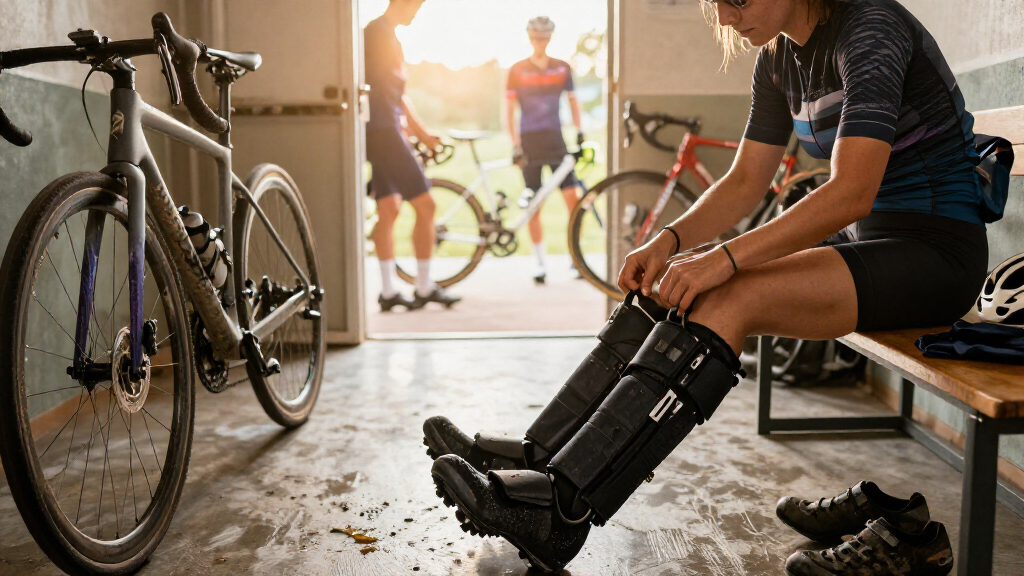
To rank these compression boots, I evaluated each unit based on four core criteria relevant to cycling recovery: compression efficacy, ergonomic fit, portability, and build durability. Compression efficacy was assessed by looking at the number of air chambers and the sophistication of the pressure patterns; units with sequential, wave-like inflation were ranked higher than those with simple static hold functions because they better mimic the muscle pump action needed to clear lactate and reduce swelling. Ergonomic fit was scrutinized by examining sizing charts and closure systems; boots that rely solely on Velcro without adjustable strap ranges were penalized for poor compatibility with varying leg shapes, a common issue for cyclists with developed quadriceps or calves.
Portability was judged by weight, cord management, and battery life for cordless models. Since many cyclists recover in shared spaces or while traveling, the ability to move freely or use the device without being tethered to a wall outlet was a significant differentiator. Finally, build durability focused on the quality of the air hoses and the integrity of the fabric materials, ensuring that the boots can withstand the frequent packing and unpacking associated with a rigorous training schedule. This logic prioritizes long-term utility and recovery performance over simple feature lists.
Factors to Consider When Choosing Best Compression Boots For Cyclists
Selecting compression boots is not just about picking the most expensive pair or the one with the most modes. It requires matching the technology to your specific training volume and recovery timeline. Here are the key factors to weigh before making a purchase.
Compression Patterns vs. Static Squeeze
The effectiveness of compression therapy hinges on how the air moves. Sequential compression, where air chambers inflate in a wave from the foot up to the thigh, is designed to push blood and lymph fluid toward the heart. This mimics the body’s natural venous return and is far more effective for reducing edema and muscle soreness than static compression, which simply inflates all chambers at once. Many budget models offer static squeeze only, which can feel like a tight hug but does little to actively flush waste products. If you are dealing with heavy training loads, investing in a unit with dynamic sequencing is worth the premium, as it targets the physiological mechanisms of recovery rather than just providing temporary comfort.
Sizing and Fit Precision
Cyclists often have disproportionate leg development, with large quadriceps or calves relative to their frame. A common mistake is buying ‘one-size-fits-all’ boots that are actually too tight at the top and loose at the bottom, leading to uneven pressure and potential nerve irritation. Look for models that offer modular sizing for the calf and thigh separately, or those with extensive Velcro adjustment ranges. If a boot restricts blood flow rather than aiding it, it becomes counterproductive. Always measure your circumference at the widest points of your thigh and calf before ordering, and prioritize brands that provide clear size charts over those that claim universal fit.
Cordless Freedom vs. Corded Power
The decision between corded and cordless boots is largely about lifestyle integration. Cordless models offer unparalleled freedom, allowing you to move around, cook, or work while recovering, which is ideal for time-poor athletes. However, they rely on batteries that degrade over time and add weight to the boots. Corded models typically offer more consistent pressure and unlimited runtime but tether you to a power source. For cyclists who recover in a fixed spot like a living room, a corded unit is often more reliable and cheaper. For those who travel or have limited space, the convenience of wireless operation usually outweighs the slight reduction in maximum pressure intensity.
Heat Therapy Integration
Some units integrate infrared heat, which can enhance vasodilation and relax tight muscles before or after compression. While this sounds beneficial, it introduces complexity. Heat elements increase power consumption, which is problematic for cordless boots, and they add weight and potential failure points in the fabric. For most cyclists, the mechanical action of compression is sufficient for recovery. Heat is a luxury feature that is best suited for those with chronic stiffness or arthritis, rather than acute post-ride recovery. If you choose a heated model, ensure the heat is adjustable and not forced, as excessive warmth combined with compression can sometimes increase inflammation if used immediately after intense exertion.
Hygiene and Material Maintenance
Compression boots trap sweat and bacteria against the skin. Over time, this can lead to odors or skin infections if not managed. The best models feature removable, washable liners or inner sleeves that can be cleaned easily. Non-removable liners require careful spot cleaning and air drying, which is cumbersome and often insufficient for heavy sweaters. Check the care instructions before buying; if the inner material is not machine washable, you will need to invest in separate hygiene liners or accept a higher maintenance burden. This factor is often overlooked but significantly impacts long-term usability and comfort.
Frequently Asked Questions
How long should cyclists wear compression boots after a ride?
Most manufacturers recommend sessions lasting between 20 to 30 minutes. This duration is generally sufficient to promote blood flow and reduce swelling without over-compressing the tissues. Wearing them for longer periods, such as an hour, is usually unnecessary for acute recovery and may lead to skin irritation or reduced circulation if the pressure is too high. It is more effective to use them consistently after key training sessions rather than for extended, infrequent blocks. Listen to your body; if you feel numbness or tingling, stop immediately.
Can compression boots help with shin splints?
Compression boots can provide symptomatic relief for shin splints by reducing inflammation and improving circulation in the lower leg. However, they do not treat the underlying cause, which is often biomechanical or related to training errors. The gentle pressure can soothe the anterior tibialis muscle and reduce the throbbing sensation associated with overuse. For best results, use them in conjunction with rest, ice, and appropriate footwear adjustments. They are a supportive tool, not a cure, so persistent pain should always be evaluated by a medical professional.
Is it safe to use compression boots while sleeping?
It is generally not recommended to sleep with compression boots on. These devices are designed for active, short-term recovery sessions. Prolonged use during sleep can lead to uneven pressure distribution as you shift positions, potentially causing nerve compression or restricted blood flow. Additionally, the noise of the pump and the heat generated by the unit can disrupt sleep quality. If you want overnight benefits, consider graduated compression socks instead, which are designed for low-level, continuous support without mechanical inflation.
Do cordless compression boots lose pressure over time?
Yes, all cordless units experience some pressure drop as the battery depletes, but the extent varies by model. High-quality units use pressure sensors to maintain consistent inflation levels until the battery is critically low, whereas cheaper models may gradually lose pressure as the power fades. To mitigate this, keep the batteries charged and avoid using the highest pressure settings if you need the full session duration. It is also worth noting that battery capacity degrades with age, so older cordless boots may not hold pressure as well as they did when new.
What is the difference between full-leg and calf-only boots?
Full-leg boots cover the foot, calf, and thigh, providing comprehensive recovery for the entire lower extremity. Calf-only boots focus on the lower leg, which is where many cyclists experience the most acute tightness in the gastrocnemius and soleus muscles. Full-leg options are more expensive and bulkier but offer a more complete recovery experience by addressing the quadriceps and hamstrings, which also accumulate fatigue. If your budget or storage space is limited, calf-only boots are a practical compromise, but full-leg units provide superior overall circulation benefits for high-volume riders.
Conclusion
Choosing the right compression boots depends on your specific recovery needs and lifestyle constraints. For the serious cyclist who wants the most effective dynamic compression, the Hyperice Normatec 3 is the definitive choice, despite its higher cost. If you value mobility and want to avoid being tethered to a wall, the Anaconda Wireless Leg Compression Boots offer the best balance of power and portability. For those on a tighter budget who still want decent quality, the FIT KING Cordless Air Compression Recovery Boots provide a solid entry point into sequential compression without breaking the bank. Beginners should start with a reliable mid-range option like the MUSUGY Full-Leg Sequential Compression Massager to gauge their tolerance for pressure before investing in premium gear. Ultimately, the best boot is the one you will use consistently, so prioritize fit and ease of use over flashy features.