
Choosing the best bike computers depends heavily on whether you prioritize detailed navigation, battery life, or raw performance metrics. The Garmin Edge Explore 2 stands out as the top overall pick for riders who need robust mapping and reliable route guidance without breaking the bank. For those seeking premium performance with advanced connectivity, the Garmin Edge 1050 offers a superior screen and extensive training features, while the Wahoo ELEMNT ROAM V3 excels for cyclists who value seamless third-party app integration and a clean interface. The main tradeoff in this category often lies between battery endurance and feature density, with larger screens consuming more power. Continue reading to see how these devices compare on display quality, sensor compatibility, and ease of use.

Get sports gear delivered free — and shop member deals
- Fast, free delivery on millions of items
- Access to Prime Big Deal Days deals on October 6–7
- Prime Video, Amazon Music and more included
Complete the kit


Key Takeaways
- The Garmin Edge Explore 2 offers the best balance of navigation features and price for most road cyclists, avoiding the premium cost of the Edge 1050 while retaining key mapping tools.
- Wahoo ELEMNT ROAM V3 provides the most intuitive user experience through its companion app, making it ideal for riders who prefer configuring settings on a phone rather than the device itself.
- Budget options like the COOSPO CS600 and CYCPLUS G1 have closed the gap on basic GPS accuracy and battery life but still lack the ecosystem depth and sensor reliability of Garmin or Wahoo.
- Screen size directly impacts usability in bright sunlight, with larger displays on the Garmin Edge 1050 and iGPSPORT BSC500 offering better readability than compact units like the Garmin Edge 850.
- Battery life varies wildly, with the Magene C506 and Garmin Edge 1050 leading in endurance, making them better suited for ultra-endurance rides than smaller, feature-rich units.
| Garmin Edge Explore 2 GPS Cycling Navigator |  | Best for Navigation | Screen size: 3 inches | Battery life: Up to 16 hours | Storage: 16 GB | VIEW LATEST PRICE | See Our Full Breakdown |
| COOSPO CS600 GPS Bike Computer with Color Touchscreen |  | Best for Long Battery Life | Display: 2.4-inch color touchscreen | Battery life: Up to 36 hours | Water resistance: IPX7 | VIEW LATEST PRICE | See Our Full Breakdown |
| iGPSPORT BSC300T Touchscreen GPS Bike Computer |  | Best for Offline Mapping | Screen size: 2.4 inches | Dimensions: 82 × 53 × 14.1 mm | Weight: 67 g | VIEW LATEST PRICE | See Our Full Breakdown |
| Garmin Edge 540 GPS Cycling Computer |  | Best for Training and Climbing | Screen size: 2.6 inches | Resolution: 246 × 322 | Display type: LCD | VIEW LATEST PRICE | See Our Full Breakdown |
| Wahoo ELEMNT ROAM V3 GPS Cycling Computer, Black |  | Best for Flexible Route Planning | Display: 2.8-inch LCD | Resolution: 480 × 800 | Battery life: Up to 25 hours | VIEW LATEST PRICE | See Our Full Breakdown |
| CYCPLUS G1 Wireless GPS Bike Computer | 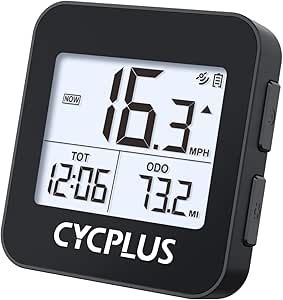 | Best for Long Battery Life on a Budget | Display: 2-inch LED, FSTN | Battery capacity: 1,200 mAh lithium polymer | Battery life: More than 55 hours | VIEW LATEST PRICE | See Our Full Breakdown |
| Wahoo ELEMNT BOLT V3 GPS Bike Computer |  | Best for Compact, Connected Navigation | Display: 2.2-inch, 64-color screen; product information also lists 2.3 inches | Memory: 16 GB | Battery life: 15 hours in product description; 20 hours in product information | VIEW LATEST PRICE | See Our Full Breakdown |
| Magene C506 GPS Bike Computer |  | Best Value for Sensor-Rich Training | Screen: 2.4-inch LCD capacitive touchscreen | Weight: 76 g | Battery life: Up to 24 hours in endurance mode | VIEW LATEST PRICE | See Our Full Breakdown |
| iGPSPORT BSC500 GPS Bike Computer with 3.3-Inch Touchscreen and Voice Navigation |  | Best for Clear, Guidance-Heavy Navigation | Display: 3.3-inch touchscreen | Controls: Touchscreen and buttons | Positioning: Dual-band L1/L5; GPS, Beidou, GLONASS, Galileo, QZSS | VIEW LATEST PRICE | See Our Full Breakdown |
| Garmin Edge 1050 Premium Cycling Computer |  | Best Premium Training and Navigation Computer | Screen: 3.5-inch capacitive LCD touchscreen | Battery life: Up to 20 hours in demanding use; up to 60 hours in battery saver mode | Connectivity: Bluetooth, USB, Wi-Fi | VIEW LATEST PRICE | See Our Full Breakdown |
| Garmin Edge 850 Compact GPS Cycling Computer |  | Best Compact Premium Pick | Screen size: 2.7 inches | Display: LCD color touchscreen with button controls | Battery life: Up to 12 hours in demanding use; up to 36 hours in battery saver mode | VIEW LATEST PRICE | See Our Full Breakdown |
| CATEYE Padrone Wireless Bike Computer |  | Best for Simple Ride Tracking | Display: 5.5 cm LCD | Wireless range: 70 cm | Sensor type: Analog wireless | VIEW LATEST PRICE | See Our Full Breakdown |
| Garmin Edge 840 GPS Cycling Computer |  | Best for Long Training Rides | Screen size: 2.6 inches | Display resolution: 240 × 320 | Input methods: Buttons and touchscreen | VIEW LATEST PRICE | See Our Full Breakdown |
| iGPSPORT BSC200S GPS Bike Computer with Route Navigation |  | Best Value for Route Navigation | Display: 2.4-inch color screen, 320 × 240 resolution | Battery life: Up to 25 hours | Battery: 600 mAh lithium polymer | VIEW LATEST PRICE | See Our Full Breakdown |
| BKVTOP Wireless GPS Bike Computer |  | Best Sensor-Free GPS Pick | Display: 2.4-inch LCD | Weight: 50 g | Battery life: Up to 28 hours | VIEW LATEST PRICE | See Our Full Breakdown |
| bike computer | Battery life | Connectivity | Display | Weight |
|---|---|---|---|---|
| Garmin Edge Explore 2 GPS Cycl | Up to 16 hours | Bluetooth, Wi-Fi | LCD or LED | — |
| COOSPO CS600 GPS Bike Computer | Up to 36 hours | Bluetooth, ANT+ | 2.4-inch color touchscreen | 120 g |
| iGPSPORT BSC300T Touchscreen G | Up to 20 hours | ANT+, Bluetooth 5.0, USB Type-C | — | 67 g |
| Garmin Edge 540 GPS Cycling Co | Up to 26 hours; up to 42 hours in battery-saver mode | Bluetooth, Wi-Fi, USB | — | — |
| Wahoo ELEMNT ROAM V3 GPS Cycli | Up to 25 hours | Bluetooth, USB, Wi-Fi | 2.8-inch LCD | 109 g |
| CYCPLUS G1 Wireless GPS Bike C | More than 55 hours | Wireless | 2-inch LED, FSTN | 70 g |
| Wahoo ELEMNT BOLT V3 GPS Bike | 15 hours in product description; 20 hours in product information | Bluetooth Smart, ANT+, Wi-Fi, USB-C | 2.2-inch, 64-color screen; product information also lists 2.3 inches | 84 g |
| Magene C506 GPS Bike Computer | Up to 24 hours in endurance mode | ANT+, Bluetooth, Wi-Fi | — | 76 g |
| iGPSPORT BSC500 GPS Bike Compu | — | — | 3.3-inch touchscreen | 107 g |
| Garmin Edge 1050 Premium Cycli | Up to 20 hours in demanding use; up to 60 hours in battery saver mode | Bluetooth, USB, Wi-Fi | — | — |
| Garmin Edge 850 Compact GPS Cy | Up to 12 hours in demanding use; up to 36 hours in battery saver mode | Bluetooth, USB, Wi-Fi | LCD color touchscreen with button controls | — |
| CATEYE Padrone Wireless Bike C | — | — | 5.5 cm LCD | 1.12 oz |
| Garmin Edge 840 GPS Cycling Co | Up to 26 hours; up to 32 hours in battery saver mode | Bluetooth, USB, Wi-Fi | — | — |
| iGPSPORT BSC200S GPS Bike Comp | Up to 25 hours | Bluetooth, ANT+, USB | 2.4-inch color screen, 320 × 240 resolution | Listed as 66 g; also listed as 67 g in product information |
| BKVTOP Wireless GPS Bike Compu | Up to 28 hours | No app connection or external sensor support | 2.4-inch LCD | 50 g |
More Details on Our Top Picks
Garmin Edge Explore 2 GPS Cycling Navigator
The Garmin Edge Explore 2 is the navigation-first choice here: its 3-inch touchscreen and preloaded road, off-road, and indoor maps make routes easier to follow at a glance than on the smaller screens of the COOSPO CS600 or iGPSPORT BSC300T. Turn-by-turn directions and eBike-specific guidance also make it a natural fit for varied rides, not just structured training. Its 16-hour battery life is shorter than the CS600’s stated 36 hours, so frequent long-distance riders may prefer that model. Smartphone connectivity adds ride tracking and safety functions, but some safety features depend on a paired phone and network coverage. I’d choose this for accessible route guidance, not for a sensor-rich training setup: heart-rate and other sensors are separate.
Pros:- Large 3-inch touchscreen gives maps and directions more room than the CS600 and BSC300T displays.
- Preloaded maps and turn-by-turn cycling navigation support road and off-road route following.
- eBike-specific guidance suits riders using compatible electric bikes.
- Smartphone connectivity adds ride tracking and access to compatible safety features.
Cons:- Up to 16 hours of battery life is shorter than the CS600’s stated runtime.
- Heart-rate and other sensors must be purchased separately.
- Some safety features depend on a paired smartphone and network coverage.
Best for: Recreational road, gravel, and eBike riders who prioritize a large, readable map and turn-by-turn guidance over advanced training analysis.
Not ideal for: Riders planning long unsupported rides or training around heart-rate and power data who want long battery life or bundled sensors.
- Screen size:3 inches
- Battery life:Up to 16 hours
- Storage:16 GB
- Connectivity:Bluetooth, Wi-Fi
- Navigation:GPS
- Display:LCD or LED
- Touchscreen:Capacitive
Our verdict“Choose the Edge Explore 2 if clear, accessible mapping matters more than extended battery life or advanced training data.”
COOSPO CS600 GPS Bike Computer with Color Touchscreen
The COOSPO CS600 is the endurance-minded touchscreen pick, with a claimed up to 36 hours of battery life that exceeds the Garmin Edge Explore 2 and the Wahoo ELEMNT ROAM V3. That reserve is useful for extended rides or multi-day outings where charging access is limited. Its 2.4-inch color screen handles route navigation and customizable ride data, though the Explore 2’s larger display gives maps more space. Bluetooth and ANT+ support let riders connect compatible sensors, while IPX7 water resistance suits wet-weather use. The tradeoff is that sensors and extension mounts are sold separately, so building out a complete cockpit takes extra purchases. I’d put it ahead of the Garmin for runtime, but not for riders who value a larger navigation display or an included sensor package.
Pros:- Up to 36 hours of battery life outlasts the listed runtimes of the Garmin Edge Explore 2 and Wahoo ELEMNT ROAM V3.
- Color touchscreen supports route guidance and customizable ride-data screens.
- Bluetooth and ANT+ provide compatibility with a range of cycling sensors.
- IPX7 water resistance and automatic backlight support varied weather and light conditions.
Cons:- Additional sensors are not included.
- Extension mounts are sold separately.
- The 2.4-inch display gives maps less viewing area than the Edge Explore 2’s 3-inch screen.
Best for: Touring and endurance riders who want a touchscreen GPS computer with long stated runtime and support for Bluetooth and ANT+ sensors.
Not ideal for: Riders who want a larger map display or need sensors and an extension mount included with the computer.
- Display:2.4-inch color touchscreen
- Battery life:Up to 36 hours
- Water resistance:IPX7
- Connectivity:Bluetooth, ANT+
- Satellite systems:GPS, GLONASS
- Weight:120 g
- Charging:USB Type-C
- Mounting:Handlebar mount
Our verdict“Pick the CS600 if long battery life is your priority and you’re comfortable buying compatible sensors separately.”
iGPSPORT BSC300T Touchscreen GPS Bike Computer
The iGPSPORT BSC300T brings offline worldwide maps, turn prompts, and off-course alerts to a compact 67 g touchscreen unit. That combination makes it a stronger fit for riders who want route guidance without relying on a live connection than a basic data-focused computer. Its support for five satellite systems and ANT+/Bluetooth sensors also gives it broad compatibility, while more than 130 ride metrics offer plenty of detail for riders who like to tailor their data screens. Compared with the Garmin Edge Explore 2, the BSC300T is smaller and lighter, but its 2.4-inch display is less spacious for reading a map. Battery life reaches up to 20 hours, below the CS600’s stated 36 hours, and the charging cable is not included.
Pros:- Offline worldwide maps, turn prompts, and off-course alerts support route following without relying on live navigation.
- Lightweight 67 g design is easier to keep compact on the handlebars than the 120 g CS600.
- More than 130 riding metrics allow extensive data customization.
- Multiple satellite systems and ANT+/Bluetooth support provide broad tracking and sensor compatibility.
Cons:- Up to 20 hours of battery life is shorter than the CS600’s stated 36 hours.
- The charging cable is not included.
- Its 2.4-inch screen is smaller than the Garmin Edge Explore 2’s display for viewing maps.
Best for: Riders who want offline route maps and off-course alerts in a lightweight computer that can connect to a wide range of sensors.
Not ideal for: Riders who prefer a large navigation screen, need the longest listed battery runtime, or expect a charging cable in the box.
- Screen size:2.4 inches
- Dimensions:82 × 53 × 14.1 mm
- Weight:67 g
- Battery life:Up to 20 hours
- Memory:8 GB
- Connectivity:ANT+, Bluetooth 5.0, USB Type-C
- Navigation:Worldwide offline maps, route preview, turn prompts, off-course alerts
- Satellite systems:GPS, BeiDou, GLONASS, Galileo, QZSS
Our verdict“Choose the BSC300T for lightweight offline mapping and broad sensor support, provided its smaller screen and missing cable suit your setup.”
Garmin Edge 540 GPS Cycling Computer
The Garmin Edge 540 is the training-focused choice in this group. Rather than a touchscreen, it uses button controls, which keep operation centered on physical inputs, while multi-band GNSS supports positioning in more challenging surroundings. Its maps cover road, trail, and gravel routes, and features such as ClimbPro and stamina insights help riders plan effort instead of simply following directions. Compared with the Garmin Edge Explore 2, the 540 puts more emphasis on training guidance than on a large, easy-to-read touchscreen. The Wahoo ELEMNT ROAM V3 offers touch input as well as buttons, but the Edge 540 counters with adaptive coaching and a longer stated maximum runtime in battery-saver mode. Some performance guidance depends on separate heart-rate and power sensors.
Pros:- Multi-band GNSS supports enhanced positioning accuracy for route tracking.
- Adaptive coaching and workout prompts suit riders following a training plan.
- ClimbPro and stamina insights help riders manage effort over challenging routes.
- Battery life is listed at up to 42 hours in battery-saver mode.
Cons:- Button controls may be less convenient for riders who prefer touchscreen interaction.
- Some coaching and performance features require a compatible power meter and heart-rate monitor.
- Its 2.6-inch display is smaller than the Garmin Edge Explore 2’s 3-inch screen.
Best for: Committed road, gravel, and trail cyclists who want training guidance, climb information, and multi-band positioning in a button-operated computer.
Not ideal for: Casual riders who mainly want a large touchscreen for simple directions or who do not plan to use training sensors.
- Screen size:2.6 inches
- Resolution:246 × 322
- Display type:LCD
- Controls:Buttons
- Battery life:Up to 26 hours; up to 42 hours in battery-saver mode
- Storage:16 GB
- Navigation:GPS, multi-band GNSS
- Connectivity:Bluetooth, Wi-Fi, USB
Our verdict“Choose the Edge 540 if training and climb insights matter more to you than touchscreen navigation.”
Wahoo ELEMNT ROAM V3 GPS Cycling Computer, Black
The Wahoo ELEMNT ROAM V3 suits riders who want options for building and following routes: routes can come from files and popular cycling apps, or be created on the device or in the companion app. Its 2.8-inch color display is larger than the CS600 and BSC300T screens, while dual-band GPS is designed to maintain positioning in forests and dense urban areas. The 25-hour stated battery life sits between the Garmin Edge Explore 2 and COOSPO CS600, making it a more balanced choice than either for riders who need both navigation and substantial runtime. It combines buttons and touchscreen input, unlike the button-only Edge 540. The tradeoffs are that heart-rate and cadence readings need compatible sensors, and the supplied product information inconsistently identifies the unit as V2 and V3.
Pros:- Routes can be created on the computer or companion app and imported from popular cycling services.
- Dual-band GPS supports positioning in forests and dense urban areas.
- Buttons and touchscreen offer more than one way to control the computer, unlike the Edge 540.
- Up to 25 hours of battery life exceeds the Edge Explore 2’s listed 16 hours.
Cons:- Heart-rate and cadence measurements require compatible sensors.
- The product information inconsistently refers to the device as both V2 and V3.
- Its stated 25-hour battery life is shorter than the CS600’s up to 36 hours.
Best for: Route-focused riders who build rides with cycling apps and want a color screen, dual-band GPS, and both button and touchscreen controls.
Not ideal for: Riders who need verified model-generation details before buying or expect heart-rate and cadence sensors to be included.
- Display:2.8-inch LCD
- Resolution:480 × 800
- Battery life:Up to 25 hours
- Connectivity:Bluetooth, USB, Wi-Fi
- Sensors:GPS, heart rate, cadence
- Controls:Buttons, touchscreen
- Weight:109 g
- Water resistance:IPX7
Our verdict“Choose the ROAM V3 if flexible route creation and dual-band GPS matter more than bundled sensors or the CS600’s longer stated runtime.”
CYCPLUS G1 Wireless GPS Bike Computer
The CYCPLUS G1 keeps its job simple: it uses GPS to record ride time, distance, and altitude, then puts those figures on a 2-inch screen designed for outdoor visibility. Its standout is endurance: the stated more-than-55-hour battery life means fewer charging stops than the Wahoo ELEMNT BOLT V3, whose listed runtime is shorter even at its higher feature level. The G1 is also light at 70 g and has IPX6 water resistance, giving it a straightforward fit for regular rides in changeable weather.
The tradeoff is a basic data set and button controls, with no listed navigation, sensor connectivity, or training analysis. I’d choose it for riders who want core ride tracking without the complexity of the Magene C506 or Garmin Edge 1050. Riders who need routes, structured training, or broader sensor support should look elsewhere.
Pros:- GPS records ride time, distance, and altitude
- Rated for more than 55 hours of battery life
- 2-inch backlit screen designed for sunlight visibility
- IPX6 water resistance and 70 g weight
Cons:- Limited to the basic cycling data listed in the description
- Button input lacks the touchscreen control offered by the Magene C506
- No navigation or sensor connectivity is specified
Best for: Riders who want GPS records of basic ride metrics and long battery life without needing route guidance or advanced training features.
Not ideal for: Riders who rely on turn-by-turn navigation, sensor pairing, or detailed performance analysis; those features are not listed for this model.
- Display:2-inch LED, FSTN
- Battery capacity:1,200 mAh lithium polymer
- Battery life:More than 55 hours
- Water resistance:IPX6
- Weight:70 g
- Connectivity:Wireless
- Mounting:Handlebar mount
- Warranty:Two years
Our verdict“Choose the CYCPLUS G1 for uncomplicated GPS ride tracking and long stretches between charges, but pick a navigation-capable computer if routes or richer ride data matter.”
Wahoo ELEMNT BOLT V3 GPS Bike Computer
The Wahoo ELEMNT BOLT V3 is a compact option for riders who want turn-by-turn navigation and connected ride handling without moving to a larger screen like the Garmin Edge 1050’s 3.5-inch display. It can download routes automatically and upload rides, while Bluetooth, ANT+, and Wi-Fi support connections to cycling sensors and compatible accessories such as rearview radar. That makes it a more capable route-and-data hub than the basic CYCPLUS G1, which lists only core ride tracking.
The 2.2-inch color screen and button controls keep the unit compact, but riders who prefer touch navigation may favor the Magene C506 or Garmin Edge 1050. Battery and display details are inconsistent across the supplied product information: runtime is listed as both 15 and 20 hours, and screen size as 2.2 and 2.3 inches. Smart notifications and LiveTrack also need a connected phone, so this is less self-contained than its navigation features may suggest.
Pros:- On-device turn-by-turn navigation with rerouting
- Automatic route downloads and ride uploads
- Bluetooth, ANT+, and Wi-Fi support sensor and accessory connections
- IPX7 water resistance and USB-C charging
Cons:- Supplied product details conflict on display size and battery runtime
- Button interface may be less convenient for riders who prefer touchscreen operation
- Smart notifications and LiveTrack require a connected smartphone
Best for: Road and gravel riders who want turn-by-turn directions, automatic route syncing, and connections to cycling sensors or radar in a compact computer.
Not ideal for: Riders who prefer a touchscreen, need a clearly established battery runtime, or want phone-free access to smart notifications and LiveTrack.
- Display:2.2-inch, 64-color screen; product information also lists 2.3 inches
- Memory:16 GB
- Battery life:15 hours in product description; 20 hours in product information
- Connectivity:Bluetooth Smart, ANT+, Wi-Fi, USB-C
- Water resistance:IPX7
- Weight:84 g
- Controls:Buttons
- Compatible sensors:Heart rate, cadence, and speed
Our verdict“Pick the BOLT V3 if compact navigation and broad connectivity matter more than touchscreen controls or certainty about the listed runtime.”
Magene C506 GPS Bike Computer
The Magene C506 earns its place by combining a 2.4-inch color touchscreen with route navigation and unusually broad device support for a lightweight 76 g computer. ANT+, Bluetooth, and Wi-Fi let it pair with speed, cadence, and heart-rate sensors, power meters, smart trainers, radar, and electronic shifting systems. Compared with the simpler CYCPLUS G1, it suits riders who want one screen for outdoor rides and indoor training; against the Wahoo ELEMNT BOLT V3, its touch display and stated endurance-mode runtime are appealing, though the BOLT’s listed navigation workflow includes automatic route downloads and ride uploads.
The C506’s up-to-24-hour endurance mode supports longer outings, but app dependence is part of the deal: indoor training and ride analysis use OnelapFit, and some smart riding assistant features require compatible Magene lights. I’d skip it if you want advanced functions to work independently of companion apps or accessories.
Pros:- 2.4-inch capacitive color touchscreen
- Supports downloadable maps, custom routes, and turn-by-turn navigation
- Connects with sensors, power meters, smart trainers, radar, and electronic shifting
- Weighs 76 g and offers up to 24 hours in endurance mode
Cons:- Indoor training and ride analysis use the OnelapFit app
- Some smart riding assistant features require compatible Magene lights
- App and accessory dependencies may add setup steps compared with basic computers such as the CYCPLUS G1
Best for: Riders building a sensor-connected setup who want touchscreen navigation, indoor trainer support, and broad compatibility in a lightweight unit.
Not ideal for: Riders who want analysis and indoor training without relying on OnelapFit, or who expect all smart riding features to work without compatible Magene lights.
- Screen:2.4-inch LCD capacitive touchscreen
- Weight:76 g
- Battery life:Up to 24 hours in endurance mode
- Connectivity:ANT+, Bluetooth, Wi-Fi
- Map type:Street
- Mounting:Handlebar mount
- Supported devices:Speed, cadence, and heart-rate sensors; power meters; smart trainers; radar and smart tail lights; electronic shifting systems
- Training and analysis app:OnelapFit
Our verdict“Choose the C506 if you want touchscreen navigation and wide sensor support for both indoor and outdoor riding, and are comfortable using its companion app.”
iGPSPORT BSC500 GPS Bike Computer with 3.3-Inch Touchscreen and Voice Navigation
The iGPSPORT BSC500 puts navigation front and center with a 3.3-inch touchscreen, voice guidance, turn alerts, and automatic rerouting. Its larger display gives route cues more room than the Wahoo ELEMNT BOLT V3’s compact screen, while dual-band L1/L5 positioning and support for several satellite systems are designed to keep location tracking dependable across varied riding conditions. It can show up to 12 data points per page, and hill-climb previews add useful context before a sustained ascent.
That feature set makes the BSC500 a better fit for riders who follow imported routes than the basic CYCPLUS G1, but setup depends on the iGPSPORT app or compatible third-party services such as Strava and Komoot. Its battery runtime is not provided, a real gap for riders planning long days out, and its 107 g weight is higher than the Magene C506’s 76 g. I’d favor it for prominent guidance, not minimum weight or proven endurance.
Pros:- Large 3.3-inch touchscreen with button controls
- Dual-band positioning and support for multiple satellite systems
- Route imports, turn alerts, automatic rerouting, and voice navigation
- Displays up to 12 cycling data points per page
Cons:- No battery runtime details are provided
- Route planning and imports rely on the iGPSPORT app or compatible third-party apps
- At 107 g, it is heavier than the Magene C506
Best for: Riders who follow imported routes and value a large screen, voice directions, rerouting, and climb previews.
Not ideal for: Long-distance riders who need a stated battery runtime, or weight-conscious cyclists comparing it with lighter units such as the Magene C506.
- Display:3.3-inch touchscreen
- Controls:Touchscreen and buttons
- Positioning:Dual-band L1/L5; GPS, Beidou, GLONASS, Galileo, QZSS
- Data display:Up to 12 cycling data points per page
- Weight:107 g
- Water resistance:IPX7
- Battery type:Lithium-ion
- Route services:iGPSPORT app or compatible third-party apps
Our verdict“Choose the BSC500 for a large, guidance-rich display and rerouting tools, but look elsewhere if published battery endurance or low weight is a priority.”
Garmin Edge 1050 Premium Cycling Computer
The Garmin Edge 1050 is the most feature-rich pick here, built around a 3.5-inch color touchscreen for course planning, navigation, and performance data. Its connected ride tools include messaging, live locations, and incident detection alerts, while a built-in speaker handles prompts and a bike bell. Compared with the Wahoo ELEMNT BOLT V3, the 1050 offers a much larger display and a broader set of connected and training features; the tradeoff is a bulkier unit and greater reliance on the Garmin ecosystem. The Magene C506 is lighter and also supports a wide range of sensors, but it does not list the same connected ride features.
Battery life is rated for up to 20 hours in demanding use, rising to 60 hours in battery saver mode. Those figures suit varied ride lengths, though personalized training tools require a compatible power meter and heart-rate monitor. Some connected functions also need a smartphone and Garmin Connect, so riders seeking a simple, self-contained computer may be better served by the CYCPLUS G1.
Pros:- Large 3.5-inch capacitive color touchscreen for maps and data
- Up to 20 hours in demanding use or 60 hours in battery saver mode
- Connected features include messaging, live locations, and incident detection alerts
- Built-in speaker provides navigation prompts and a bike bell
Cons:- Some connected features require a compatible smartphone and Garmin Connect
- Personalized training features require a compatible power meter and heart-rate monitor
- Its large feature set is more than basic riders need compared with the CYCPLUS G1
Best for: Committed cyclists who want a large navigation screen, connected safety and ride tools, and performance features paired with compatible sensors.
Not ideal for: Riders who want a lightweight, simple computer or prefer not to depend on a smartphone, Garmin Connect, and extra sensors for connected and personalized training features.
- Screen:3.5-inch capacitive LCD touchscreen
- Battery life:Up to 20 hours in demanding use; up to 60 hours in battery saver mode
- Connectivity:Bluetooth, USB, Wi-Fi
- Storage:64 GB
- Map coverage:North America
- Satellite navigation:GPS, GLONASS, Galileo
- Audio:Built-in speaker
- Mounting:Handlebar mount
Our verdict“Choose the Edge 1050 if you want a large-screen premium computer with connected ride tools and sensor-based training, rather than a lightweight basic tracker.”
Garmin Edge 850 Compact GPS Cycling Computer
The Edge 850 suits riders who want detailed navigation and training tools without moving to a larger computer. Its 2.7-inch color touchscreen works alongside physical buttons, giving riders an alternative when touch input is awkward. Preloaded road, gravel, and trail maps, multi-band satellite support, and fueling alerts make it more feature-rich than the CATEYE Padrone, which focuses on basic ride data and has no GPS. The compact design does come with a runtime tradeoff: Garmin lists up to 12 hours in demanding use, or 36 hours in battery saver mode, so long rides may call for more careful power planning than the Edge 840. Some connected features also depend on a compatible phone and Garmin Connect.
Pros:- Preloaded maps cover road, gravel, and trail riding in North America.
- Touchscreen and physical buttons offer two ways to control the unit.
- Training tools and smart fueling alerts support structured rides.
- Built-in speaker can provide prompts and a bike-bell function.
Cons:- Up to 12 hours of battery life in demanding use is limiting for some long rides.
- Some connected features require a compatible smartphone and Garmin Connect.
Best for: Road, gravel, and trail riders who want Garmin navigation and training features in a compact touchscreen unit.
Not ideal for: Riders who regularly take long, demanding rides and want more than 12 hours of runtime without using battery saver mode, or who prefer a basic computer without app-dependent features.
- Screen size:2.7 inches
- Display:LCD color touchscreen with button controls
- Battery life:Up to 12 hours in demanding use; up to 36 hours in battery saver mode
- Satellite systems:GPS, GLONASS, Galileo
- Connectivity:Bluetooth, USB, Wi-Fi
- Map coverage:North America; road, gravel, and trail maps
- Mounting type:Handlebar mount
- Operating system:Garmin OS
Our verdict“Choose the Edge 850 if you want compact Garmin navigation and training features and can plan around its demanding-use battery life.”
CATEYE Padrone Wireless Bike Computer
The CATEYE Padrone is the straightforward choice for riders who want speed, distance, and time without GPS setup, route planning, or a smartphone connection. Its large LCD makes core figures easy to read, while ClickTec controls and a tool-free mount keep operation simple. Automatic stop detection pauses elapsed-time and average-speed calculations at stops, which makes everyday ride summaries more useful. This is a different kind of pick from the GPS-equipped BKVTOP Wireless GPS Bike Computer: the Padrone relies on an analog front-wheel sensor and does not provide navigation, altitude, or GPS-recorded routes. That simplicity also limits its scope; riders who want heart-rate data, maps, or sensor expansion should choose a more capable computer. The stated one-year battery life reduces frequent battery changes, but it is not a substitute for GPS functionality.
Pros:- Large LCD presents core ride figures clearly.
- Tracks current, maximum, and average speed, distance, elapsed time, and clock.
- Automatic stop detection pauses time and average-speed calculations.
- Tool-free FlexTight mount adjustment and ClickTec controls keep setup simple.
Cons:- No GPS, route navigation, or heart-rate tracking.
- The wireless sensor is intended for front-wheel use only.
- Relies on an analog wheel sensor rather than satellite-based ride tracking.
Best for: Commuters and casual cyclists who want an easy-to-read display for speed, distance, and ride time without GPS or app setup.
Not ideal for: Route-focused riders, training-oriented cyclists, and anyone who wants GPS tracking, heart-rate data, or navigation.
- Display:5.5 cm LCD
- Wireless range:70 cm
- Sensor type:Analog wireless
- Average battery life:1 year
- Mounting type:Handlebar mount
- Dimensions:2.66 × 1.69 × 0.57 in
- Weight:1.12 oz
- Warranty:2 years
Our verdict“Pick the Padrone for simple, sensor-based ride statistics, but choose the BKVTOP or another GPS unit if you want recorded routes or navigation.”
Garmin Edge 840 GPS Cycling Computer
The Garmin Edge 840 balances navigation, physical controls, and training features with a longer stated runtime than the Edge 850. Its up to 26-hour battery life (32 hours in battery saver mode) makes it the stronger fit of the two for extended rides where frequent charging is inconvenient. The 2.6-inch touchscreen and buttons provide flexible control, while multi-band GNSS supports positioning and the adaptive coaching features can help guide structured training. Unlike the simpler CATEYE Padrone, this is a GPS computer built for route and training data, but some coaching insights rely on compatible power and heart-rate sensors. Buyers who want Garmin’s compact color-screen approach may prefer the Edge 850; the 840’s appeal is its longer listed runtime and training focus, not an especially large display.
Pros:- Up to 26 hours of battery life, with a battery saver mode extending runtime to 32 hours.
- Touchscreen and buttons allow more flexible operation on the bike.
- Multi-band GNSS supports positioning for navigation and ride recording.
- Adaptive coaching and course insights add training guidance.
Cons:- Some training features require compatible power and heart-rate sensors.
- Its 2.6-inch display is smaller than the Edge 850’s 2.7-inch screen.
Best for: Cyclists who follow structured training or take long rides and want Garmin navigation, dual input controls, and extended battery life.
Not ideal for: Riders seeking a simple speed-and-distance display or those who do not own compatible heart-rate and power sensors but expect every training feature to work.
- Screen size:2.6 inches
- Display resolution:240 × 320
- Input methods:Buttons and touchscreen
- Battery life:Up to 26 hours; up to 32 hours in battery saver mode
- Storage capacity:32 GB
- Connectivity:Bluetooth, USB, Wi-Fi
- Map coverage:North America
- Mounting type:Handlebar mount
Our verdict“Choose the Edge 840 over the Edge 850 if longer stated battery life and training-focused use matter more than the newer model’s slightly larger screen.”
iGPSPORT BSC200S GPS Bike Computer with Route Navigation
The iGPSPORT BSC200S brings route guidance, broad sensor compatibility, and long stated battery life into a button-controlled unit. Its up to 25-hour runtime is close to the Edge 840’s 26 hours on paper, while the BSC200S adds route import, back-to-start guidance, and storage for up to 400 hours of ride data. The six-button interface and 2.4-inch color display are a more basic setup than the Garmin Edge 840’s touchscreen-and-button combination, and the product data does not specify the same multi-band positioning feature. Still, support for speed, cadence, heart-rate, and power sensors gives training-focused riders room to build out their setup. The IPX7 rating suits wet-weather use, though the USB Type-C cable is not included, and the listed weight varies between product details.
Pros:- Route creation, imported routes, and back-to-start guidance support navigation.
- Up to 25 hours of battery life suits longer rides.
- Supports speed, cadence, heart-rate, and power sensors.
- IPX7 waterproof rating and storage for up to 400 hours of ride data.
Cons:- USB Type-C charging cable is not included.
- Product information lists the weight as both 66 g and 67 g.
- Six-button controls and a 2.4-inch display are less suited to riders who want touchscreen operation.
Best for: Route-focused riders who want GPS navigation, long battery life, and compatibility with several sensor types without choosing a touchscreen Garmin.
Not ideal for: Riders who prefer touchscreen controls, want clearly specified weight information, or expect a charging cable to come in the box.
- Display:2.4-inch color screen, 320 × 240 resolution
- Battery life:Up to 25 hours
- Battery:600 mAh lithium polymer
- Charging interface:USB Type-C
- Connectivity:Bluetooth, ANT+, USB
- Data storage:Up to 400 hours of ride data
- Controls:6 buttons
- Water resistance:IPX7
- Weight:Listed as 66 g; also listed as 67 g in product information
Our verdict“Choose the BSC200S if route tools, sensor compatibility, and long runtime matter more than touchscreen control or tightly consistent product specifications.”
BKVTOP Wireless GPS Bike Computer
The BKVTOP Wireless GPS Bike Computer offers GPS-based ride figures without requiring an external wheel sensor, app connection, or accessory sensors. It tracks speed, distance, time, and elevation-related metrics such as altitude, gradient, and ascent, giving it more range than the CATEYE Padrone while retaining a simple, standalone setup. Its 50 g weight, automatic backlight, and start/stop recording keep the package uncomplicated, and the stated 28-hour runtime exceeds the BSC200S’s 25 hours. The tradeoff is limited connectivity: it cannot pair with an app or external sensors, so riders who want heart-rate, cadence, or power data should look to the iGPSPORT or Garmin options instead. It also comes with a standard handlebar mount; an extended out-front mount is a separate variant.
Pros:- Built-in GPS tracks speed, distance, ride time, and elevation-related data without a wheel sensor.
- Lightweight 50 g design.
- Automatic backlight and start/stop recording simplify ride tracking.
- Up to 28 hours of battery life and an IPX7 waterproof design.
Cons:- Does not support app connections or external sensors.
- The described features do not include route navigation.
- An extended out-front mount is a separate variant; the listed unit uses a standard mount.
Best for: Casual and commuting cyclists who want GPS-recorded speed, distance, and elevation data without phone pairing or separate sensors.
Not ideal for: Structured-training riders who need heart-rate, cadence, or power sensors, or cyclists who want app syncing and route navigation.
- Display:2.4-inch LCD
- Weight:50 g
- Battery life:Up to 28 hours
- GPS:Built-in
- Connectivity:No app connection or external sensor support
- Units:MPH and KMH
- Mounting type:Standard handlebar mount
- Dimensions:1.77 × 0.63 × 2.76 in
Our verdict“Choose the BKVTOP for standalone GPS ride metrics and long runtime, but pick the BSC200S if you need route guidance or sensor support.”

How We Picked
To determine the best bike computers for 2027, I evaluated each device based on four core pillars: navigation accuracy, display readability, battery endurance, and ecosystem compatibility. I prioritized units that offer reliable GPS signal acquisition in varied terrain, from dense urban canyons to remote mountain trails, as this is the foundational function of any cycling computer. Display quality was assessed not just by resolution, but by visibility in direct sunlight and the intuitiveness of the interface during motion. I also weighed the value proposition of each unit, distinguishing between devices that offer genuine utility for their price point and those that are simply rebranded generic hardware. Finally, I considered the long-term viability of the software ecosystem, ensuring that recommended devices receive regular firmware updates and support for emerging sensor standards like ANT+ and Bluetooth LE.
Factors to Consider When Choosing Best Bike Computers
Selecting the right cycling computer requires balancing your specific riding needs with technical specifications that often sound similar on paper. This guide breaks down the critical factors that differentiate a good device from the best fit for your routine.
Navigation vs. Data Tracking
Many riders confuse navigation capabilities with data tracking, but these serve different purposes. Navigation-focused computers like the Garmin Edge Explore 2 prioritize map rendering, turn-by-turn directions, and route planning tools. In contrast, performance-focused units emphasize real-time metrics like power, heart rate, and cadence, often with simpler mapping. If you frequently ride unfamiliar routes, prioritize a device with detailed topographic maps and offline route storage. However, if you ride familiar loops and focus on training zones, a simpler unit with advanced data fields may serve you better and offer longer battery life by not constantly rendering maps.
Battery Life and Charging Standards
Battery life is often overstated by manufacturers, so look for real-world usage estimates rather than theoretical maximums. GPS accuracy modes significantly impact power consumption, with multi-band GPS draining batteries faster than single-band models. Consider whether the device uses a standard USB-C port, which allows for easier charging on the go, or proprietary cables that require carrying specific accessories. For ultra-endurance events, a device with 40+ hours of battery life in GPS mode is necessary, whereas daily commuters might find 15 hours sufficient. Remember that larger screens and backlight usage are the primary drains, so balance screen size against your expected ride duration.
Screen Readability and Touch Controls
Sunlight readability is a critical differentiator that spec sheets often obscure. Transflective displays, common in Garmin devices, remain readable in bright daylight without requiring a backlight, preserving battery life. In contrast, many budget touchscreen devices use OLED or LCD panels that require maximum brightness outdoors, draining power quickly. Touchscreens offer convenience for zooming maps but can be frustrating with gloves or wet hands. Physical buttons provide tactile feedback and reliability in poor weather conditions. Determine if you value the ease of touch for navigation or the reliability of buttons for data entry during intense efforts.
Ecosystem and Sensor Compatibility
The value of a bike computer often lies in its software ecosystem. Garmin Connect and Wahoo Training offer robust platforms for analyzing ride data, planning routes, and syncing with other devices. Ensure the computer supports the sensors you already own or plan to buy, such as power meters, heart rate straps, and radar systems. Some budget devices may lack support for specific ANT+ profiles or fail to integrate seamlessly with third-party apps like Strava. A cohesive ecosystem allows for automatic upload of rides, detailed analysis, and easy route syncing, which saves time and enhances the overall training experience.
Mounting Options and Aerodynamics
How a device mounts to your bike affects both aesthetics and aerodynamics. Out-front mounts offer the best visibility but can look cluttered and catch more wind. Top-cap or stem mounts are cleaner but may require tilting your head down to view data, which can strain the neck on longer rides. Some high-end units, like the Wahoo ELEMNT ROAM V3, offer modular mounting options that adapt to different bar setups. Consider whether you need a universal mount that fits multiple bikes or a streamlined setup for a single dedicated road bike. Easy swap capability is essential if you rotate between a commuter bike and a training bike.
Frequently Asked Questions
Do I need multi-band GPS for cycling?
Multi-band GPS is highly beneficial if you ride in areas with poor signal reception, such as dense forests, deep valleys, or urban canyons with tall buildings. It allows the device to receive signals from multiple satellite constellations simultaneously, resulting in faster fix times and more accurate track logs. For open-road cycling in rural areas, single-band GPS is usually sufficient and consumes less battery. If you are an urban commuter or trail rider, investing in a multi-band capable unit like the Garmin Edge 1050 or Wahoo ELEMNT ROAM V3 will provide noticeably more reliable navigation and distance tracking.
Can I use a smartphone instead of a dedicated bike computer?
While smartphones offer powerful navigation apps, they are inferior to dedicated bike computers for several reasons. Phones have shorter battery life under GPS load, screens that are hard to read in sunlight, and are susceptible to theft or damage from weather and crashes. Dedicated units offer longer battery life, rugged builds, and interfaces designed for gloved use. However, for casual riders who rarely ride long distances and prioritize cost savings, a phone mount with a free app is a viable entry-level option. Serious cyclists will find the reliability and data integration of a dedicated unit well worth the investment.
Is touchscreen necessary for a bike computer?
A touchscreen is not strictly necessary but significantly enhances the user experience for navigation-heavy activities. Zooming in on maps, selecting routes, and navigating menus is much faster with touch than with button combinations. However, touchscreens can be unreliable when wearing gloves or in rainy conditions. Devices like the Garmin Edge 850 combine a touchscreen with physical buttons to offer the best of both worlds. If you primarily ride in fair weather and value ease of use, a touchscreen is a worthwhile feature. If you ride in all conditions, prioritize a unit with responsive physical buttons.
How important is battery life for short rides?
For rides under two hours, battery life is rarely a limiting factor for any modern GPS bike computer. Even budget models like the CYCPLUS G1 can easily last a full day of commuting or short training loops. Battery capacity becomes a critical differentiator only for ultra-endurance events, multi-day bikepacking trips, or riders who forget to charge their devices regularly. If you ride daily and charge every night, you can prioritize other features like screen size or navigation accuracy over maximum battery endurance. Focus on charging convenience, such as USB-C compatibility, for daily use.
Do I need offline maps on my bike computer?
Offline maps are essential for riders who venture into areas with poor cellular connectivity, such as remote trails or rural roads. Without offline maps, your device relies on live data to render maps, which can fail or drain data plans. Devices like the Garmin Edge Explore 2 and Wahoo ELEMNT ROAM V3 allow you to download detailed maps to the device, ensuring you always have navigation guidance regardless of signal strength. For urban riders with consistent cell coverage, online maps may suffice, but offline capability provides peace of mind and reliability for any unexpected detours or dead zones.
Conclusion
Choosing the right bike computer depends on your specific riding priorities. For the Best Overall experience, the Garmin Edge Explore 2 delivers an unmatched combination of navigation features, battery life, and ease of use at a reasonable price. If you are a Premium Rider seeking the absolute best display and training tools, the Garmin Edge 1050 is the definitive choice. For those who value App Integration and a clean design, the Wahoo ELEMNT ROAM V3 offers the smoothest user experience. Beginners and budget-conscious riders should look at the COOSPO CS600 or CYCPLUS G1, which provide essential GPS tracking without the premium price tag. Finally, for Ultra-Endurance specialists, the Magene C506 offers exceptional battery life at a competitive cost. Match these recommendations to your riding style to find the perfect companion for your bike.
Halloween Picks
halloween
As an affiliate, we earn on qualifying purchases.