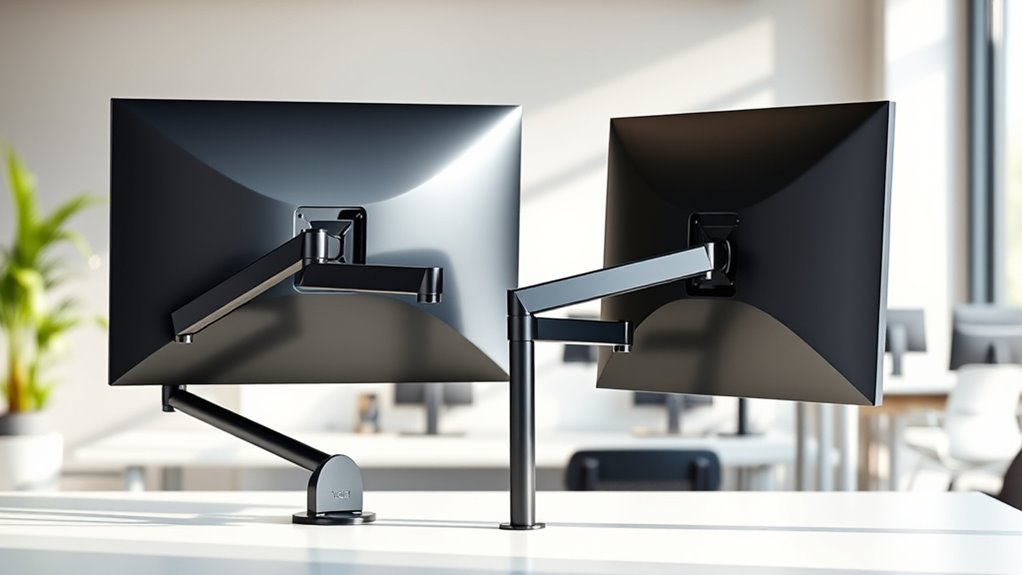

For adjustable monitor arms for dual setups, I’d start with the HUANUO Dual Monitor Stand for 13–40-Inch Monitors as the best overall choice for its broad screen-size range and high per-arm capacity. The VIVO Heavy-Duty Dual Monitor Desk Mount is a strong alternative for heavier screens, while the HUANUO FlowLift Pro suits smaller monitors and buyers who want tool-free VESA attachment. The main tradeoffs are gas-spring convenience versus mechanical simplicity, screen-size and weight limits, and desk space or mounting restrictions. A mount that fits the screen diagonally may still be unsuitable if the monitor is too heavy or its VESA pattern is incompatible. Read on for how all 15 options compare and which setup each one fits best.

Get sports gear delivered free with Prime
- Fast, free delivery on millions of items
- Prime Video, Amazon Music and more included
- Member-only deals all year
Complete the kit


Key Takeaways
- The HUANUO 13–40-inch dual mount has the broadest listed screen-size range and supports up to 26.4 pounds per arm, making it a flexible pick for mixed or larger displays—provided the desk mount and screen dimensions also fit.
- VIVO’s heavy-duty desk mount lists support for two screens up to 30 inches and 22 pounds each, a useful fit for buyers prioritizing load capacity over a wider screen-size range.
- The HUANUO FlowLift Pro is limited to 13–27-inch monitors and 15.4 pounds per arm, so its tool-free VESA setup makes more sense for lighter displays than for large, heavy screens.
- Some models use mechanical arms rather than gas springs; those can suit buyers who prefer a simpler adjustment mechanism, but may not offer the same feel when repositioning screens frequently.
- Desk fit is a deciding factor, not an afterthought: several picks offer clamp and grommet mounting, but buyers still need to check desktop thickness, edge clearance, base footprint, and whether the desk can handle the combined load.


| adjustable monitor arms for dual setup | VESA compatibility | Mounting options | Tilt | Material |
|---|---|---|---|---|
| EVEO Premium Dual Monitor Moun | 75×75 mm and 100×100 mm | Desk clamp or grommet mount | +90° to −90° | High-quality materials |
| monTEK Heavy-Duty Dual Monitor | 75×75 mm and 100×100 mm | C-clamp or grommet | — | Reinforced steel |
| HUANUO FlowLift Dual Monitor S | 75×75 mm and 100×100 mm | C-clamp or grommet | +85°/−50° | — |
| ErGear Dual Monitor Arm | — | — | — | — |
| HUANUO 17-32 Inch Dual Monitor | 75×75 mm and 100×100 mm | C-clamp or grommet | 90° | — |
| VIVO Dual Monitor Desk Mount | 75 × 75 mm / 100 × 100 mm | — | +90° to −90° | Steel |
| MOUNTUP Dual Monitor Stand for | 75 × 75 mm / 100 × 100 mm | — | 135° | — |
| VIVO Dual Monitor Stand | 75 × 75 mm / 100 × 100 mm | — | — | Alloy steel |
| HUANUO Dual Monitor Stand for | 75 × 75 mm / 100 × 100 mm | — | −30° to +85° | — |
| VIVO Dual Mechanical Monitor M | 75 × 75 mm / 100 × 100 mm | — | — | Steel and aluminum |
| HUANUO Dual Monitor Mount for | 75×75 mm or 100×100 mm | C-clamp or grommet | — | Aluminum |
| ErGear Dual Monitor Stand | 75×75 mm or 100×100 mm | C-clamp or grommet mount | ±45° | Metal and plastic |
| HUANUO 2 Pack Monitor Arm for | — | Clamp or grommet | — | — |
| WALI Adjustable Dual Monitor A | 75×75 mm or 100×100 mm | C-clamp or grommet; desks 0.39–2.76 inches thick | +70°/-45° | — |
| HUANUO FlowLift Pro Dual Monit | 75×75 mm or 100×100 mm | — | — | 90% professional-grade metal |
More Details on Our Top Picks
EVEO Premium Dual Monitor Mount 14-32″ Dual Monitor Arm VESA Bracket Adjustable Height Gas Spring
The EVEO Premium Dual Monitor Mount is a flexible choice when a dual desk setup may include screens of different sizes, or when you want room to change monitors later. Its 14–32-inch range reaches smaller displays that the monTEK starts at 17 inches, while 360° rotation and ±90° tilt support portrait orientation and substantial angle changes. Clamp and grommet mounting also give it more placement options than a setup tied to one desk-edge style. The tradeoff is a bulky footprint, which can be awkward on a compact desk, and there is no built-in cable management. Unlike the ErGear, this model’s listed details do not specify extension distance or a weight limit, so check your monitors’ load requirements before choosing it.
Pros:- Accommodates screens from 14 to 32 inches, including smaller displays.
- 360° rotation and a broad tilt range allow portrait and angled viewing positions.
- Offers both desk-clamp and grommet mounting.
- Includes a two-year warranty.
Cons:- The mount may feel bulky on a small or crowded desk.
- No built-in cable management is listed.
- A monitor weight limit is not provided in the supplied specifications.
Best for: People pairing smaller 14-inch displays with larger monitors, or expecting to change screen sizes while keeping the same dual-arm mount.
Not ideal for: Compact-desk users who need a small mounting footprint, or owners of monitors without compatible VESA holes.
- Supported screen size:14–32 inches
- VESA compatibility:75×75 mm and 100×100 mm
- Mounting options:Desk clamp or grommet mount
- Rotation:360°
- Tilt:+90° to −90°
- Material:High-quality materials
- Warranty:2 years
Our verdict“Choose the EVEO if your dual setup needs broad screen-size flexibility and your desk has room for its bulk.”
monTEK Heavy-Duty Dual Monitor Stand for 17-32″ Screens
For a dual setup built around heavier displays, the monTEK Heavy-Duty Dual Monitor Stand has a clear advantage: it is rated for 22 pounds per monitor, more than the 19.8-pound limit listed for the HUANUO FlowLift. Its reinforced-steel construction and clamp or grommet bases suit buyers who want a substantial desk-mounted frame rather than a lighter-duty option. Full-motion adjustment covers tilt, swivel, and rotation, though the listed maximum tilt is 45 degrees rather than the unusually broad range on the EVEO. That makes monTEK a better fit for supporting larger, heavier screens than for extreme downward or upward angles. The stand itself is heavy, assembly may take longer, and its 17-inch minimum rules out smaller monitors.
Pros:- Supports up to 22 pounds per monitor.
- Fits screens up to 32 inches.
- Reinforced-steel construction is suited to a substantial dual-screen setup.
- Includes both C-clamp and grommet mounting options.
Cons:- The heavy stand may be unsuitable for desks that cannot support a substantial mount.
- Assembly can be time-consuming.
- The 17-inch minimum excludes smaller displays, and listed tilt tops out at 45 degrees.
Best for: Desk users with two VESA-compatible monitors weighing up to 22 pounds each who want a reinforced-steel mount.
Not ideal for: Owners of monitors smaller than 17 inches, people who need a lightweight mount, or users who require a tilt range beyond 45 degrees.
- Supported screen size:17–32 inches
- Support weight:Up to 22 lbs per monitor
- VESA compatibility:75×75 mm and 100×100 mm
- Material:Reinforced steel
- Maximum tilt:45 degrees
- Mounting options:C-clamp or grommet
- Color:Matte black
Our verdict“Pick the monTEK for two heavier monitors when load capacity matters more than a lighter frame or a wider tilt range.”
HUANUO FlowLift Dual Monitor Stand – Fully Adjustable Desk Mount for 13-32″ Screens with Full Motion VESA Compatibility
The HUANUO FlowLift is the most clearly specified option here for dialing in a dual-screen arrangement: its arms list 15.75 inches of maximum height adjustment, ±90° swivel, and 360° rotation. That detail helps buyers judge whether the screens can reach their preferred height before committing to a desk mount. Its 13–32-inch compatibility also covers smaller monitors than the monTEK, though each screen must weigh between 4.4 and 19.8 pounds. Clamp and grommet mounting add flexibility, but the desk requirements narrow the audience: the supplied guidance recommends wooden desks, and crossbeams or panels can complicate installation. Compared with the ErGear, FlowLift lists a slightly narrower weight ceiling and less maximum height adjustment, but gives a defined monitor-weight range.
Pros:- Supports 13–32-inch monitors within a stated 4.4–19.8-pound weight range.
- Provides up to 15.75 inches of height adjustment.
- Offers ±90° swivel, 360° rotation, and +85°/−50° tilt.
- Can be installed with a C-clamp or grommet mount.
Cons:- Recommended for wooden desks rather than glass or plastic surfaces.
- Desk crossbeams or panels may interfere with installation.
- Its per-monitor limit is lower than the monTEK’s 22-pound capacity.
Best for: Users arranging two mid-sized VESA monitors on a suitable wooden desk who want specific height and movement ranges to guide positioning.
Not ideal for: People with glass or plastic desks, obstructed desk undersides, monitors outside the 4.4–19.8-pound range, or screens without VESA holes.
- Monitor size range:13–32 inches
- Monitor weight range:4.4–19.8 lbs per monitor
- VESA compatibility:75×75 mm and 100×100 mm
- Desk thickness range:0.59–3.54 inches
- Mounting options:C-clamp or grommet
- Tilt:+85°/−50°
- Swivel and rotation:±90° swivel; 360° rotation
- Maximum height adjustment:15.75 inches
Our verdict“Choose the FlowLift when defined positioning adjustments suit your monitors and your wooden desk provides clear mounting access.”
ErGear Dual Monitor Arm – Fully Adjustable Mount for 13-32″ Screens with Tool-Free VESA Installation
If frequent monitor mounting or replacement is part of your setup, the ErGear Dual Monitor Arm makes that task its main distinction: tool-free VESA installation can simplify attaching compatible screens compared with the HUANUO FlowLift’s standard VESA setup. It also lists useful reach measurements—up to 17.5 inches of height adjustment and 18.1 inches of extension—so buyers can assess whether the arms can span their desk layout. Its 13–32-inch range and 19.8-pound limit match the FlowLift’s weight ceiling, while cable management gives it an advantage over the EVEO for a tidier workstation. The tradeoffs are a wooden-desk recommendation, possible initial stiffness, and a load limit below the monTEK’s 22 pounds per monitor.
Pros:- Tool-free VESA installation can speed up monitor attachment.
- Lists up to 17.5 inches of height adjustment and 18.1 inches of extension.
- Includes cable management for a tidier desk.
- Supports 13–32-inch monitors weighing up to 19.8 pounds.
Cons:- The 19.8-pound limit is lower than the monTEK’s 22 pounds per screen.
- Recommended for wooden desks without crossbeams.
- Adjustment mechanisms may feel stiff at first.
Best for: People who regularly attach or change VESA-compatible monitors and want a stated reach range plus built-in cable management.
Not ideal for: Owners of monitors heavier than 19.8 pounds, users with glass desks or obstructive crossbeams, and anyone seeking a loose, easy-moving adjustment feel from the start.
- Monitor compatibility:13–32 inches
- Maximum load:19.8 lbs per monitor
- VESA pattern:75×75 mm and 100×100 mm
- Height adjustment:Up to 17.5 inches
- Extension:Up to 18.1 inches
- Tilt and swivel:+80°/−50° tilt; ±90° swivel
- Rotation:360°
- Desk thickness:Clamp: 0.39–2.56 inches; grommet: 0.39–2.95 inches
Our verdict“The ErGear suits buyers who value quick VESA attachment, useful arm reach, and cable tidiness over heavier-monitor capacity.”
HUANUO 17-32 Inch Dual Monitor Stand, Stacked Monitor Mount, Adjustable Tilt/Swivel/Rotate, Supports 2 Monitors up to 19.8 lbs, VESA 75/100mm
Unlike the side-by-side arms in this group, the HUANUO stacked monitor mount is aimed at a vertical layout, making it a distinct fit when desk width is limited or one screen needs to sit above the other. Its 17-inch minimum and 17-inch height extension suit a pair of standard-sized displays, while tilt, swivel, and rotation allow adjustment after mounting. The ErGear offers a longer listed extension and covers 13-inch screens; this HUANUO instead emphasizes stacked placement and cable management. Both options top out at 19.8 pounds per monitor. The narrower size range excludes smaller displays, and the supplied details rule out glass desks. VESA holes are also required, so screen compatibility needs checking before purchase.
Pros:- Designed for a stacked arrangement that uses less desk width than side-by-side placement.
- Supports two monitors up to 32 inches and 19.8 pounds each.
- Provides 17 inches of height extension.
- Includes cable management and clamp or grommet mounting.
Cons:- The stacked layout may not suit users who want both screens at the same horizontal level.
- Not compatible with glass desks, according to the supplied product details.
- Requires VESA mounting holes and does not support monitors smaller than 17 inches.
Best for: People who need two 17–32-inch monitors arranged vertically to save desk width or create a stacked viewing layout.
Not ideal for: Users who prefer side-by-side positioning, own screens smaller than 17 inches or heavier than 19.8 pounds, or have a glass desk.
- Monitor compatibility:17–32 inches
- Maximum monitor weight:19.8 lbs per monitor
- VESA compatibility:75×75 mm and 100×100 mm
- Height extension:17 inches
- Tilt:90°
- Swivel:180°
- Rotation:360°
- Mounting options:C-clamp or grommet
- Desk thickness range:0.39–3.54 inches
Our verdict“Choose this HUANUO when a vertical two-screen layout is the priority and both monitors fit its VESA, size, and weight limits.”
VIVO Dual Monitor Desk Mount – Holds 2 Screens up to 30″ and 22 lb Each, Heavy-Duty Fully Adjustable Steel Stand with C-Clamp & Grommet (Black)
For a pair of monitors near 30 inches or toward the heavier end of the range, this VIVO’s 22-pound capacity per arm and steel construction make it a sturdier fit than the MOUNTUP, which supports up to 17.6 pounds per screen. Tilt, swivel, rotation, and height adjustment on the center pole provide useful positioning options, while C-clamp and grommet mounting let buyers match the base to their desk. Cable clips help keep the workspace orderly, and the three-year warranty adds practical reassurance.
The tradeoff is its 30-inch screen limit: the MOUNTUP accommodates screens up to 32 inches, and the HUANUO reaches 40 inches. Installation may take patience if VESA mounting is unfamiliar, and the clamp requires a desk edge no thicker than 3.25 inches. I’d choose this for two substantial, VESA-compatible monitors rather than oversized displays or a quick, tool-free setup.
Pros:- Supports two monitors up to 30 inches and 22 pounds per arm.
- Steel construction and full tilt, swivel, rotation, and height adjustment.
- Offers both C-clamp and grommet mounting.
- Includes cable clips and a three-year warranty.
Cons:- The 30-inch screen limit falls short of the MOUNTUP and HUANUO models’ larger-screen ranges.
- The clamp may not fit desks thicker than 3.25 inches.
- VESA installation can take time for first-time arm buyers.
Best for: Buyers mounting two VESA-compatible monitors up to 30 inches that weigh as much as 22 pounds each, especially on a desk suited to a clamp or grommet base.
Not ideal for: Owners of monitors larger than 30 inches, desks thicker than 3.25 inches, or anyone who wants a particularly simple first-time installation.
- Screen size:13–30 inches
- Maximum weight per arm:22 lb
- VESA compatibility:75 × 75 mm / 100 × 100 mm
- Mounting:C-clamp or grommet
- Material:Steel
- Tilt:+90° to −90°
- Swivel and rotation:180° swivel; 360° rotation
- Warranty:3 years
Our verdict“Choose this VIVO when a pair of sturdy, 30-inch-or-smaller monitors needs more per-arm capacity than the MOUNTUP provides.”
MOUNTUP Dual Monitor Stand for Desk, Adjustable VESA Mount for 2 Monitors 22-32 Inches, Holds 4.4-17.6 lbs, C-Clamp & Grommet Base
The MOUNTUP makes sense when screen size matters more than high per-arm capacity: it accepts monitors up to 32 inches, while the VIVO B009S750LA stops at 30 inches. Its 17.6-pound limit per screen suits many lighter displays, and the stated 17.3-inch arm extension offers room to bring screens forward or shift them across a dual setup. Tilt, swivel, and 360-degree rotation cover the adjustments most buyers need for side-by-side viewing, with clamp and grommet bases for different desk layouts.
That larger screen range comes with a weight tradeoff. The VIVO B009S750LA supports 22 pounds per arm, and the HUANUO B07X262MRK supports 26.4, making both safer candidates for heavier displays. This model also starts at 22 inches, so it’s a poor match for smaller monitors. Its pneumatic arms need proper tension adjustment; buyers who want mechanical arms may prefer the VIVO STAND-V002K.
Pros:- Supports screens up to 32 inches.
- Arm extension reaches 17.3 inches for flexible desk positioning.
- Includes tilt, swivel, and 360-degree rotation.
- Provides C-clamp and grommet mounting options.
Cons:- 17.6-pound capacity per arm is lower than both featured VIVO alternatives and the HUANUO B07X262MRK.
- The 22-inch minimum excludes smaller displays.
- Pneumatic arm tension needs adjustment to suit the monitor load.
Best for: People building a side-by-side setup with 22–32-inch monitors that weigh no more than 17.6 pounds each and want useful forward reach.
Not ideal for: Owners of monitors under 22 inches or heavier displays, who will get a broader size range or more weight headroom from the VIVO B009S750LA or HUANUO B07X262MRK.
- Screen size:22–32 inches
- Load capacity:4.4–17.6 lb per monitor
- VESA compatibility:75 × 75 mm / 100 × 100 mm
- Mounting:C-clamp or grommet
- Arm extension:17.3 inches
- Height adjustment range:9.4 inches
- Tilt:135°
- Swivel and rotation:180° swivel; 360° rotation
Our verdict“Pick the MOUNTUP for larger but relatively light monitors when its extended reach matters more than the heavier-load capacity of the VIVO or HUANUO alternatives.”
VIVO Dual Monitor Stand, Fully Adjustable Arms for 17 to 32 inch Screens, Mechanical Articulating Desk Mount, VESA 75x75mm and 100x100mm, Max 19.8 lbs, Black
This VIVO is a straightforward mechanical option for a pair of 17–32-inch monitors, with a 19.8-pound limit on each arm. That broader screen range accommodates more setups than the VIVO B009S750LA, which tops out at 30 inches, while its load rating remains below that model’s 22 pounds and the HUANUO B07X262MRK’s 26.4. The articulating arms and listed 90-degree tilt support changes in viewing angle, and the mechanical design avoids the pneumatic tension adjustment required by the MOUNTUP.
The specifications supplied here are less detailed about mounting hardware and adjustment ranges than those of the VIVO STAND-V002K, which explicitly lists C-clamp and grommet options. This model also needs enough desk space for its arms, which may extend beyond the desk edge. I’d put it on the shortlist for a flexible, moderate-weight dual setup, but verify the mounting arrangement and desk clearance before choosing it.
Pros:- Covers a broad 17–32-inch monitor size range.
- Supports up to 19.8 pounds per screen.
- Articulating arms provide tilt, swivel, and rotation.
- Mechanical adjustment avoids pneumatic arm tension setup.
Cons:- Per-arm capacity is lower than the VIVO B009S750LA and HUANUO B07X262MRK.
- Arms may extend past the desk edge, requiring adequate clearance.
- Supplied specifications do not detail mounting choices or adjustment ranges beyond tilt.
Best for: Buyers with VESA-compatible 17–32-inch monitors under 19.8 pounds each who prefer mechanical articulation and can accommodate the arm footprint.
Not ideal for: People with heavy monitors, limited desk clearance, or a requirement for clearly specified C-clamp and grommet mounting options.
- Screen size:17–32 inches
- Maximum weight capacity:19.8 lb per monitor
- VESA compatibility:75 × 75 mm / 100 × 100 mm
- Movement type:Articulating
- Material:Alloy steel
- Maximum tilt:90 degrees
- Color:Black
Our verdict“Choose this VIVO for a mechanical dual-arm setup with midweight 17–32-inch displays, provided your desk has room for the arms.”
HUANUO Dual Monitor Stand for 13-40 inch Monitors with USB, Height Adjustable, VESA Mount, Clamp/Grommet Base, Supports 26.4 lbs per Arm
For buyers pairing unusually large or heavy monitors, the HUANUO has the strongest stated capacity in this group: 26.4 pounds per arm, with support for screens up to 40 inches. That gives it more headroom than either featured VIVO, and it reaches beyond the MOUNTUP’s 32-inch ceiling. Its 25.59-inch maximum arm extension and height adjustment up to 21.1 inches give a dual setup room to spread out, while two built-in USB ports add convenient access at the desk.
Those capabilities call for a stable desk, and the 13–40-inch size range does not remove the need to check VESA compatibility: the mount accepts 75 × 75 mm or 100 × 100 mm patterns only. Compared with the simpler VIVO STAND-V002K, this HUANUO offers more reach, greater capacity, and USB ports, but it may be more mount than a compact, light-monitor setup needs. Assembly instructions may also take patience.
Pros:- Supports monitors up to 40 inches and 26.4 pounds per arm.
- Offers up to 25.59 inches of arm extension and 21.1 inches of height adjustment.
- Includes two built-in USB ports.
- Fits either a clamp or grommet installation.
Cons:- A sturdy desk is needed to support the mount and heavy displays reliably.
- Compatible only with VESA 75 × 75 mm or 100 × 100 mm patterns.
- Assembly instructions may be unclear.
Best for: Users mounting two large or heavy VESA-compatible monitors who need extended reach, a taller adjustment range, and USB ports at the desk.
Not ideal for: Owners of non-VESA monitors or desks that are not sturdy enough for a long-reach mount and substantial monitor loads.
- Screen size:13–40 inches
- Maximum weight per arm:26.4 lb
- VESA compatibility:75 × 75 mm / 100 × 100 mm
- Mounting:Clamp or grommet
- Maximum arm extension:25.59 inches
- Height adjustment:Up to 21.1 inches
- Tilt:−30° to +85°
- USB ports:2
Our verdict“Choose the HUANUO when screen size, per-arm capacity, and reach outweigh the simplicity of a lighter-duty mount like the VIVO STAND-V002K.”
VIVO Dual Mechanical Monitor Mount for 17-32 inch Screens, Heavy Duty VESA Desk Stand with C-clamp and Grommet Mount, Black, STAND-V002K
The STAND-V002K is the clearest pick here for buyers who want a conventional mechanical dual mount with both C-clamp and grommet installation spelled out. It supports 17–32-inch monitors up to 19.8 pounds each, a practical range for many everyday dual displays. Its tilt, swivel, rotation, and height adjustment cover the core positioning needs, while steel-and-aluminum construction and a three-year warranty make it a more fully specified alternative to the other featured mechanical VIVO, B01N2YFO5Z.
The HUANUO B07X262MRK is the better match for monitors above 32 inches or heavier than 19.8 pounds; it also offers much more stated extension and built-in USB ports. This VIVO stays simpler, but its 75 × 75 mm / 100 × 100 mm VESA limit excludes other mounting patterns. Heavier screens may also take effort to reposition, and the stand’s weight is worth factoring into a desk setup.
Pros:- Offers C-clamp and grommet installation.
- Supports 17–32-inch screens up to 19.8 pounds per monitor.
- Provides tilt, swivel, rotation, and height adjustment.
- Uses steel and aluminum construction and includes a three-year warranty.
Cons:- Supports only 75 × 75 mm or 100 × 100 mm VESA patterns.
- Heavier monitors may require more effort to adjust.
- The mount’s weight may not suit every desk setup.
Best for: Buyers seeking a mechanical dual mount for 17–32-inch monitors who need a choice between clamp and grommet installation.
Not ideal for: Owners of monitors over 32 inches or 19.8 pounds each, or anyone seeking long arm extension and built-in USB ports like those on the HUANUO B07X262MRK.
- Screen size:17–32 inches
- Maximum weight per monitor:19.8 lb
- VESA compatibility:75 × 75 mm / 100 × 100 mm
- Mounting:C-clamp or grommet
- Material:Steel and aluminum
- Movement:Tilt, swivel, rotation, and height adjustment
- Warranty:3 years
- Model number:STAND-V002K
Our verdict“Pick the STAND-V002K for a well-specified mechanical mount with two desk-installation options, but choose the HUANUO if your screens exceed its size or weight limits.”
HUANUO Dual Monitor Mount for 2 Monitors up to 32 inches, Supports 17-32 inch Monitors, Max 22 lbs per arm, Adjustable Height, Tilt, Swivel, Rotate, VESA Compatible
For a dual setup with monitors near the upper end of the size range, this HUANUO stands out with support for screens up to 32 inches and 22 pounds per arm. That gives it more headroom than the ErGear Dual Monitor Stand, which is rated for 17.6 pounds per screen, though ErGear lists a broader 13-inch minimum and built-in cable management. HUANUO offers height, tilt, swivel, and rotation adjustments, plus C-clamp or grommet mounting to suit different desk layouts. The tradeoff is a narrower stated screen-size range of 17–32 inches and no cable-management feature listed. Buyers also need VESA holes and a desk within the specified thickness range, so I would check both before choosing it.
Pros:- Supports up to 22 pounds per arm
- Fits screens from 17 to 32 inches
- Offers height, tilt, swivel, and rotation adjustment
- Can mount with a C-clamp or grommet
Cons:- No built-in cable management is specified
- Desk thickness is limited to 0.39–2.56 inches
- Requires VESA-compatible monitors
Best for: Dual-monitor users with VESA-compatible screens up to 32 inches that weigh no more than 22 pounds each, especially those who want extra capacity headroom.
Not ideal for: People using monitors smaller than 17 inches, non-VESA displays, or desks outside the stated 0.39–2.56-inch thickness range.
- Supported screen size:17–32 inches
- Weight capacity:22 lbs per arm
- VESA compatibility:75×75 mm or 100×100 mm
- Maximum tilt:90°
- Mounting options:C-clamp or grommet
- Desk thickness:0.39–2.56 inches
- Material:Aluminum
- Color:Black
Our verdict“Choose this HUANUO when your two larger monitors need more weight capacity than the ErGear option provides and your desk fits its mounting range.”
ErGear Dual Monitor Stand, Heavy Duty Adjustable Desk Mount for 2 Screens up to 32 Inches
The ErGear is a practical pick when a dual setup needs to stay tidy as well as adjustable. Its built-in cable management gives it a useful advantage over the first HUANUO mount in this batch, which does not list a cable feature. ErGear also supports 13–32-inch screens, making it a better fit for smaller displays than that HUANUO’s 17-inch minimum. The arms provide tilt, swivel, and full rotation, with a listed span of up to 31.22 inches. The tradeoff is its 17.6-pound limit per monitor, below the 22-pound capacity of the WALI and HUANUO options here. Assembly instructions may also take patience, and the clamp or grommet requires a compatible desk. I’d favor it for a moderate-weight setup where cable tidiness matters more than extra load capacity.
Pros:- Built-in cable management helps keep cords organized
- Supports a wide 13–32-inch screen range
- Provides tilt, swivel, and 360° rotation
- Offers C-clamp and grommet mounting
Cons:- Lower per-monitor capacity than the 22-pound HUANUO and WALI arms
- Desk type and thickness can limit installation
- Assembly instructions may be complex for some buyers
Best for: Home-office users with two VESA monitors weighing no more than 17.6 pounds each who want cable management and broad positioning adjustments.
Not ideal for: Owners of heavier displays above 17.6 pounds per arm or buyers who want a particularly simple assembly process.
- Monitor size range:13–32 inches
- Weight limit:17.6 lbs per monitor
- VESA compatibility:75×75 mm or 100×100 mm
- Tilt:±45°
- Swivel:±90°
- Rotation:360°
- Maximum arm span:31.22 inches
- Mounting options:C-clamp or grommet mount
- Material:Metal and plastic
Our verdict“Pick the ErGear over the higher-capacity HUANUO or WALI if cable organization and support for smaller screens matter more than carrying heavier monitors.”
HUANUO 2 Pack Monitor Arm for Dual Monitor Setup, Adjustable VESA Mount for 13 to 32 Inch Screens
This two-arm HUANUO set suits desks where each screen needs its own placement rather than a shared, fixed arrangement. The independent arms and wide tilt range—from -50° to +85°—offer flexible positioning, while the ErGear stand lists a more defined tilt range of ±45°. Its 13–32-inch compatibility also covers smaller monitors than the 17-inch-minimum HUANUO model in this batch. The weight specification is given as 4.4–19.8 pounds, so it is aimed at monitors within that band rather than the heavier screens supported by the 22-pound HUANUO and WALI arms. Clamp and grommet mounting adds desk flexibility, but the desk needs to be sturdy and within the stated thickness range. I’d choose it for a custom side-by-side layout, not for maximum load capacity.
Pros:- Two independent arms allow separate screen positioning
- Supports 13–32-inch monitors
- Wide -50° to +85° tilt range
- Clamp and grommet mounting options
Cons:- Maximum stated capacity is lower than the 22-pound HUANUO and WALI models
- Requires a sturdy desk for stable mounting
- Installation may be complex for some users
Best for: Users combining two VESA monitors of different sizes or positions who want independent arms and a broad tilt range.
Not ideal for: Owners of monitors heavier than 19.8 pounds or anyone mounting to a desk that cannot handle an articulating dual-arm setup.
- Number of arms:2
- Supported screen size:13–32 inches
- Weight capacity:4.4–19.8 lbs
- Tilt range:-50° to +85°
- Swivel:±90°
- Rotation:360°
- Maximum height:15.75 inches
- Mounting options:Clamp or grommet
- Supported desk thickness:0.59–3.54 inches
Our verdict“Choose this HUANUO for independently positioned screens and flexible tilt, but choose the 22-pound HUANUO or WALI if your monitors are heavier.”
WALI Adjustable Dual Monitor Arm for 13-32 inch Screens, 22 lbs per Arm
WALI is the strongest match here for buyers who need to move screens well beyond the desk’s rear edge or adjust them frequently. It lists 19.3 inches of extension and raises monitors up to 17.3 inches, giving its stated reach more detail than the first HUANUO mount, which provides a weight rating but no extension measurement. Like that HUANUO, WALI supports 22 pounds per arm and screens up to 32 inches; unlike it, WALI also includes cable management and a 10-year warranty. The tradeoff is a heavy arm that may be harder to reposition often, and installation can be awkward around crossbars or on non-wood desks. Its desk thickness range is slightly broader than the other HUANUO’s listed range, but buyers still need to check their mounting surface.
Pros:- Supports up to 22 pounds per arm
- Extends 19.3 inches and raises screens up to 17.3 inches
- Integrated cable management
- Includes C-clamp and grommet mounting options
Cons:- Heavy arms can be difficult to reposition frequently
- Installation may be challenging around crossbars or on non-wood desks
- Desk thickness is limited to 0.39–2.76 inches
Best for: Desk users with two VESA screens up to 32 inches who need substantial extension, cable routing, and a high per-arm load limit.
Not ideal for: People who frequently reposition their monitors or have a desk with crossbars or a mounting surface unsuitable for the clamp or grommet.
- Screen size compatibility:13–32 inches
- Maximum load:22 lbs per arm
- VESA compatibility:75×75 mm or 100×100 mm
- Extension:19.3 inches
- Maximum raise:17.3 inches
- Tilt:+70°/-45°
- Swivel:±90°
- Mounting options:C-clamp or grommet; desks 0.39–2.76 inches thick
- Warranty:10 years
Our verdict“Choose WALI over the first HUANUO if you want specified reach and cable management alongside the same 22-pound capacity.”
HUANUO FlowLift Pro Dual Monitor Mount for 13–27″ Screens, MechaSpring Monitor Stand, Adjustable Arms with Tilt/Swivel/Rotation, Tool-Free VESA Mount, Max Load 15.4 lbs
The FlowLift Pro is the clear choice in this batch for a dual setup built around smaller, lighter screens. Its 13–27-inch range suits compact monitors, while the 15.4-pound limit per arm is lower than the 19.8-pound HUANUO two-arm set and the 22-pound HUANUO and WALI mounts. That narrower capacity is the main compromise, but buyers with lightweight displays may value the tool-free VESA mounting for a less fiddly screen attachment. It offers tilt, swivel, and rotation, though the provided specs do not give angle ranges, so I would not choose it based on a specific movement requirement. The stated 0.59–3.54-inch desk range is broad, but the product is recommended only for wood desks. That surface restriction makes it less flexible than the clamp-and-grommet alternatives.
Pros:- Tool-free VESA mount for easier monitor attachment
- Designed for compact 13–27-inch screens
- Offers tilt, swivel, and rotation
- Uses 90% professional-grade metal and includes a five-year warranty
Cons:- Lower weight capacity than the other HUANUO arms and the WALI
- Supports screens only up to 27 inches
- Recommended only for wood desks
Best for: People building a dual setup with two lightweight 13–27-inch monitors who want tool-free VESA attachment and a wood desk within the stated thickness range.
Not ideal for: Users with monitors larger than 27 inches, heavier than 15.4 pounds, or desks made from materials other than wood.
- Screen size range:13–27 inches
- Maximum load:15.4 lbs per monitor
- VESA compatibility:75×75 mm or 100×100 mm
- Desk thickness:0.59–3.54 inches
- Adjustment:Tilt, swivel, and rotation
- VESA attachment:Tool-free
- Material:90% professional-grade metal
- Warranty:5 years
Our verdict“Choose the FlowLift Pro for a compact, lightweight dual-monitor setup on a wood desk, but pick another model for larger or heavier screens.”

How We Picked
I compared the 15 mounts against the decisions that matter in a two-screen setup: screen-size range, per-arm weight capacity, VESA compatibility, adjustment style, and mounting options. I also looked at whether the listed specifications suit common use cases, such as positioning two different monitors, supporting heavier displays, or making frequent adjustments. A wide advertised screen range is helpful, but it does not override the load limit or the physical space needed for two screens.
The ranking favors mounts with a practical combination of fit, capacity, flexibility, and clear setup advantages. Options with higher stated load limits or broader screen compatibility rank well for buyers with more demanding or changeable setups; more specialized picks rank higher for the users they serve, such as compact-screen owners or people choosing a stacked layout. I treat gas-spring and mechanical designs as different tradeoffs rather than assuming one is right for every desk, and I call out compromises where a narrower size range, lower capacity, or less flexible layout limits who should choose a model.
| adjustable monitor arms for dual setup | Mounting options |
|---|---|
| EVEO Premium Dual Monitor Moun | Desk clamp or grommet mount |
| monTEK Heavy-Duty Dual Monitor | C-clamp or grommet |
| HUANUO FlowLift Dual Monitor S | C-clamp or grommet |
| ErGear Dual Monitor Arm | — |
| HUANUO 17-32 Inch Dual Monitor | C-clamp or grommet |
| VIVO Dual Monitor Desk Mount | — |
| MOUNTUP Dual Monitor Stand for | — |
| VIVO Dual Monitor Stand | — |
| HUANUO Dual Monitor Stand for | — |
| VIVO Dual Mechanical Monitor M | — |
| HUANUO Dual Monitor Mount for | C-clamp or grommet |
| ErGear Dual Monitor Stand | C-clamp or grommet mount |
| HUANUO 2 Pack Monitor Arm for | Clamp or grommet |
| WALI Adjustable Dual Monitor A | C-clamp or grommet; desks 0.39–2.76 inches thick |
| HUANUO FlowLift Pro Dual Monit | — |
Factors to Consider When Choosing Adjustable Monitor Arms For Dual Setups
Before choosing a dual arm, I’d check the complete desk-and-monitor fit rather than relying on a single headline specification. These factors help prevent common mismatches that are easy to miss when shopping by screen size alone.
Match Weight Capacity to Each Monitor
Check the weight of each monitor without its original stand, then compare each one with the arm’s per-screen limit. The monitor’s diagonal measurement does not tell you how heavy it is, and two screens of similar size can differ substantially in weight. Leave some capacity margin if you expect to change displays later; choosing a mount that barely meets the stated limit can narrow your options. Also check whether a product gives a separate limit per arm or a combined limit for the whole stand. A dual mount is only as useful as its weakest arm for the screen you plan to place there.
Check VESA Fit and the Back of the Monitor
Most options in this roundup list VESA 75-by-75 or 100-by-100 millimeter compatibility, but verify the pattern on both monitors before buying. Some displays have recessed mounting points, unusual back shapes, or a stand attachment that needs an adapter. A compatible hole pattern does not guarantee that the mounting plate can sit flush against the monitor. If you use a compact display or a model with a curved back, check the monitor maker’s mounting guidance and the arm’s included hardware. This small check can prevent a mount that technically matches on paper but is difficult to install securely.
Choose Gas-Spring or Mechanical Arms for How Often You Adjust
Gas-spring arms are aimed at frequent repositioning, such as moving screens between seated and standing heights or changing their angle during the day. Mechanical arms can be a sensible choice when the screens mostly stay in one position and you value a simpler style of articulation. Neither label alone tells you how easy an arm will be to set: monitor weight, joint design, and the maker’s adjustment instructions matter too. A common mistake is to buy a spring arm for a very light screen without checking whether the arm’s supported weight range accommodates it. Match the mechanism to your routine, not just to a feature list.
Measure the Desk Before Picking a Base
A clamp or grommet option can free up desk surface, but the desk must support the mounting method. Measure desktop thickness, check for an apron or frame beneath the edge, and confirm there is room to tighten a clamp. Grommet mounting needs an appropriate hole or a willingness to make one, while a clamp can be blocked by a raised lip or cable tray. Pay attention to the base’s footprint and the space behind the desk, since the arms need room to swing. If the desktop is lightweight, hollow, or made from a fragile material, check its construction and use suitable reinforcement rather than assuming any mount will be safe.
Plan the Layout Around Screen Width and Movement
Two monitors need more than enough arm reach: their width, bezel placement, and desired angle determine whether they can sit side by side without colliding. Large or ultrawide screens may fit an arm’s stated diagonal limit yet still be awkward to position together. Measure both displays and sketch the intended layout, including room for inward rotation and access to desk items. Stacked mounts solve a different problem by using vertical space, but they can place the upper screen too high for comfortable viewing. Choose the arrangement based on your desk width and posture, not on the number of adjustment directions alone.
Decide Whether You Need a Specialty Feature
Features such as tool-free VESA attachment, built-in USB, or a stacked configuration can be useful, but only when they solve a real constraint in your setup. Tool-free attachment may simplify mounting the screens, while an integrated USB port can reduce the need to reach for a computer’s rear ports; neither replaces checking cable routing and port access. A stacked stand can help when desk width is limited, but it trades horizontal spread for vertical placement. If you do not need a specialty feature, prioritize stable support, adequate reach, and a good fit for both monitors. Paying for added convenience is most sensible when it removes a recurring setup problem.
Frequently Asked Questions
Can one dual monitor arm hold two monitors with different sizes or weights?
Often, but check the weight limit for each arm separately and confirm that both screen sizes fall within the mount’s stated range. A lighter monitor on one side does not compensate for an overweight screen on the other. Different screen widths can also affect how closely the monitors sit together and whether both arms have enough reach. Before choosing a model, note each monitor’s weight without its stand, VESA pattern, and dimensions. This is a case where a wider compatibility range can provide useful flexibility, but it does not remove the need to check each display individually.
Is a monitor’s listed screen size enough to tell whether it will fit?
No. Screen size is only one part of fit: weight, VESA pattern, screen width, and back shape matter as well. Two monitors with the same diagonal measurement can have different weights or mounting layouts. A wide bezel or curved housing may also limit how closely two displays can sit side by side. Check the monitor specifications and measure the screens if you need a tight arrangement. Treat an advertised size range as a first filter, not proof that your exact pair will work.
Should I choose a gas-spring arm or a mechanical dual mount?
Choose based on how often you expect to reposition the screens. Gas-spring arms suit frequent height and angle changes, while mechanical mounts can make sense for a layout that rarely moves. The mount still has to match your monitors’ weight: a spring arm may not hold a screen properly if it falls outside the supported range. Mechanical models can also require deliberate adjustment rather than quick repositioning. Compare each product’s adjustment instructions and weight limits instead of assuming the mechanism alone determines ease of use.
Will a clamp-mounted dual arm work on a standing desk?
It can, if the desk edge and frame leave enough space for a secure clamp and the desktop can support the mounted screens. Check desktop thickness, underside clearance, and construction, especially if the desk has a crossbar, cable tray, or a thin top. Movement from raising or lowering the desk can make loose hardware more noticeable, so follow the mount’s installation and tightening guidance. A grommet base may be an alternative if the desk has a suitable hole and enough room underneath. When desk construction is uncertain, confirm the desk maker’s mounting guidance before attaching a heavy dual setup.
When should I choose a stacked dual mount instead of side-by-side arms?
A stacked mount is worth considering when desk width is limited or your work benefits from one display directly above the other. It saves horizontal space, but raises the upper monitor and may make it harder to maintain a comfortable viewing position. Side-by-side arms are usually easier to arrange for work that involves switching between screens or viewing both at once. Check that the stacked stand supports your monitors’ individual weights and that the upper screen can sit at a suitable height. The right layout depends on your desk dimensions and viewing habits, not just how many monitors you need to hold.
Conclusion
Best overall: I’d choose the HUANUO Dual Monitor Stand for 13–40-inch monitors when broad screen compatibility and its 26.4-pound-per-arm capacity match the displays. Best value: the VIVO Dual Mechanical Monitor Mount is a practical pick for buyers who want a straightforward mechanical setup and do not need a gas-spring design. Best premium-style convenience: the HUANUO FlowLift Pro is aimed at lighter, smaller screens and makes sense if tool-free VESA attachment matters more than high capacity. Best for beginners: the ErGear Dual Monitor Arm with tool-free VESA installation offers a more approachable screen-attachment process, though I’d still check desk fit and monitor weight before ordering. For heavier monitors, compare the stated per-arm capacities of the HUANUO 13–40-inch and VIVO heavy-duty options; for a vertical layout, pick the HUANUO stacked stand. My final choice would be the mount that fits both monitors and the desk with room to spare—not simply the one with the largest advertised screen size.
Fall Picks
fall essentials
As an affiliate, we earn on qualifying purchases.