For most households seeking luxury rice cookers, I’d start with the Zojirushi NW-QAC10: its induction heating and 5.5-cup capacity offer a compelling balance of precision and everyday practicality. The pressure-induction Zojirushi NP-NWC10XB is a stronger fit for shoppers who want a more elaborate cooking approach, while the KitchenAid Grain & Rice Cooker stands out for its integrated scale and grain-focused design. The main tradeoffs are cooking technology versus simplicity, family-sized capacity versus counter space, and specialty features versus ease of use. More features can widen the menu, but they can also add steps, cleaning, and cost without improving every batch. Read on for the full comparison, selection criteria, and advice for matching a cooker to your household.

Get sports gear delivered free with Prime
- Fast, free delivery on millions of items
- Prime Video, Amazon Music and more included
- Member-only deals all year
Complete the kit


Key Takeaways
- Induction is the clearest dividing line: Several Zojirushi picks use it for tightly controlled heating, while the Micom models prioritize convenient automated cooking without the same heating setup.
- Pressure cooking is a premium specialization, not a universal upgrade: The NP-NWC10XB and NW-JEC10BA are aimed at shoppers who want pressure-based rice programs; buyers who mainly cook standard white rice may prefer a simpler model.
- Capacity should match how you serve rice: The lineup ranges from a compact 3-cup cooker to 10-cup models, so household size and batch habits matter more than choosing the largest capacity available.
- The KitchenAid models distinguish themselves through grain-oriented workflow: Their integrated scale is a different kind of convenience from Zojirushi’s focus on rice-specific heating and cooking programs.
- Luxury does not require the most complex machine: The NS-TSC10, NS-TPC10XT, and other Micom choices may suit buyers better than pressure-induction models if straightforward everyday cooking is the priority.






| luxury rice cooker | Capacity | Dimensions | Voltage | Power |
|---|---|---|---|---|
| Zojirushi NW-QAC10 5.5-Cup Ind | 5.5 cups | 12.25 × 9.25 × 7.88 inches | 120 volts | 1080 watts |
| Zojirushi NP-NWC10XB Pressure | 5.5 cups | 16.5 × 15.38 × 10.13 inches | 120 volts | 1240 watts |
| Zojirushi NP-GBC05XT Induction | 0.54 liters | 9.13 × 11.88 × 7.5 inches | 120 volts | 700 watts |
| Zojirushi Micom 3-Cup Compact | 3 cups | 11.8 × 9.1 × 7.5 inches | 120 volts | 450 watts |
| Zojirushi NS-ZCC10 Neuro Fuzzy | 5.5 cups uncooked | 10.125 × 13 × 8.125 inches | 120 volts | 680 watts |
| Zojirushi NS-TSC10 5.5-Cup Mic | 1.0 liter; 5.5 cups uncooked | 14 x 10-1/8 x 8-1/2 inches | 120 volts | 610 watts |
| KitchenAid Compact 8-Cup Grain | Up to 8 cups cooked grains | 12 x 9 x 8.7 inches | 120 volts | 700 watts |
| Zojirushi NW-JEC10BA Pressure | 5.5 cups | 13.62 x 10.75 x 8.5 inches | 120 volts | 700 watts |
| Zojirushi Micom 10-Cup Rice Co | 10 cups | 14.38 x 11 x 9.88 inches | 110 volts | 700 watts |
| Zojirushi NS-TPC10XT Micom Ric | 5.5 cups | 14 x 10.13 x 8.63 inches | — | — |
| Cuckoo High Pressure Rice Cook | 12 cups cooked | 14.2 × 10.1 × 11.6 inches | 110 volts | 890 watts |
| Cosori 10-Cup Rice Cooker with | 10 cups | 12.3 × 10.6 × 9.2 inches | AC 120V, 60Hz | 1000 watts |
| KitchenAid 8 Cup Grain and Ric | 8 cups | 9.75 × 13.5 × 8.88 inches | 120 volts | 700 watts |
| Zojirushi NL-GAC18 BM Umami Mi | 10 cups (1.9 quarts) | 14.88 × 10.13 × 8.75 inches | 120 volts | — |
| Zojirushi NW-YNC10WA Induction | 5.5 cups | 14.5 × 9.88 × 8.13 inches | 120 volts | 1240 watts |
More Details on Our Top Picks
Zojirushi NW-QAC10 5.5-Cup Induction Rice Cooker and Warmer (Black)
I’d choose the NW-QAC10 for buyers who want a luxury cooker with induction precision and useful range beyond everyday white rice. Its heat adjustments support settings for sushi rice, brown rice, and congee, while the steam function adds flexibility for preparing other foods. The double nonstick coating and included steamer accessories make cleanup and multi-part cooking easier than on the simpler NS-ZCC10 Neuro Fuzzy. Compared with the pressure-induction NP-NWC10XB, this model skips pressure cooking and AI-adapted cycles, but its listed size is more compact and the controls cover a broad set of common cooking needs. The tradeoff is a premium purchase for a 5.5-cup capacity, plus a footprint that may feel substantial in a tight kitchen.
Pros:- Induction heat with precise temperature adjustments
- Settings include white, brown, sushi, and congee
- Double nonstick coating simplifies cleanup
- Steam function includes an adjustable timer and accessories
Cons:- 5.5-cup size may occupy too much counter space for compact kitchens
- Lacks the pressure-cooking and AI features of the NP-NWC10XB
- Premium feature set may be excessive for buyers who mainly cook plain white rice
Best for: Rice-focused cooks who want induction heat, varied menu settings, and steaming capability in a mid-size cooker.
Not ideal for: Small-kitchen buyers who need a narrow appliance, or cooks seeking pressure cooking and adaptive AI cycles.
- Capacity:5.5 cups
- Power:1080 watts
- Voltage:120 volts
- Dimensions:12.25 × 9.25 × 7.88 inches
- Weight:10.8 pounds
- Color:Black
- Included components:Measuring cup, rice paddle, steamer basket, steaming tray, spatula, instruction manual
- Warranty:2 years
Our verdict“Choose the NW-QAC10 if you want versatile induction cooking and steaming without moving up to a pressure-induction model.”
Zojirushi NP-NWC10XB Pressure Induction Heating Rice Cooker & Warmer, 5.5 Cup, Black
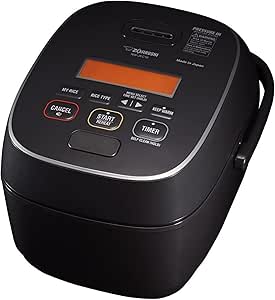
The NP-NWC10XB is the most advanced choice here for buyers drawn to pressure cooking as well as induction heat. Its AI-adjusted cycles adapt cooking to the rice, while pressure induction aims for a more involved cooking process than the standard induction design of the NW-QAC10. That extra sophistication suits households that cook rice often and want a broad menu of rice styles rather than a simple one-button appliance. The detachable, washable stainless-steel inner lid is a practical plus for regular maintenance. Compared with the smaller NP-GBC05XT, it offers a full 5.5-cup capacity, but the listed dimensions make it a much larger commitment on the counter. Its 1240-watt draw and 120-volt requirement also make outlet compatibility worth checking.
Pros:- Pressure induction heating with AI-adjusted cooking cycles
- Multiple menu options for different rice types and styles
- Detachable, washable stainless-steel inner lid
- 5.5-cup capacity suits shared meals
Cons:- Large listed dimensions demand substantial counter or storage space
- More complex technology may be unnecessary for occasional rice cooking
- 120-volt requirement limits use where that supply is unavailable
Best for: Frequent rice cooks who want pressure-induction technology, adaptive cooking cycles, and capacity for several servings.
Not ideal for: Apartment cooks with limited counter space, or international buyers whose power supply is not 120 volts.
- Capacity:5.5 cups
- Heating system:Pressure induction heating
- Power:1240 watts
- Voltage:120 volts
- Dimensions:16.5 × 15.38 × 10.13 inches
- Weight:13 pounds
- Exterior color:Stainless Black
- Inner lid:Detachable, washable stainless steel
- Made in:Japan
Our verdict“Pick the NP-NWC10XB if pressure-induction cooking and adaptive cycles matter more to you than a compact footprint.”
Zojirushi NP-GBC05XT Induction Heating System Rice Cooker and Warmer, 0.54 L, Stainless Dark Brown
For one or two people who still want induction heating, the NP-GBC05XT brings a more premium cooking approach to a distinctly small capacity. Its 0.54-liter bowl and menu choices for white rice, sushi rice, porridge, and brown rice make it more specialized than the three-cup Zojirushi Micom Compact, which emphasizes convenient portability and settings such as steel-cut oatmeal. Automatic keep-warm and a delay timer help fit rice around a small household’s schedule. The stainless-steel exterior also gives it a more refined look than a basic compact cooker. The catch is capacity: it is not a practical choice for family portions or batch cooking. It also requires hand washing, and the induction hardware means this small format is still a premium-minded purchase.
Pros:- Induction heating in a compact 0.54-liter format
- Settings include white, sushi, porridge, and brown rice
- Automatic keep-warm and delay timer support flexible meal timing
- Stainless-steel exterior
Cons:- Limited capacity cannot readily serve larger households
- Hand washing adds cleanup work
- Small size does not make its premium induction feature set necessary for every buyer
Best for: Singles or couples who want induction-cooked rice and varied grain settings without a full-size cooker.
Not ideal for: Families, meal-preppers, or anyone who wants dishwasher-friendly maintenance or frequent large batches.
- Capacity:0.54 liters
- Power:700 watts
- Voltage:120 volts
- Heating system:Induction heating
- Dimensions:9.13 × 11.88 × 7.5 inches
- Weight:8 ounces (listed)
- Material:Stainless steel
Our verdict“Choose the NP-GBC05XT if you cook small portions but still want induction heat and dedicated grain settings.”
Zojirushi Micom 3-Cup Compact Rice Cooker and Warmer
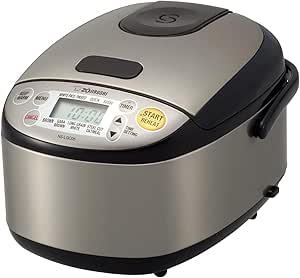
The Zojirushi Micom 3-Cup favors easy storage and transport over the induction performance of the NP-GBC05XT. Its fold-down handle and retractable cord make it especially appealing for couples, small households, or cooks who need to put the appliance away between meals. The menu selection reaches beyond rice, with settings for steel-cut oatmeal, brown rice, and long-grain white rice. Against the induction-equipped NP-GBC05XT, this model gives up induction heating and has a larger stated capacity, while offering more obvious portability features. Its 450-watt power rating and three-cup capacity fit modest cooking needs, not big family meals. Hand washing is another compromise, and buyers looking for pressure cooking or a more advanced heating system should step up to the NP-NWC10XB.
Pros:- Three-cup capacity suits small households
- Settings include steel-cut oatmeal, brown rice, and long-grain white rice
- Fold-down handle and retractable cord ease storage and transport
- Compact dimensions fit more readily into limited storage
Cons:- Limited capacity is poorly suited to larger households
- Does not offer the induction heating found in the NP-GBC05XT
- Hand washing is required for maintenance
Best for: Couples and small households who value easy storage, transport, and specialized settings for everyday grains.
Not ideal for: Large families, induction-seeking buyers, or anyone who wants a cooker suited to frequent batch cooking.
- Capacity:3 cups
- Power:450 watts
- Voltage:120 volts
- Dimensions:11.8 × 9.1 × 7.5 inches
- Weight:16 ounces (listed)
- Color:Stainless Black
- Portability features:Fold-down handle and retractable power cord
Our verdict“Pick this Micom if compact storage and portability matter more than induction heating or family-size capacity.”
Zojirushi NS-ZCC10 Neuro Fuzzy Rice Cooker and Warmer
The NS-ZCC10 Neuro Fuzzy makes sense for buyers who want automated cooking flexibility without stepping up to pressure induction. Its computerized fuzzy-logic system adjusts cooking, and its menu includes white, mixed, porridge, and brown rice alongside automatic keep-warm and delay-timer functions. The spherical nonstick inner pan is a distinct design choice within this group, while the LCD panel gives the controls a clear, dedicated interface. Compared with the NW-QAC10, it lacks induction heat and the listed steaming accessories, but it still covers several common rice styles in a 5.5-cup format. It is less advanced than the pressure-induction NP-NWC10XB, which adds pressure and AI-driven cycles. The tradeoffs are its sizable countertop footprint and the need to measure carefully with the supplied cups.
Pros:- Neuro Fuzzy logic adjusts computerized cooking cycles
- Menus include white, mixed, porridge, and brown rice
- Automatic keep-warm and delay timer support planned meals
- Spherical nonstick inner pan and LCD control panel
Cons:- Lacks induction heating available in the NW-QAC10
- Larger footprint may be awkward in a compact kitchen
- Accurate measuring with the included cups is needed for consistent results
Best for: Households wanting a 5.5-cup computerized cooker for varied rice menus, delayed cooking, and automatic warming.
Not ideal for: Buyers seeking induction or pressure cooking, or cooks with very limited counter space.
- Capacity:5.5 cups uncooked
- Power:680 watts
- Voltage:120 volts
- Dimensions:10.125 × 13 × 8.125 inches
- Inner pan:Spherical nonstick
- Material:Plastic and metal
- Controls:LCD control panel
- Features:Automatic keep-warm, delay timer, and multiple menu settings
- Included accessories:Measuring cups, rice paddle, and lid
Our verdict“Choose the NS-ZCC10 if you want a capable computerized 5.5-cup cooker but do not need induction or pressure cooking.”
Zojirushi NS-TSC10 5.5-Cup Micom Rice Cooker and Warmer
The NS-TSC10 is a strong fit for buyers who want a polished, flexible cooker without moving up to pressure induction technology. Its micom fuzzy logic adjusts the cooking cycle, while the steam setting, delay timer, and keep-warm function cover more than basic rice preparation. Compared with the more advanced Zojirushi NW-JEC10BA, it gives up pressure and induction heating, but its simpler feature set may suit cooks who want capable automation without as much complexity. The 5.5-cup uncooked capacity works for regular household meals, though the body is sizable for a countertop appliance and does not offer the headroom of the Zojirushi Micom 10-Cup. I’d choose it for dependable multi-use cooking, not for the smallest kitchen or the most ambitious rice-focused setup.
Pros:- Fuzzy-logic cooking adjusts the cycle for more consistent rice
- Steam menu and included basket add another practical cooking use
- Delay timer and automatic keep warm support flexible meal timing
- Stainless steel exterior is straightforward to wipe clean
Cons:- Its footprint is substantial for a cooker with a 5.5-cup uncooked capacity
- Lacks the pressure and induction heating offered by the NW-JEC10BA
- Capacity may fall short for households cooking large batches
Best for: Households seeking a versatile, mid-capacity cooker with fuzzy-logic rice programs, steaming, and scheduled cooking.
Not ideal for: Buyers with very limited counter space or large families who regularly need more than 5.5 cups of uncooked rice.
- Capacity:1.0 liter; 5.5 cups uncooked
- Power:610 watts
- Voltage:120 volts
- Dimensions:14 x 10-1/8 x 8-1/2 inches
- Weight:9.5 pounds
- Exterior material:Stainless steel
- Included accessories:Measuring cup, spatula, spatula holder, and steaming basket
Our verdict“Choose the NS-TSC10 if you want an adaptable, automated everyday cooker and do not need pressure induction or a larger batch capacity.”
KitchenAid Compact 8-Cup Grain & Rice Cooker with Integrated Scale (KGC2154PL)
Where the Zojirushi models in this group lean on rice-specific cooking programs, the KitchenAid Compact Grain & Rice Cooker makes measurement the main convenience. Its integrated scale weighs ingredients and calculates the water-to-grain ratio, so cooks can add grains and liquid directly rather than juggling a cup and separate measuring tools. The touchscreen prompts and 16 presets also make it approachable for people who cook beans and other grains alongside rice. Its 9-inch width is notably narrower than the Zojirushi NS-TSC10, while the stated capacity reaches 8 cups of cooked grains. That compact footprint comes with a tradeoff: it offers less batch capacity than the 10-cup Zojirushi Micom and is not the rice-specialist choice of the NW-JEC10BA. I’d pick it for a tidy, multi-grain kitchen workflow.
Pros:- Integrated scale calculates water ratios without separate measuring cups
- Narrow 9-inch width suits crowded countertops
- Sixteen presets support a range of grains and cooking tasks
- Ceramic-coated pot is dishwasher safe, and a steam basket is included
Cons:- Eight cups of cooked grains may not cover larger family meals or batch cooking
- At 6.7 pounds, it is relatively heavy for a compact countertop appliance
- Its broad grain-and-bean focus may be less appealing to buyers seeking a dedicated rice specialist
Best for: Apartment cooks and small households who prepare rice, grains, or beans and value built-in measuring guidance.
Not ideal for: Large families needing bigger rice batches or buyers who prioritize specialized rice cooking over multi-grain convenience.
- Capacity:Up to 8 cups cooked grains
- Power:700 watts
- Voltage:120 volts
- Dimensions:12 x 9 x 8.7 inches
- Weight:6.7 pounds
- Presets:16
- Pot:Non-stick ceramic-coated; dishwasher safe
- Integrated scale:Yes
Our verdict“Pick the KitchenAid if compact dimensions and guided grain measurements matter more to you than large capacity or advanced rice-specific heating.”
Zojirushi NW-JEC10BA Pressure Induction Heating (IH) Rice Cooker & Warmer, 5.5-Cup, Made in Japan
The NW-JEC10BA is the most technically ambitious pick here for buyers who make rice often and want the cooking process to adapt closely to each batch. Pressure cooking and induction heating work alongside AI fuzzy logic, which adjusts cooking cycles rather than relying on a simpler fixed program. That puts it above the NS-TSC10 in cooking technology, while the 5.5-cup capacity keeps it aimed at households rather than large-scale batch cooking. It is also more involved than the Zojirushi Micom 10-Cup: the extra cooking controls offer more room to tune results, but may feel like unnecessary complexity if you mainly need dependable everyday rice. The detachable, washable inner lid helps with cleanup. I’d reserve this premium-style choice for rice enthusiasts who will make use of its more advanced heating approach.
Pros:- Pressure induction heating offers a more advanced approach than the NS-TSC10’s micom system
- AI fuzzy logic adjusts cooking cycles
- Detachable, washable inner lid supports more direct cleaning
- Includes measuring cup, spatula, and spatula holder
Cons:- The range of features can take time to learn
- 5.5-cup capacity is restrictive for large households and batch cooking
- Its premium technology is hard to justify for cooks who mostly make basic rice
Best for: Rice-focused cooks who want pressure induction heating, adaptive cooking, and a 5.5-cup household capacity.
Not ideal for: Buyers who want simple one-touch operation, need large family-sized batches, or do not value advanced cooking technology.
- Capacity:5.5 cups
- Heating:Pressure induction heating
- Power:700 watts
- Voltage:120 volts
- Dimensions:13.62 x 10.75 x 8.5 inches
- Materials:Stainless steel and plastic
- Inner lid:Detachable and washable
- Model number:NW-JEC10BA
Our verdict“Choose the NW-JEC10BA if rice quality and pressure-induction features justify a more complex cooker for your household.”
Zojirushi Micom 10-Cup Rice Cooker and Warmer, White
The Zojirushi Micom 10-Cup makes the clearest case for households that need more rice per cycle. Its 10-cup capacity gives it a practical advantage over the 5.5-cup NS-TSC10 and NW-JEC10BA, while fuzzy logic and dedicated brown-rice and sushi settings give cooks options beyond a basic white-rice program. An easy-to-read LCD, timer, and keep-warm function make routine meal planning straightforward. The tradeoff is size: at more than 14 inches deep, it takes up more counter space than the compact KitchenAid, and its listed cleaning requirement is hand washing. It also lacks the pressure induction system of the NW-JEC10BA, so this is a capacity-first choice rather than the most technically advanced one. I’d favor it when serving several people matters more than compact storage or premium heating methods.
Pros:- 10-cup capacity outpaces the 5.5-cup Zojirushi models in this group
- Fuzzy logic supports consistent cooking across rice types
- Brown-rice and sushi settings extend its usefulness
- LCD, timer, and keep-warm function simplify meal planning
Cons:- Its 14.38-inch depth takes considerable counter or storage space
- Cleaning requires hand washing
- Does not have the pressure induction heating found in the NW-JEC10BA
Best for: Families and frequent hosts who cook varied rice types and want a larger batch capacity with guided programs.
Not ideal for: Small-kitchen cooks, or buyers who want pressure induction heating and dishwasher-friendly cleanup.
- Capacity:10 cups
- Power:700 watts
- Voltage:110 volts
- Dimensions:14.38 x 11 x 9.88 inches
- Weight:9 pounds
- Color:White
- Inner pan:Non-stick
- Settings:Includes brown-rice and sushi programs
Our verdict“Choose this Micom model if your household needs larger rice batches and can make room for a full-size cooker.”
Zojirushi NS-TPC10XT Micom Rice Cooker & Warmer, 5.5-Cup, Stainless Brown
The NS-TPC10XT is a fit for cooks who want more than plain rice from a mid-capacity cooker. Its menu includes sushi, brown rice, porridge, and cake, giving it a broader kitchen role than the capacity-focused Zojirushi Micom 10-Cup. Fuzzy logic, an LCD, delay timing, and automatic keep warm handle everyday cooking, while the stainless brown exterior brings a more finished look than a basic plastic-bodied appliance. Compared with the NW-JEC10BA, it does not offer pressure induction heating, so its appeal is menu variety and familiar micom automation rather than the most advanced rice-cooking hardware. The 5.5-cup capacity is also a poor match for large gatherings, and its 14-inch depth still takes meaningful counter space. I’d choose it for varied small-to-medium household cooking, not for compact storage or large batches.
Pros:- Specialty menus include sushi, brown rice, porridge, and cake
- Fuzzy logic supports adjusted cooking cycles
- Automatic keep warm and delay timer help with meal timing
- Stainless brown exterior and detachable lid simplify routine care
Cons:- 5.5-cup capacity is limiting for large families and entertaining
- Its 14-inch depth may be awkward on crowded counters
- Does not match the NW-JEC10BA’s pressure induction heating
Best for: Cooks in small or medium households who want micom automation and programs for porridge, sushi rice, and cake.
Not ideal for: Large families needing 10-cup batches or buyers seeking pressure induction heating in a premium rice-focused cooker.
- Capacity:5.5 cups
- Power source:Corded electric
- Dimensions:14 x 10.13 x 8.63 inches
- Exterior material:Stainless steel
- Lid material:Plastic
- Color:Stainless brown
- Cooking programs:White rice, sushi, brown rice, porridge, and cake
- Included components:Steaming basket, rice measuring cup, nonstick rice spatula, and spatula holder
Our verdict“Pick the NS-TPC10XT if specialty menus and a refined stainless finish matter more than large capacity or pressure induction.”
Cuckoo High Pressure Rice Cooker, 12-Cup Cooked, Black, CRP-P0609S
For households that want large batches and fast pressure cooking, this Cuckoo is the strongest fit in this group. Its 12-cup cooked capacity exceeds the 10-cup Zojirushi NL-GAC18 BM and Cosori, while 29 PSI pressure cooking is aimed at speeding up preparation. Thirteen modes give families room to cook more than plain white rice, though the menus take more learning than the KitchenAid’s automatic grain-and-water sensing. The stainless-steel construction and included measuring cup and spatula add practical touches, but the 14.3-pound body is less convenient to move or store than the lighter Cosori. I’d choose it for frequent family meals, not for cooks seeking a simple, compact appliance; its pressure-focused feature set may be more than occasional rice eaters need.
Pros:- 12-cup cooked capacity suits larger households and batch cooking.
- 29 PSI pressure level supports faster cooking than a basic rice cooker.
- Thirteen cooking modes cover multiple rice styles.
- Includes a measuring cup and spatula for everyday use.
Cons:- At 14.3 pounds, it is heavy to move and store.
- Multiple modes and pressure settings can take time to learn.
- The feature-rich design is more involved than a simple rice-only cooker.
Best for: Families who routinely cook large rice portions and want pressure-assisted cooking with several menu options.
Not ideal for: Small households or cooks who want a lightweight, straightforward cooker that is easy to put away.
- Capacity:12 cups cooked
- Power:890 watts
- Pressure level:29 PSI (200 KPa)
- Voltage:110 volts
- Material:Stainless steel
- Dimensions:14.2 × 10.1 × 11.6 inches
- Weight:14.3 pounds
- Model:CRP-P0609S
Our verdict“Choose the Cuckoo if your priority is fast, high-capacity pressure cooking and you are comfortable learning a more involved appliance.”
Cosori 10-Cup Rice Cooker with Fuzzy Logic and Ceramic Coating Inner Pot
The Cosori earns its place through breadth beyond rice: its 18 functions include steaming, slow cooking, and sautéing, giving it a more all-purpose role than the Zojirushi NL-GAC18 BM’s rice-focused menu. Fuzzy logic adjusts cooking to support consistent results, while the ceramic-coated inner pot and stainless-steel steamer basket make the setup useful for grain-and-vegetable meals. A 24-hour delay timer helps plan ahead, and the listed dishwasher-safe accessories ease cleanup. The tradeoff is that this broad menu can feel busy for someone who mainly wants a push-button rice cooker. At 9.3 pounds it is lighter than the Cuckoo, but its stated footprint still takes meaningful counter space. I’d favor it when one appliance needs to cover several cooking tasks; dedicated rice cooks may prefer a simpler interface.
Pros:- Eighteen functions include steaming, sautéing, and slow cooking.
- Fuzzy logic supports consistent cooking across different settings.
- Ceramic-coated pot and stainless-steel steamer basket expand cooking options.
- 24-hour delay timer helps coordinate meal preparation.
Cons:- The broad feature set may be confusing for users who only cook rice.
- Its dimensions may be cumbersome in a small kitchen.
- The data does not specify a pressure-cooking feature found on the Cuckoo.
Best for: Home cooks who want one countertop appliance for rice, steaming, sautéing, and slow-cooked dishes.
Not ideal for: Buyers with limited counter space or anyone who wants a simple cooker focused mostly on rice.
- Capacity:10 cups
- Power:1000 watts
- Voltage:AC 120V, 60Hz
- Weight:9.3 pounds
- Dimensions:12.3 × 10.6 × 9.2 inches
- Inner pot:Ceramic coating
- Warranty:2 years
- Model:CRC-R501-KUS
Our verdict“Pick the Cosori if you will use its extra cooking modes regularly; choose a more focused model if rice is its only job.”
KitchenAid 8 Cup Grain and Rice Cooker with Integrated Scale, Porcelain White
The KitchenAid’s defining advantage is its integrated scale and water tank: it senses the amount of grain, rice, or beans and dispenses the matching water, reducing measuring work. That makes it a more guided choice than the Cosori, whose 18 functions offer wider cooking flexibility but leave more decisions to the cook. Its 21 presets and 24-hour delayed start also suit households that rotate among grains and want a planned cooking schedule. The limit is capacity: at 8 cups, it trails the Cuckoo’s 12 cups and the 10-cup Zojirushi NL-GAC18 BM, so it is less suited to large family batches. The plastic construction may also feel less substantial than stainless-steel-bodied alternatives. I’d put it on the shortlist for convenience-focused grain eaters, not buyers who want the biggest capacity or pressure cooking.
Pros:- Integrated scale and water dispensing reduce measuring and ratio guesswork.
- Twenty-one presets cover a range of grains and beans.
- 24-hour delayed cooking supports flexible meal planning.
- Included steamer basket adds another cooking option.
Cons:- 8-cup capacity is smaller than the Cuckoo and 10-cup models in this group.
- Plastic body and lid may feel less premium than metal-built alternatives.
- The product data does not list a power rating beyond 700 watts or a pressure feature.
Best for: Cooks who prepare different grains or beans and value automatic water measurement over manual ratios.
Not ideal for: Large households needing more than 8 cups or buyers seeking a pressure-cooking rice cooker.
- Capacity:8 cups
- Power:700 watts
- Voltage:120 volts
- Material:Plastic
- Dimensions:9.75 × 13.5 × 8.88 inches
- Weight:10.5 pounds
- Model:KGC3155PL
- Included components:Inner pot and steamer basket
Our verdict“Choose the KitchenAid for low-effort, measured grain cooking, but skip it if you need large batches or pressure-based performance.”
Zojirushi NL-GAC18 BM Umami Micom Rice Cooker & Warmer, 10-Cup, Metallic Black, Made in Japan
This Zojirushi is a strong match for cooks who care about specific rice styles and flavor-focused programming. Its UMAMI setting extends soaking and steaming, while dedicated choices include sushi, jasmine, congee, and GABA brown rice. That makes it more tailored to rice preparation than the Cosori, whose appeal is a wider mix of non-rice functions such as sautéing and slow cooking. The 10-cup capacity also sits between the KitchenAid’s 8 cups and the Cuckoo’s 12, a useful middle ground for many households. Its nonstick inner pan, detachable lid, and BPA-free steaming basket support easier cleanup and added flexibility. The tradeoff is a sizable footprint and a menu that may feel elaborate to first-time users. I’d choose it for varied rice routines, not for minimal-counter kitchens.
Pros:- UMAMI setting extends soaking and steaming for a more flavor-focused cycle.
- Menu includes specialty rice options, congee, steaming, and slow cooking.
- 10-cup capacity accommodates larger meals than the KitchenAid 8-cup model.
- Detachable lid and nonstick pan simplify routine cleaning.
Cons:- The 14.88-inch depth takes substantial counter space.
- Numerous menu choices can add a learning curve for beginners.
- Its capacity is below the 12-cup Cuckoo for the largest family batches.
Best for: Rice enthusiasts who regularly prepare specialty varieties such as sushi rice, jasmine, congee, and GABA brown rice.
Not ideal for: First-time rice-cooker owners wanting a very simple menu, or households with little counter space.
- Capacity:10 cups (1.9 quarts)
- Wattage:880 watts
- Voltage:120 volts
- Dimensions:14.88 × 10.13 × 8.75 inches
- Weight:10 pounds
- Color:Metallic black
- Inner pan:BPA-free, nonstick
- Model:NL-GAC18 BM
Our verdict“Pick this Zojirushi for a generous capacity and dedicated specialty-rice programs, provided its size and menu complexity suit your kitchen.”
Zojirushi NW-YNC10WA Induction Rice Cooker and Warmer 5.5 Cup, White
Among these larger-capacity cookers, the Zojirushi NW-YNC10WA is the smaller-batch induction specialist. Its 5.5-cup capacity makes more sense for couples or smaller households than the Cuckoo’s 12 cups or the NL-GAC18 BM’s 10. Induction heating and pressurized cooking are designed to produce fluffy, sticky rice, while settings for sushi and congee give it more range than a basic compact model. The stainless-steel-clad, aluminum inner pan with double nonstick layers is a durable, carefully specified cooking surface, and the self-cleaning function can help manage lingering odors. That performance comes with a 1240-watt draw and a 12-pound weight, so it is compact in serving capacity rather than especially light. I’d choose it for premium rice preparation in smaller portions, not for big family batches.
Pros:- Induction heating and pressurized cooking target fluffy, sticky rice.
- 5.5-cup capacity suits smaller households better than the larger Cuckoo and Zojirushi models.
- Menu includes white rice, sushi rice, and congee.
- Self-cleaning function helps reduce lingering odors.
Cons:- 5.5-cup capacity is limiting for large households and batch cooking.
- 1240-watt power rating is the highest among these five listed models.
- At 12 pounds, it is not especially light despite its smaller capacity.
Best for: Couples and small households seeking induction and pressure-assisted rice cooking for frequent, smaller batches.
Not ideal for: Families that routinely serve large groups, or buyers who prioritize low power use and a lightweight appliance.
- Capacity:5.5 cups
- Power:1240 watts
- Voltage:120 volts
- Inner pan:Stainless-steel clad, aluminum, double nonstick layers
- Dimensions:14.5 × 9.88 × 8.13 inches
- Weight:12 pounds
- Color:White
Our verdict“Choose this Zojirushi for induction-and-pressure cooking in smaller portions, but pick a larger-capacity model for family-scale meals.”

How We Picked
I compared these 15 models by the factors that change daily ownership: heating method, capacity, control complexity, and cooking versatility. I gave more weight to features that have a clear use case than to specifications that sound premium on their own. For example, induction and pressure heating can appeal to cooks seeking more deliberate control, while Micom models may be easier to live with when the goal is reliable, low-effort rice. I also considered whether the product’s format fits a particular kitchen, from the compact 3-cup Zojirushi to larger-capacity choices and the grain-focused KitchenAid cookers.
The ranking favors models with a persuasive balance of capability and everyday usefulness, rather than simply placing the most feature-rich machines first. That puts the NW-QAC10 in the lead as a versatile induction choice, with pressure-induction options placed for buyers who specifically value that cooking approach. Compact, beginner-friendly, and larger-batch models earn their places by serving distinct needs, while each carries tradeoffs such as reduced capacity, added complexity, or a narrower fit. I treated listed capacity and named features as decision aids, not as proof that one cooker will suit every rice variety or household.
Factors to Consider When Choosing Luxury Rice Cookers
Luxury is most useful when it solves a recurring kitchen problem. I’d choose a rice cooker by matching its heating approach and size to the meals I actually make, then checking how much attention and cleanup I’m willing to take on.
Choose Heating Technology for Your Routine
Induction and pressure-induction models are aimed at cooks who want more involved control over how rice is heated, while Micom models emphasize automated cooking programs and ease. That distinction matters more than a long list of menu names if you mostly prepare one or two familiar rice styles. Before paying for advanced heating, ask whether you will use the cooker’s more specialized programs or simply want it to cook rice while you handle dinner. A common mistake is treating pressure or induction as automatically better for every cook; the added capability has little value if your usual routine does not call for it. If you enjoy experimenting with rice textures and settings, advanced models may justify their complexity. If you want a dependable daily appliance with fewer decisions, a Micom cooker may be the more satisfying choice.
Size the Cooker to Your Normal Batch
Capacity labels are easy to compare, but the right choice depends on how often you cook rice and whether you make extra portions. A compact cooker can suit a small household and save counter space, while a larger model gives families more room to prepare a batch for multiple meals. Bigger is not automatically more luxurious: an oversized appliance can occupy valuable storage space when most batches are small. Also check whether the listed capacity is measured in uncooked rice, cooked rice, or another convention before comparing products. Think through your busiest realistic meal, not an imagined gathering that happens once a year. For everyday cooking, a close fit between typical batch size and cooker capacity can make the appliance easier to store and use.
Separate Rice Specialization From Grain Versatility
Some premium cookers concentrate on rice-specific programs, while the KitchenAid Grain & Rice Cooker models highlight a grain-oriented workflow with an integrated scale. That difference can shape your purchase more than brand preference if you regularly cook grains beyond rice. A scale may simplify measuring, but it does not replace checking which ingredients and recipes the cooker is designed to handle. Conversely, a rice-focused machine may be a better fit if rice is the main reason you want a dedicated appliance. Avoid buying a broad menu on the assumption that every setting will see regular use. List the grains you actually prepare, then match the appliance’s stated functions to those habits.
Account for Controls, Cleaning, and Counter Space
Luxury appliances still have to fit into a real kitchen, and a complicated control panel can become a daily nuisance if you prefer one-touch cooking. Compare the amount of setup you are comfortable with against the programs you are likely to use. Before choosing a large cooker, measure both its countertop footprint and the storage space needed for its lid and accessories. Check the care instructions for the inner pot and removable parts, since maintenance can matter as much as cooking performance over years of use. A model with more features may bring more components or steps to clean, so do not judge convenience by the cooking cycle alone. Choose the level of automation you will welcome rather than the one with the longest feature list.
Pay More Only for a Feature You Will Use
A higher-end cooker makes sense when its heating system, capacity, or specialized programs solve a real need in your kitchen. It is harder to justify extra complexity if your main requirement is a pot of everyday rice with minimal setup. Compare premium options by asking what changes in your routine: more control over cooking, a larger batch, a compact footprint, or a way to measure grains. Be cautious about assuming that a more advanced machine will make every rice type better, since results also depend on the grain, water measurement, and settings. Buyers who cook rice often may value precision and dedicated programs more than occasional users do. A simpler model can be the more considered purchase when it meets the household’s actual needs.
Frequently Asked Questions
Is an induction rice cooker worth choosing over a Micom model?
It can be, if you want the heating approach and cooking control associated with induction and expect to use the cooker often. The NW-QAC10 and NW-YNC10WA represent induction choices, while Micom models such as the NS-TSC10 focus on automated cooking convenience. The practical question is whether induction features match your rice habits, not whether the technology sounds more advanced. If you mainly want simple everyday operation, a Micom model may be easier to justify. If you value a more specialized cooking setup, compare the induction models’ capacity and controls before deciding.
Should I choose a pressure-induction model if I mostly cook plain white rice?
Not necessarily: pressure-induction models are best treated as specialized options for shoppers who want their particular cooking method and programs. The NP-NWC10XB and NW-JEC10BA stand out in that group, but the lineup also includes less complex induction and Micom alternatives. If your meals rarely call for anything beyond familiar white rice, the extra functionality may not change your routine enough to matter. Consider how often you will use the features you are paying for and how comfortable you are with additional controls. A less elaborate cooker may be a better fit when simplicity is your main goal.
How do I choose between a compact cooker and a 10-cup model?
Start with the batch size you make on an ordinary weeknight, then think about how often you cook ahead or serve a larger group. The Zojirushi Micom 3-Cup Compact model fits space-conscious kitchens and smaller portions, while the lineup’s 10-cup choices give more room for larger batches. Check how the capacity is defined before comparing labels, since rice cookers may describe uncooked and cooked amounts differently. A large cooker is useful when you regularly need its capacity, but it can be an awkward fit for a small counter and small meals. Choose for your recurring routine rather than rare occasions.
Are the KitchenAid grain cookers a better choice if I make more than rice?
They may be a better match if the integrated scale and grain-focused workflow fit the way you prepare meals. The KitchenAid models offer a different emphasis from Zojirushi’s broad range of rice-specific formats and heating approaches. Before choosing one, confirm that its stated functions suit the grains and recipes you make; a scale alone does not guarantee that every grain is supported in the way you expect. If rice remains your main use, a dedicated rice cooker may be a more direct fit. Your decision should follow your actual menu, not the assumption that a multipurpose label always means greater usefulness.
What should I check before choosing a luxury rice cooker for a small kitchen?
Measure the counter area where the cooker will sit and the cupboard space where it will live between uses. Capacity is only part of the footprint: the lid, cord, and any removable components can affect storage and handling. A compact model such as the 3-cup Zojirushi is designed for a different kitchen need than a 10-cup cooker. Also think about whether you want to keep the appliance accessible or will need to move it frequently. For a tight kitchen, a cooker you can store and set up comfortably may be more useful than one with features you rarely use.
Conclusion
For the strongest all-around balance, I’d choose the Zojirushi NW-QAC10, a practical starting point for buyers seeking induction heating in an everyday capacity. The best value in capability is the Zojirushi NS-TSC10 if straightforward Micom convenience matters more than pressure or induction specialization. For a premium, pressure-focused pick, compare the NP-NWC10XB and NW-JEC10BA by their capacity, controls, and fit with your cooking habits. Beginners are better served by a simpler Micom model than by paying for advanced programs they may not use. For small kitchens, look at the compact 3-cup Zojirushi; for grain-focused cooking, consider KitchenAid’s integrated-scale models; and for larger batches, compare the 10-cup options. Choose the cooker whose capacity, cooking method, and daily upkeep suit your routine—not simply the one with the most features.
Black Friday Picks

Therabody Theragun Prime 6th Generation Deep Tissue Massage Gun, Black
As an affiliate, we earn on qualifying purchases.