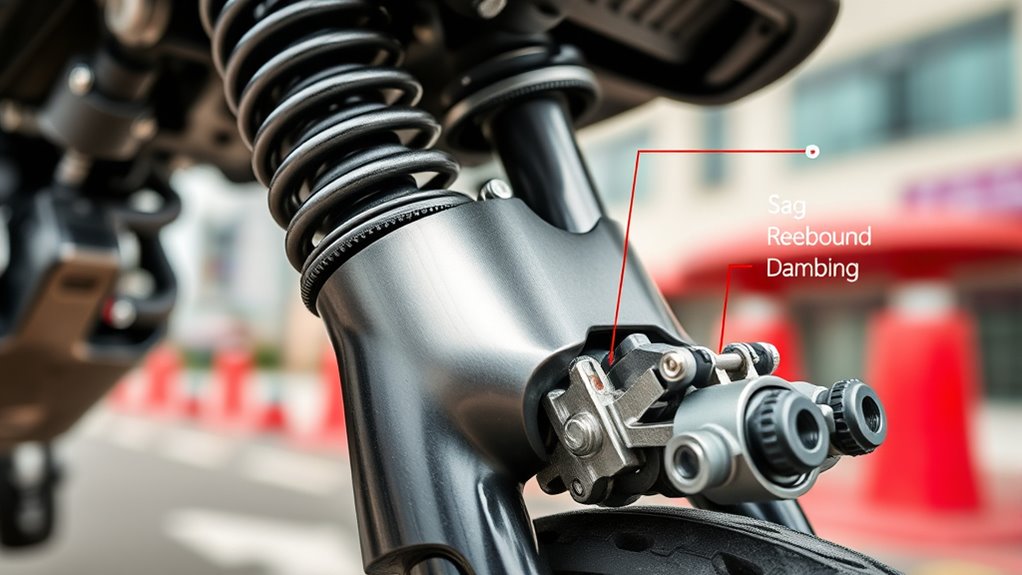

To optimize your bike’s suspension, you need to understand sag, rebound, and compression damping. Sag measures how much the suspension compresses under your weight, and setting it correctly guarantees smooth handling. Rebound controls how fast the suspension extends after compression, affecting ride stability. Compression damping manages how the suspension absorbs impacts, balancing comfort and responsiveness. Fine-tuning these settings will improve performance and comfort, and exploring each adjustment further can help you master your bike’s suspension system.
Key Takeaways
- Sag measures suspension compression under rider’s weight, ensuring optimal ride comfort and handling.
- Rebound controls how quickly suspension extends after compression, affecting ride smoothness and traction.
- Compression damping manages the suspension’s response to bumps, balancing impact absorption and responsiveness.
- Proper shock tuning involves adjusting spring rate, rebound, and compression for rider weight and terrain.
- Small adjustments in rebound and compression significantly improve handling and ride quality when properly set.
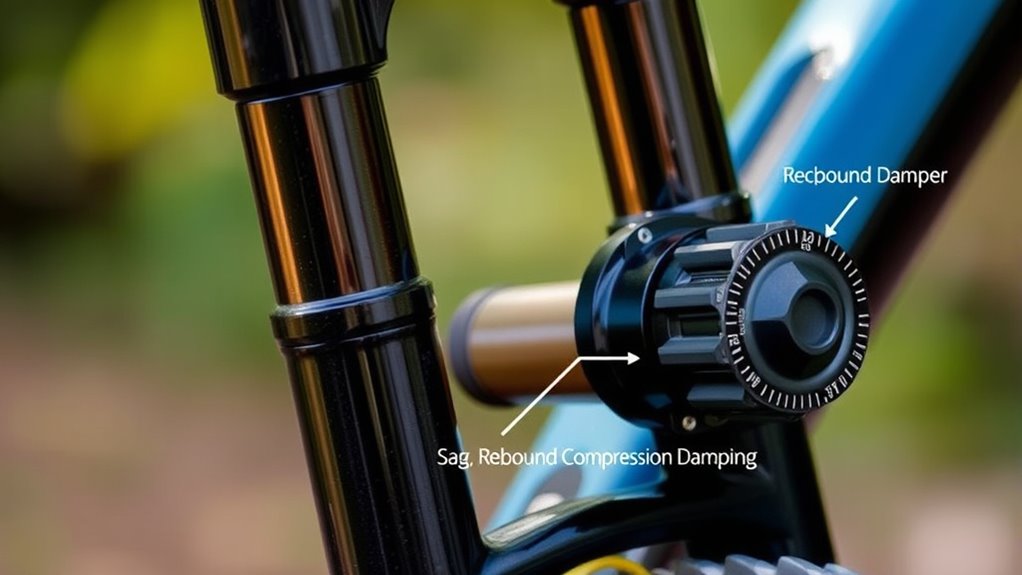
Understanding sag, rebound, and compression damping is essential for optimizing your suspension system‘s performance. These factors directly influence how your bike or vehicle handles terrain, comfort, and stability. To achieve optimal performance, you need to focus on shock tuning, which involves adjusting the spring rate and damping settings to match your riding style and weight. The spring rate determines how stiff or soft your suspension feels; a proper balance ensures that your suspension neither bottoms out nor feels overly rigid. When you set the correct spring rate, you create a foundation for effective shock tuning, making it easier to fine-tune rebound and compression damping.
Proper shock tuning balances spring rate, rebound, and compression damping for optimal handling and comfort.
Sag is the initial setting that indicates how much your suspension compresses under your body weight when you’re seated on the bike or vehicle. Proper sag ensures that your suspension is neither too stiff nor too soft, providing just enough travel to absorb bumps while maintaining control. To set sag correctly, you sit on your bike in your riding gear and measure how far the suspension compresses from its full extension. Adjustments to the spring rate may be necessary if the sag is outside the recommended range. Once you’ve achieved the right sag, you can proceed to fine-tune rebound and compression damping.
Rebound damping controls how quickly your suspension extends after compression. If rebound is too fast, the suspension will extend abruptly, causing a bouncy ride and reduced traction. Conversely, if it’s too slow, your suspension might stay compressed longer than necessary, leading to poor handling and increased rider fatigue. Adjusting rebound damping involves turning a knob or screw on your shock to control the flow of oil within the damper. Proper rebound settings allow your suspension to recover smoothly after hitting bumps, maintaining tire contact and rider comfort. Remember, rebound adjustment often requires iterative testing—small tweaks can make a significant difference.
Compression damping, on the other hand, manages how your suspension responds to bumps and impacts. Too stiff, and your ride becomes harsh; too soft, and you risk bottoming out or losing control. Fine-tuning compression damping helps you absorb impacts effectively without sacrificing responsiveness. This adjustment is particularly important when riding on rough terrain or jumps. Like rebound, compression damping is adjusted via a knob or screw, and small changes can dramatically improve your ride quality. The goal is to find a balance where your suspension cushions impacts without feeling sluggish or overly soft. Additionally, understanding the role of foraging range can be helpful if you’re considering terrain and environment when tuning your suspension for different conditions.
Frequently Asked Questions
How Does Damping Affect Ride Comfort on Different Terrains?
Damping greatly impacts your ride comfort across terrains by controlling how your suspension absorbs bumps. Different damping fluid properties, like viscosity, influence damping effectiveness, making your ride smoother or stiffer. Shock absorber materials also play a role, providing durability and consistent performance. When damping is properly tuned, it reduces jolts on rough terrain and maintains stability on smooth surfaces, ensuring you enjoy a comfortable, controlled ride regardless of conditions.
Can Damping Settings Be Adjusted While Riding?
Yes, you can adjust damping settings while riding to improve your riding experience. Many bikes and suspension systems allow for on-the-fly damping adjustments, giving you control over rebound and compression damping. By tweaking these settings in real-time, you can better handle different terrains and riding conditions. Just make sure you’re familiar with your suspension’s adjustment mechanisms, and proceed carefully to avoid affecting ride comfort or safety.
What Are the Signs of Improper Damping in Suspension?
Improper damping feels like riding on a bumpy road with potholes. You might notice your suspension feeling too stiff or too soft, causing poor handling. If you experience excessive bouncing after bumps or a lack of control during turns, it’s a sign. Adjustments to spring preload and shock linkage can help, but if these signs persist, your damping settings need fine-tuning to match your riding style.
How Does Suspension Damping Impact Bike Handling?
Your suspension damping directly affects your bike handling by controlling how the shock absorber responds to bumps and terrain. Proper damping guarantees a smooth, controlled ride, allowing you to maintain better traction and stability. If damping is too stiff or too soft, handling suffers, making steering less predictable. Adjusting the spring rate and shock absorber settings helps optimize damping, so your bike reacts precisely to your inputs, improving overall control.
Are There Different Damping Requirements for Mountain Biking and Road Cycling?
Yes, mountain biking and road cycling have different damping needs. You’ll want softer damping for mountain biking to absorb rough terrain, which allows for better control and comfort. For road cycling, the damping is firmer to enhance efficiency and handling on smooth surfaces. Adjusting your tire pressure and considering your frame geometry also plays a role in optimizing damping for each type of riding, ensuring you stay safe and comfortable.
Conclusion
Understanding sag, rebound, and compression damping helps you fine-tune your suspension for a smoother ride. When you adjust these settings, you’re not just optimizing performance—you’re enhancing safety and comfort. Isn’t it worth taking the time to get it just right? Remember, every small tweak can make a big difference on your journey. So, why settle for anything less than perfect control? Your ride deserves the best, and now you know how to achieve it.