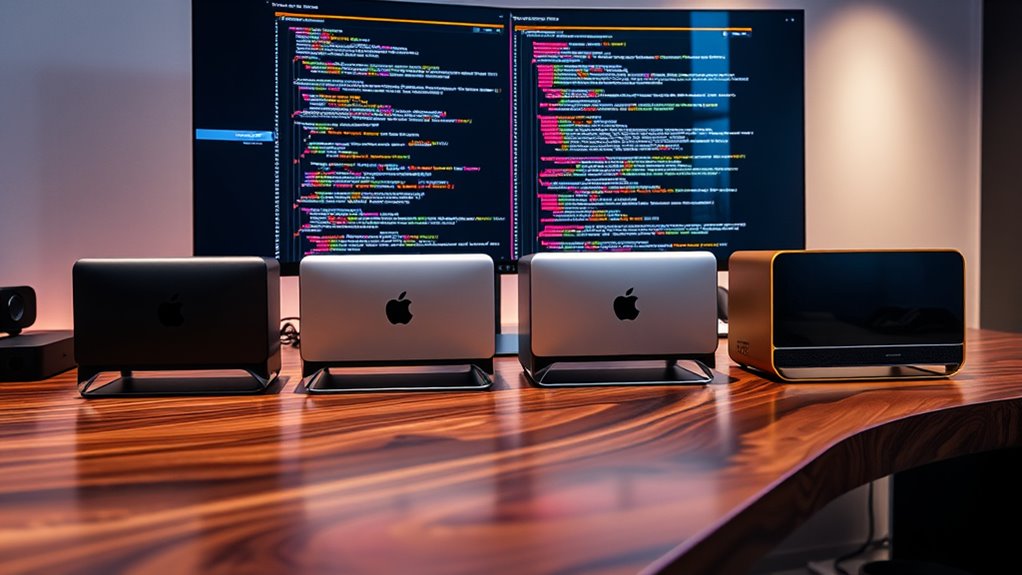

Choosing the right Mac Studio setup for machine learning in 2026 involves balancing raw power, display quality, and budget. The Apple 2024 iMac with M4 chip stands out for its integrated design and strong performance, but its limited storage may be a drawback for large datasets. The Mac Studio 2023 offers unmatched processing options with M2 Ultra, yet it lacks a built-in display, requiring additional investment. These picks are ideal for different needs—whether you prioritize all-in-one convenience or raw computational power—each has its tradeoffs.

Get sports gear delivered free — and shop member deals
- Fast, free delivery on millions of items
- Access to Prime Big Deal Days deals on October 6–7
- Prime Video, Amazon Music and more included
Complete the kit


Key Takeaways
- The Apple iMac with M4 chip is best for users seeking a sleek, integrated device with solid performance.
- Mac Studio 2023 offers more power with M2 Ultra but requires an external monitor, increasing overall cost.
- Storage capacity remains a key consideration, especially for large-scale machine learning tasks.
- Display quality is a strong point for iMacs, but Mac Studio requires a separate monitor.
- Budget-conscious buyers may need to consider additional hardware investments for Mac Studio.
| Apple 2024 iMac All-in-One Desktop Computer with M4 Chip, 24-inch Retina Display, 16GB Memory, 256GB SSD, Blue |  | Best All-in-One Machine for Efficiency and Aesthetics | Processor: M4 chip with 8-core CPU and 8-core GPU | Display: 24-inch Retina, 4.5K resolution | Memory: 16GB Unified Memory | VIEW ON AMAZON | See Our Full Breakdown |
| Apple 2024 iMac All-in-One Desktop Computer with M4 Chip, 24-inch Retina Display, 16GB RAM, 256GB SSD, Pink |  | Best for Stylish, Compact ML Setups | Processor: M4 chip with 8-core CPU and 8-core GPU | Display: 24-inch Retina, 4.5K resolution | Memory: 16GB Unified Memory | VIEW ON AMAZON | See Our Full Breakdown |
| Mac Studio 2023 (M2 Max & M2 Ultra) User Guide |  | Best for Power Users and Custom Setups | VIEW ON AMAZON | See Our Full Breakdown |
| mac studio for machine learning | Processor | Display | Memory | Storage |
|---|---|---|---|---|
| Apple 2024 iMac All-in-One Des | M4 chip with 8-core CPU and 8-core GPU | 24-inch Retina, 4.5K resolution | 16GB Unified Memory | 256GB SSD |
| Apple 2024 iMac All-in-One Des | M4 chip with 8-core CPU and 8-core GPU | 24-inch Retina, 4.5K resolution | 16GB Unified Memory | 256GB SSD |
| Mac Studio 2023 | — | — | — | — |
More Details on Our Top Picks
Apple 2024 iMac All-in-One Desktop Computer with M4 Chip, 24-inch Retina Display, 16GB Memory, 256GB SSD, Blue
The iMac with M4 chip stands out for its integrated design, combining a 24-inch Retina display with the latest M4 processor, making it perfect for users who want a machine that’s ready out of the box. Its 8-core CPU and GPU deliver quick performance for ML models that fit within its 256GB SSD, but the limited storage can be a bottleneck for handling large datasets. Compared with the Mac Studio, this option offers a cleaner setup but sacrifices expandability and storage capacity. Its vibrant display and seamless Apple ecosystem integration make it appealing for those who value simplicity and aesthetics.
Pros:- Strong M4 chip for fast processing
- Vibrant Retina display with accurate color
- Integrated design saves space
- Seamless Apple ecosystem integration
Cons:- Limited storage at 256GB SSD
- Higher price point relative to specs
- Less expandability for future upgrades
Best for: Users seeking a powerful, compact, and stylish machine with excellent display quality
Not ideal for: Heavy ML practitioners working with large datasets requiring extensive storage and expandability
- Processor:M4 chip with 8-core CPU and 8-core GPU
- Display:24-inch Retina, 4.5K resolution
- Memory:16GB Unified Memory
- Storage:256GB SSD
- Connectivity:Wi-Fi 6E, Bluetooth 5.3, Thunderbolt 4
- Color:Blue
Our verdict“Ideal for users prioritizing design and display quality over raw data handling capacity.”
Apple 2024 iMac All-in-One Desktop Computer with M4 Chip, 24-inch Retina Display, 16GB RAM, 256GB SSD, Pink
This pink iMac with M4 shares many features with its blue sibling but offers a more vibrant aesthetic that can brighten up any workspace. Its performance, driven by the same 8-core CPU and GPU, makes it suitable for similar ML tasks, but it also shares the same storage limitations. The main difference lies in its appearance, catering to users who want a machine that’s both powerful and visually distinctive. Like the blue version, it’s less suited for large datasets or future expandability but excels in delivering performance within a compact, colorful package.
Pros:- Powerful M4 chip
- Bright, attractive pink design
- Excellent display quality
- Fast connectivity options
Cons:- Limited storage at 256GB SSD
- Premium price for a compact all-in-one
- Not designed for heavy future upgrades
Best for: Design-conscious users who want a powerful machine with a splash of personality
Not ideal for: Heavy-data ML workflows needing extensive storage or hardware upgrades
- Processor:M4 chip with 8-core CPU and 8-core GPU
- Display:24-inch Retina, 4.5K resolution
- Memory:16GB Unified Memory
- Storage:256GB SSD
- Connectivity:Wi-Fi 6E, Bluetooth 5.3, four Thunderbolt 4 ports
- Color:Pink
Our verdict“A perfect choice for users who value style and performance in a compact form, not for large-scale data work.”
Mac Studio 2023 (M2 Max & M2 Ultra) User Guide
The Mac Studio 2023 isn’t a standalone computer but a manual designed for those who want to maximize their Mac Studio’s potential for ML tasks. It covers setup, macOS tips, and tricks to optimize performance, making it ideal for users who already own or plan to buy a Mac Studio. Compared to the iMacs, it offers significantly more power with options like the M2 Ultra, but it requires an external monitor, keyboard, and mouse, adding to the overall setup cost. This manual is invaluable for those comfortable customizing their hardware and software environment for demanding ML workloads.
Pros:- Detailed guidance for advanced setups
- Helps maximize Mac Studio performance
- Includes macOS optimization tips
- Suitable for power users
Cons:- No hardware included, just a guide
- Requires additional investment in hardware
- Limited to users comfortable with customization
Best for: Experienced users building a custom, high-performance ML workstation
Not ideal for: Beginners or those seeking an all-in-one solution with minimal setup
Our verdict“Best for experienced users looking to leverage maximum power from Mac Studio hardware, not for casual or novice users.”

How We Picked
Our selection process focused on hardware configurations optimized for machine learning workloads, including CPU and GPU performance, RAM capacity, and expandability. We prioritized Apple products with the latest chips—like the M4 and M2 Ultra—that deliver the processing speed and memory bandwidth needed for ML tasks. Cost considerations and user-friendliness also played roles, ensuring each pick suits different user profiles from beginners to power users.
| mac studio for machine learning | Connectivity | Color |
|---|---|---|
| Apple 2024 iMac All-in-One Des | Wi-Fi 6E, Bluetooth 5.3, Thunderbolt 4 | Blue |
| Apple 2024 iMac All-in-One Des | Wi-Fi 6E, Bluetooth 5.3, four Thunderbolt 4 ports | Pink |
| Mac Studio 2023 | — | — |
Factors to Consider When Choosing Mac Studio For Machine Learning
Choosing the right Mac setup for machine learning depends on your workload size, budget, and preference for all-in-one convenience versus raw power. This guide covers key factors like processing capability, display needs, storage, and expandability to help you identify the best fit for your ML projects.Processing Power and GPU
Machine learning benefits immensely from high CPU and GPU performance. The M4 chip in the latest iMacs provides a solid balance for moderate ML tasks, while the M2 Ultra in Mac Studio offers the computational muscle needed for intensive workloads. Consider your workload size and whether your ML models demand the highest processing power or can run efficiently on less capable hardware.
Display and User Experience
A high-quality display accelerates your workflow, especially for data visualization and model tuning. The 24-inch Retina displays in the iMacs deliver stunning visuals but come with fixed hardware options. If you prefer a larger or more customizable display environment, the Mac Studio paired with a high-resolution monitor offers flexibility but adds to the total cost.
Storage and Expandability
Large datasets common in machine learning require ample storage. The 256GB SSD in the iMacs can be limiting unless supplemented with external drives, whereas Mac Studio users will need to budget for external storage solutions. Expandability is limited in all-in-one iMacs but more feasible with Mac Studio, which allows for future hardware upgrades if paired with external peripherals.
Budget and Setup Complexity
All-in-one iMacs streamline setup and come with built-in displays, but their higher price and limited upgrade options can be drawbacks. Mac Studio offers more power at a potentially lower cost if you already own or plan to purchase a monitor and peripherals, though initial setup is more complex. Match your budget and technical comfort level to your choice.
Frequently Asked Questions
Can the iMac with M4 chip handle large machine learning models?
The iMac with M4 performs well for many ML tasks, especially those that don’t require processing enormous datasets or training very large models. Its 16GB RAM and GPU are capable, but for extensive model training or very large datasets, you might face limitations due to storage and hardware constraints. In such cases, a more expandable setup like Mac Studio with external storage might be preferable.
Is the Mac Studio a better choice for machine learning than the iMac?
For raw computational power, the Mac Studio equipped with M2 Ultra significantly outperforms the iMac’s M4 chip, making it better suited for intensive ML workloads. However, it requires additional investment in a display and peripherals, and setup is less integrated. If you need maximum power and flexibility, Mac Studio is the clear winner; if you prefer simplicity, the iMac might suffice.
How important is storage in choosing a Mac for ML?
Storage is a critical factor because ML datasets and models can occupy substantial space. The 256GB SSD in the iMacs limits how much data you can store locally, potentially requiring external drives or cloud storage. Mac Studio’s need for external drives for expanded capacity makes storage planning essential but provides more flexibility for future upgrades.
Can I upgrade the hardware in the Mac Studio later?
Unlike traditional desktop PCs, the Mac Studio’s hardware isn’t designed for user upgrades—most components are soldered or integrated. However, you can add external peripherals like drives, GPUs, and memory expansions through Thunderbolt or other interfaces. Planning your hardware needs beforehand is advisable to avoid future limitations.
What’s the best choice for beginners interested in ML on Mac?
Beginners should lean toward the iMac with M4 chip due to its all-in-one design, ease of use, and integrated display. It provides a powerful yet straightforward platform to start learning ML without the hassle of additional hardware setup. The Mac Studio, while more powerful, is better suited for users comfortable with customizing their setup and managing external peripherals.
Conclusion
If you’re a casual user or just starting out with ML, the iMac with M4 chip offers a compelling blend of performance, design, and simplicity. Power users or professionals handling large datasets and complex models will benefit more from the Mac Studio with M2 Ultra, despite its higher initial setup complexity. Budget-conscious buyers should consider the total cost of peripherals and external storage, while those seeking a stylish, integrated solution will find the iMac a perfect fit.
NFL season / tailgating Picks
team gear
As an affiliate, we earn on qualifying purchases.