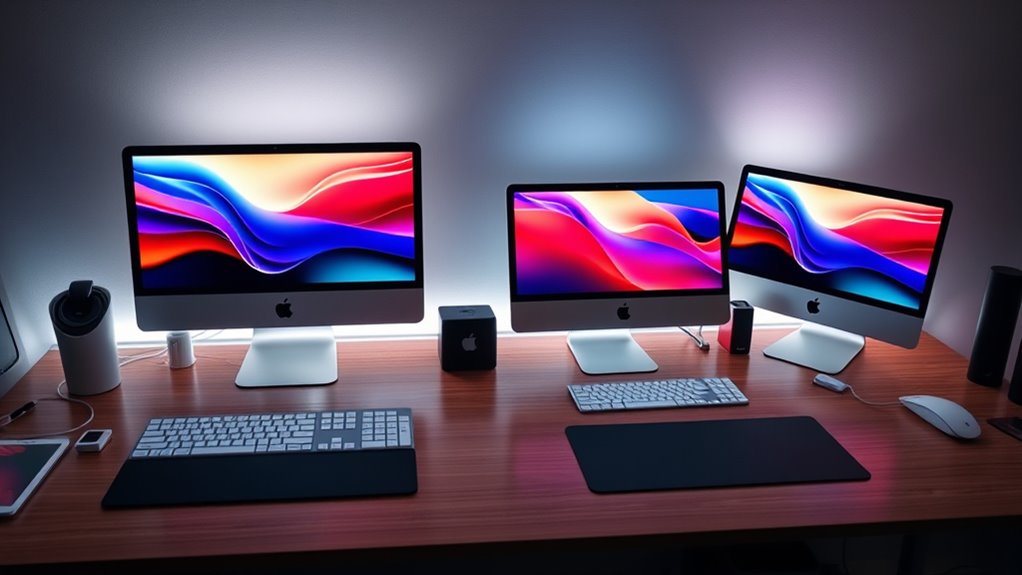

If you’re looking for the best Mac Studios with 2TB or more storage in 2025, I recommend considering models with the M4 Pro chip for top performance. Look for options with ample ports, external expandability, and high-speed connectivity to match demanding workflows. Since internal upgrades are limited, choosing a model with higher initial storage or external solutions is smart. Keep exploring, and I’ll share key factors that’ll help you make the perfect pick.
Key Takeaways
- The Mac Studio with M4 Pro offers up to 64GB RAM and supports external Thunderbolt 3/4 drives for flexible 2TB+ storage expansion.
- Internal SSD options beyond 2TB are limited; plan for higher initial storage or external solutions at purchase.
- Multiple Thunderbolt and USB-C ports ensure robust connectivity for external drives, displays, and peripherals in demanding workflows.
- Dual SSD module support varies by model, enabling internal expansion where architecture permits, but internal upgrades are generally restricted.
- External storage options like Thunderbolt SSDs and NAS systems are essential for scalable, future-proof 2TB+ data management.
Apple Mac mini Desktop Computer with M4 Chip (2024)
If you’re looking for a compact, powerful desktop that seamlessly integrates with the Apple ecosystem, the Apple Mac mini with M4 chip (2024) is an excellent choice. Its sleek aluminum design measures just 5 inches square and weighs only 1.5 pounds, making it perfect for space-saving setups. Equipped with the advanced M4 chip, it offers a 20% CPU boost and significant GPU improvements, handling demanding tasks like video editing and 3D rendering with ease. Connectivity options include Thunderbolt 4, HDMI, Ethernet, and USB-C, supporting up to three displays. Quiet and efficient, it’s ideal for both professional and everyday use, blending performance with compactness effortlessly.
Best For: users seeking a compact, high-performance desktop that offers seamless Apple ecosystem integration for creative workflows, everyday tasks, and multitasking.
Pros:
- Sleek, lightweight, and space-efficient design suitable for small setups
- Powerful M4 chip with significant CPU, GPU, and AI performance boosts
- Supports up to three external displays and features quiet, energy-efficient operation
Cons:
- No built-in USB-A ports, requiring adapters for legacy peripherals
- Power button placement on the bottom may be less intuitive for some users
- Base configuration with 16GB memory might limit demanding professional tasks
Apple Mac mini Desktop Computer with M4 Chip, 16GB RAM, 512GB SSD
Looking for a compact yet powerful desktop that seamlessly blends performance with space-saving design? The Apple Mac mini with M4 chip, 16GB RAM, and 512GB SSD delivers just that. Its sleek, lightweight aluminum body measures only 5 inches square and weighs 1.5 pounds, fitting easily next to any monitor or in tight spaces. Despite its size, it offers impressive connectivity, including Thunderbolt 4, HDMI, Ethernet, and USB-C ports. Powered by the M4 chip, it provides a significant CPU and GPU boost, plus enhanced AI performance. Ideal for creative workflows and multitasking, this Mac mini combines power, efficiency, and minimal footprint for versatile use.
Best For: users seeking a compact, powerful desktop ideal for creative work, multitasking, and space-constrained environments.
Pros:
- Small, lightweight aluminum design fits easily in tight spaces
- Powerful M4 chip with significant CPU, GPU, and AI performance improvements
- Versatile connectivity options including Thunderbolt 4, HDMI, Ethernet, and USB-C ports
Cons:
- Removal of USB-A ports requires adapters for legacy peripherals
- Base 16GB RAM may limit demanding workflows; upgrades needed for intensive tasks
- Power button located at the bottom may be less intuitive to access
Apple 2024 Mac mini Desktop Computer with M4 Chip
The Apple 2024 Mac mini with M4 chip stands out as an ideal choice for creative professionals and power users who need a compact yet powerful desktop. Its sleek aluminum design measures just 5×5 inches and weighs only 1.5 pounds, fitting easily into any workspace. Powered by the M4 chip, it offers a 10-core CPU, 10-core GPU, and a 16-core Neural Engine, delivering a noticeable performance boost over previous models. It supports up to three displays, fast connectivity with Thunderbolt 4 and HDMI, and 24GB of unified memory. Despite some port limitations, its small size, high performance, and seamless Apple ecosystem integration make it a top contender.
Best For: creative professionals and power users seeking a compact, high-performance desktop with seamless Apple ecosystem integration.
Pros:
- Small footprint and lightweight design for versatile placement
- Powerful M4 chip with impressive CPU, GPU, and Neural Engine performance
- Supports up to three displays and high-speed connectivity options
Cons:
- Lack of USB-A ports, requiring adapters for some peripherals
- Power button placement at the bottom may be less intuitive
- Base model’s 16GB memory might limit demanding workflows
Apple Mac mini Desktop Computer with M4 Pro chip
The Apple Mac mini Desktop Computer with M4 Pro chip stands out as an excellent choice for creative professionals and power users who need compact yet powerful performance. Its sleek, aluminum design measures just 5 by 5 inches and weighs only 1.5 pounds, fitting easily into tight spaces. Powered by the M4 Pro with a 12-core CPU, 16-core GPU, and up to 64GB of RAM, it handles demanding tasks like video editing and 3D rendering smoothly. With support for up to three 6K or 8K displays and extensive connectivity options, this mini packs impressive power into a tiny footprint, making it ideal for versatile, high-performance setups.
Best For: creative professionals and power users seeking a compact, high-performance desktop capable of handling demanding workflows and multi-display setups.
Pros:
- Compact and lightweight design fits easily into tight spaces and setups
- Powered by the advanced M4 Pro chip with substantial CPU, GPU, and AI performance boosts
- Supports up to three high-resolution displays, ideal for creative and multitasking needs
Cons:
- Lack of standard USB-A ports requires adapters for older peripherals
- Power button placement at the bottom may be less intuitive for some users
- Base model’s 24GB RAM could limit performance in extremely intensive tasks
Factors to Consider When Choosing Mac Studio With 2TB+ Storage

When choosing a Mac Studio with over 2TB of storage, I consider factors like how much I can expand it later, how it matches my performance needs, and the types of ports I require. I also think about its size and design to fit my workspace and whether it integrates seamlessly with my existing workflow. These points help me find a model that balances storage, power, and compatibility effectively.
Storage Expansion Options
Considering storage expansion options is crucial when choosing a Mac Studio with 2TB or more, especially since internal upgrades are often limited or complex. Most models allow you to select higher-capacity SSDs at purchase, but upgrading later isn’t straightforward and may require professional service or replacing the entire drive. To guarantee flexibility, many users rely on external storage solutions like Thunderbolt 3/4 drives, USB-C SSDs, or network-attached storage (NAS) systems. Some configurations support dual SSD modules, allowing internal expansion if the architecture permits, but this isn’t always an option. Ultimately, planning for higher initial storage or investing in high-quality external drives helps meet growing data needs without hassle down the line.
Performance Requirements
Choosing a Mac Studio with 2TB or more of storage isn’t just about capacity—it’s about making sure it can meet your performance demands. For demanding tasks like 3D rendering or professional video editing, I recommend a model with the M4 Pro chip, which offers up to 20% faster CPU and GPU performance. Adequate memory is essential; 48GB or 64GB of unified memory ensures smooth operation and minimizes bottlenecks. Larger storage isn’t just for files—it supports handling massive media libraries and project archives without relying on external drives. The M4 Pro’s media engine accelerates encoding and decoding high-res formats like ProRes and AV1, which is critical for high-performance workflows. Prioritizing power and storage future-proofs your setup, accommodating software updates and growing file sizes over time.
Connectivity Needs
To make certain your Mac Studio with 2TB+ storage meets your workflow needs, it’s vital to evaluate its connectivity options carefully. Make sure it has enough Thunderbolt 4 or 5 ports to connect multiple high-speed peripherals and displays at once. Check if there are enough USB-C or USB-A ports, or if you’ll need adapters to connect your existing devices. High-speed Ethernet support, like 10Gb Ethernet, is indispensable for fast wired network access, especially if you handle large data transfers. Also, verify compatibility with your audio and video equipment, including HDMI and audio outputs. Finally, consider expansion options for additional storage, external drives, or specialized peripherals, ensuring your setup remains flexible and future-proof.
Design and Size
The compact design of the Mac Studio makes it an excellent choice for those with limited workspace, as it measures just 7.7 inches in width and depth, with a height of around 3.7 inches. Its sturdy aluminum enclosure offers durability and a sleek, professional look that fits well in modern setups. The vertical orientation maximizes desk space, with optional stands for horizontal placement if preferred. Its minimal footprint and front-facing ports reduce clutter and improve workspace organization. The size and build make it easy to transport and integrate into various environments, from creative studios to corporate offices. Overall, the design balances form and function, ensuring that you get powerful performance without sacrificing valuable space.
Compatibility With Workflows
When evaluating a Mac Studio with 2TB+ storage, it’s important to guarantee that its hardware and connectivity options align with your workflow needs. Make sure the CPU and GPU can handle demanding tasks like video editing or 3D rendering without bottlenecks. Check that the device supports your essential peripherals and software to ensure smooth integration. If you use multiple monitors, confirm that the Mac Studio offers multi-display support to match your productivity setup. Additionally, assess whether the available ports, such as Thunderbolt 4 or USB-C, can connect your external drives, audio equipment, and other peripherals reliably. Finally, verify that the storage capacity meets your current data requirements and allows room for future growth, ensuring your workflow remains efficient and uninterrupted.
Budget Considerations
Choosing a Mac Studio with 2TB or more storage requires careful budget planning, as higher capacities usually come with a higher price tag. The cost difference between models with 1TB and 2TB+ storage can be significant, sometimes exceeding $500, which can impact affordability. If budget constraints are tight, you might need to settle for a base model with smaller storage and fewer upgrades, though this could limit future expandability. Keep in mind that investing in higher storage often means allocating funds for additional peripherals or accessories, adding to the overall expense. Planning ahead for your storage needs can help justify the initial investment, but it’s essential to balance current financial limits with your long-term requirements to make a smart choice.
Future Upgradability
While budget considerations are important, it’s also vital to think about future upgradability when selecting a Mac Studio with 2TB or more storage. Most Mac Studio models have limited internal upgrade options, especially for RAM, which is often soldered onto the motherboard, making upgrades nearly impossible. Storage upgrades beyond 2TB usually require choosing a higher-capacity configuration upfront because internal SSDs aren’t user-replaceable. To expand storage later, external drives via Thunderbolt or USB-C are your best bet. When choosing, aim for models with the highest initial storage to future-proof your setup, as internal upgrade paths are constrained by design. Planning ahead ensures your Mac Studio continues to meet your evolving data and application needs without costly replacements.
Frequently Asked Questions
How Does Storage Expandability Differ Between Mac Studio Models?
Storage expandability varies between Mac Studio models, with some offering more flexibility. I’ve found that the newer models have limited internal upgrade options, often relying on external drives for additional space. However, certain configurations still include accessible SSD slots or ports, allowing me to expand storage easily. It’s essential to check each model’s specifications because expandability can differ markedly, affecting how I manage large files and workflows.
What Are the Best Connectivity Options for 2tb+ Storage Mac Studios?
The best connectivity options for 2TB+ storage Mac Studios include Thunderbolt 4, USB-C, and Ethernet. I recommend Thunderbolt 4 ports for blazing-fast data transfer, especially when working with large files. USB-C is versatile and widely compatible, while Ethernet guarantees stable, high-speed network access. Combining these options gives you flexibility and reliability for managing extensive storage needs seamlessly.
How Does the Performance Vary With Different M4 Chips in Mac Studios?
Think of the M4 chips as the engines powering your Mac Studio. The performance varies markedly: the M4 Pro offers a solid boost for demanding tasks, while the M4 Max is like having a race car, excelling in heavy-duty creative work. I’ve noticed faster rendering, smoother multitasking, and enhanced efficiency with the higher-tier chips. Choosing the right one depends on your workload, but all deliver impressive speed and power.
Are There Any Specific Software Requirements for Large Storage Mac Studios?
Yes, there are specific software considerations for large storage Mac Studios. You’ll want to guarantee your creative software, like Adobe Creative Cloud or Final Cut Pro, can handle large files efficiently. Also, check that your operating system is up to date for maximum compatibility. I recommend using robust backup solutions like Time Machine or third-party apps to manage your storage effectively and prevent data loss.
What Warranty Options Are Available for High-Storage Mac Studio Configurations?
Think of the warranty options like a safety net beneath a tightrope walker—reliable and reassuring. For high-storage Mac Studios, Apple offers standard one-year limited warranties, with the option to extend through AppleCare+. AppleCare+ provides coverage for repairs, accidents, and support, giving you peace of mind like a sturdy umbrella on a rainy day. I recommend considering this for all-encompassing protection of your valuable investment.
Conclusion
So, I’ve shared the top Mac Studios with over 2TB of storage for 2025, but the real question is—which one will you choose? Each offers unique advantages, and the best fit depends on your needs. But there’s a twist coming that could change everything, and I can’t wait to reveal it. Stay tuned, because your perfect Mac Studio might be just around the corner—are you ready to discover it?