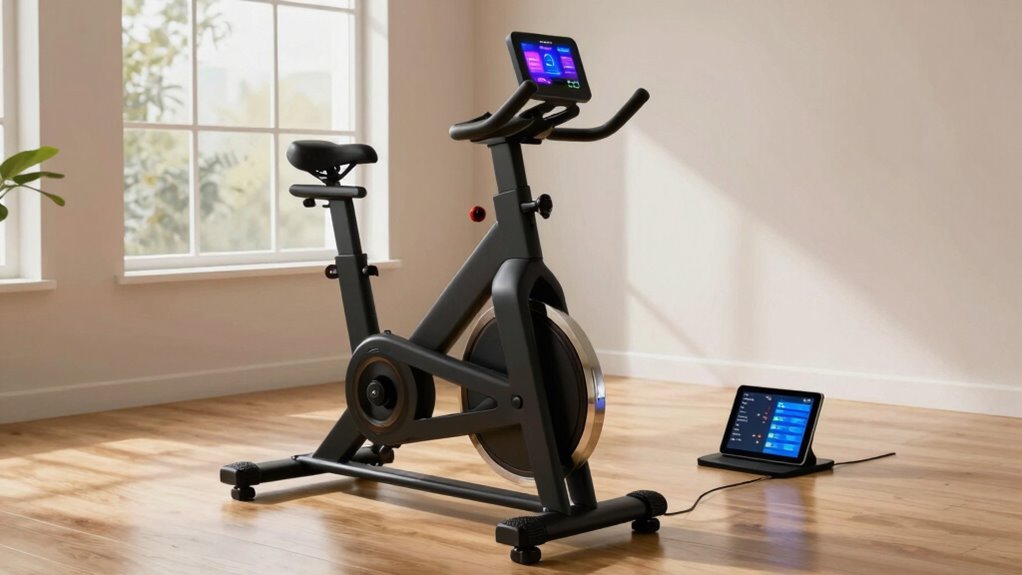

If you want a realistic outdoor riding experience and prefer seamless outdoor-to-indoor shifts, a smart bike might be your best choice. It mimics outdoor conditions closely, offering immersive feelings and advanced simulation systems. However, if you prioritize flexibility, performance tracking, and cost-efficiency, a smart trainer could suit you better, especially since it works with your existing bike and fits smaller spaces. Keep exploring to find out which setup aligns best with your cycling goals.
Key Takeaways
- Choose a smart bike for the most realistic outdoor riding experience and seamless outdoor-to-indoor transition.
- Opt for a smart trainer if you want flexibility with existing bikes and budget-friendly, space-saving setup.
- Smart bikes are ideal for those prioritizing immersive simulation and outdoor riding authenticity.
- Smart trainers excel in precise resistance control, data tracking, and compatibility with various training apps.
- Consider your space, budget, and performance goals to determine whether a smart bike or trainer better suits your needs.
If you’re looking to boost your cycling performance indoors, choosing between a smart bike and a smart trainer is an essential decision. Both options have their advantages, but your choice depends on your goals, space, and how much you value the feeling of outdoor cycling. Smart bikes simulate real riding more closely because they come with integrated systems that mimic outdoor conditions, including resistance changes and immersive displays. If you love the sensation of riding a real bike and want a seamless changeover from outdoor cycling, a smart bike could be the better fit. It offers an all-in-one setup, so you don’t need additional equipment, and you can easily hop on and start training without fuss. This makes it especially appealing if your main focus is on improving your training performance while maintaining the authentic feeling of outdoor riding.
Smart bikes offer an all-in-one, immersive outdoor riding experience for seamless indoor training.
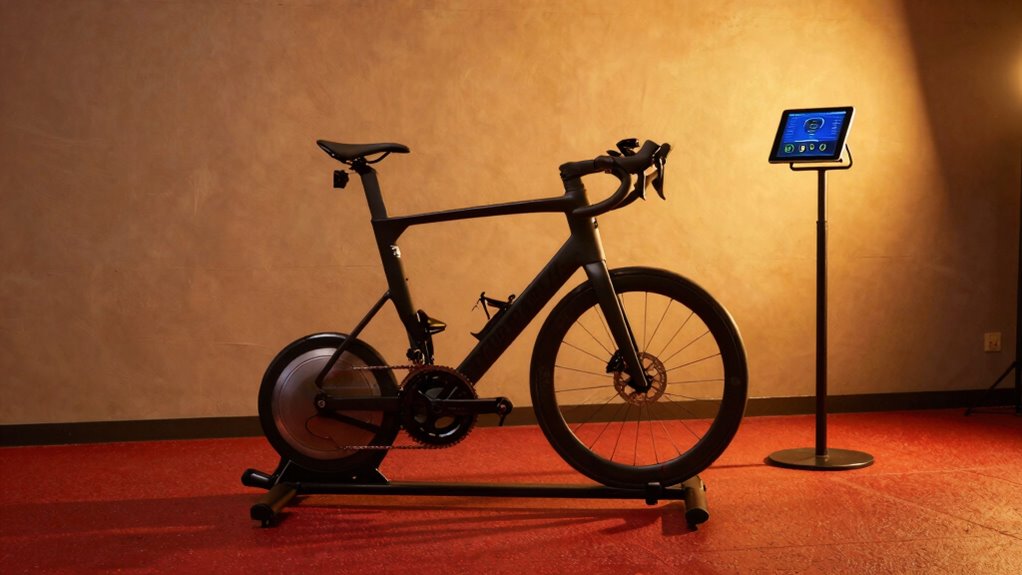
On the other hand, a smart trainer is more versatile and typically more budget-friendly. It works with your existing bike, allowing you to convert your current setup into a high-tech indoor training station. This flexibility means you can switch between outdoor cycling and indoor training without needing to purchase a whole new bike. Smart trainers excel at delivering precise resistance adjustments and data tracking, which can considerably enhance your training performance. They’re perfect if you’re looking to do structured workouts, interval training, or virtual races through apps like Zwift or TrainerRoad. Since smart trainers are compact and usually easier to store, they suit those with limited space or who prefer a more portable solution. Additionally, compatibility with various bikes makes them a versatile choice for many cyclists.
Beyond the equipment itself, consider how much you value the outdoor cycling experience. If you want to replicate the feel, sound, and engagement of outdoor riding, a smart bike provides a more immersive experience. It’s designed to mimic outdoor conditions, which can help keep your training engaging and realistic. Furthermore, technological advancements in simulation systems contribute to a more authentic and motivating indoor riding experience. However, if your main goal is to improve your fitness efficiently and you’re comfortable using software and apps for virtual rides, a smart trainer offers excellent training tools and customizable workouts that can push your performance forward.
Ultimately, the decision hinges on your specific needs. If you’re passionate about outdoor cycling and want a setup that mirrors that experience, a smart bike might make the most sense. But if you prioritize flexibility, precise performance tracking, and a cost-effective way to enhance your training, a smart trainer is a solid choice. Both options can substantially elevate your indoor workouts, helping you reach your cycling goals more effectively.

Merach Exercise Bike, Brake Pad/Magnetic Stationary Bike with Exclusive App, Low Noise Indoor Cycling Bike with 270LBS Weight Capacity, Dumbbell Rack and Fitness Courses for Weight Loss
- App Compatibility: Track metrics and sync with health apps
- Stable & Durable Frame: Reinforced steel construction with corrosion resistance
- Quiet Magnetic Resistance: Ultra-smooth, low-noise operation under 25dB
As an affiliate, we earn on qualifying purchases.
As an affiliate, we earn on qualifying purchases.
Frequently Asked Questions
What Is the Typical Cost Difference Between Smart Bikes and Trainers?
You’ll find that smart bikes typically cost more than smart trainers, often ranging from $1,500 to $3,500, due to their integrated features and realistic feel. Smart trainers usually start around $300 and go up to $1,500 for more advanced models. When considering virtual riding and power accuracy, a smart bike offers a seamless experience but at a higher price, while trainers provide flexibility and affordability, though sometimes with less precise power data.
How Much Space Is Needed for Each Indoor Setup?
Think of your indoor setup as a cozy corner for your cycling adventure. A smart bike typically needs a dedicated space around 3-4 feet for bike storage and easy access, while a smart trainer is more like a portable suitcase, easily stored away and moved with minimal space. You’ll want enough room for trainer portability and safe mounting, usually about 4-6 feet, making both options flexible for different space constraints.
Can I Use My Existing Bike With a Smart Trainer?
Yes, you can use your existing bike with a smart trainer, but you need to check bike compatibility and trainer compatibility first. Make sure your bike has the right type of quick-release or thru-axle that fits the trainer. Also, verify that your smart trainer supports your bike’s wheel size and drivetrain. Once compatibility is confirmed, you can easily connect your bike to the trainer for immersive indoor training sessions.
Which Setup Offers Better Real-Road Riding Simulation?
A smart bike setup offers a better real-road riding simulation because it often integrates seamlessly with virtual reality, immersing you in realistic environments. Plus, smart bikes typically feature resistance customization, allowing you to mimic actual terrain changes more accurately. This combination enhances your experience, making indoor riding feel more authentic. If realistic simulation matters most, a smart bike provides a more immersive and customizable ride than a smart trainer.
What Maintenance Is Required for Smart Bikes Versus Trainers?
You need to regularly check bike compatibility and perform software updates for both smart bikes and trainers. For smart bikes, keep the drivetrain clean and inspect components like chains and cogs. Trainers require periodic calibration to guarantee accurate resistance. Both setups benefit from checking connections, updating firmware, and inspecting power sensors. Staying on top of maintenance helps guarantee your indoor ride stays smooth, safe, and compatible with your favorite training apps.
Conclusion
Ultimately, whether you choose a smart bike or a smart trainer, it all comes down to your riding style and space. Coincidentally, I found that the setup you initially considered often turns out to be the perfect fit—sometimes, the choice is almost made for you. Whichever option you pick, embracing indoor training can unexpectedly ignite your passion for cycling and keep you motivated, no matter the weather. After all, the right setup might just be waiting where you least expect it.