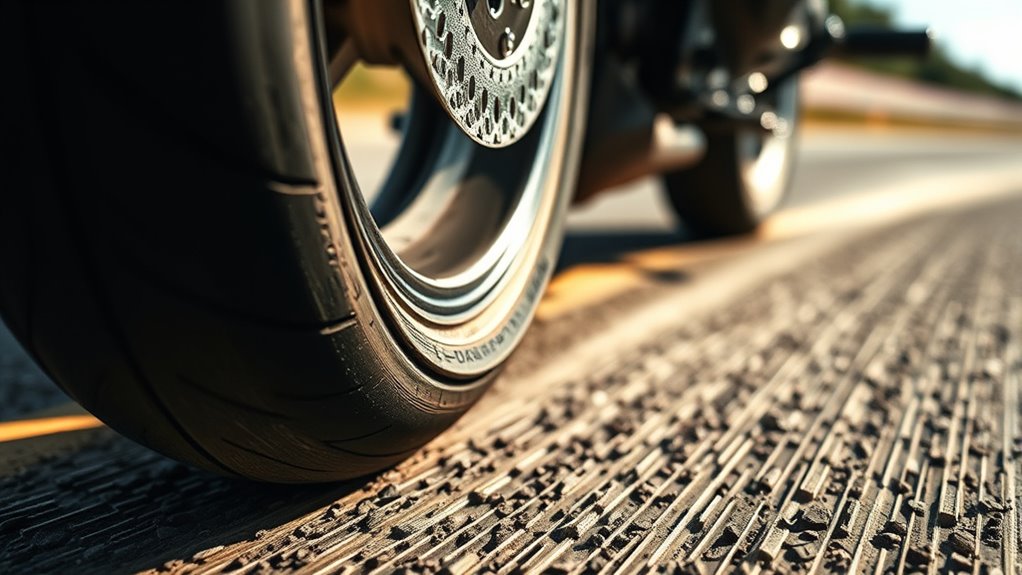

When you corner, your tire deforms to create a contact patch that adapts in shape and size, providing grip and stability. Lateral forces push against the tire, causing sidewalls to bend and the patch to elongate, which helps generate necessary traction. Softer tires deform more, offering better grip but risk overheating, while stiffer ones provide more precise handling. Understanding this interaction between tire deformation and contact patch shape is key to mastering cornering control. Keep exploring to grasp how different factors influence your grip.
Key Takeaways
- Tire deformation during cornering enlarges and shapes the contact patch to maximize grip and stability.
- Lateral forces cause tire sidewall bending, influencing contact patch size and shape for effective traction.
- Softer tires deform more, improving grip but risking overheating and wear; stiffer tires offer precise handling.
- Proper contact patch adaptation maintains grip at high speeds, preventing sliding and enhancing vehicle stability.
- Understanding tire deformation and contact patch dynamics is vital for optimizing cornering performance and safety.
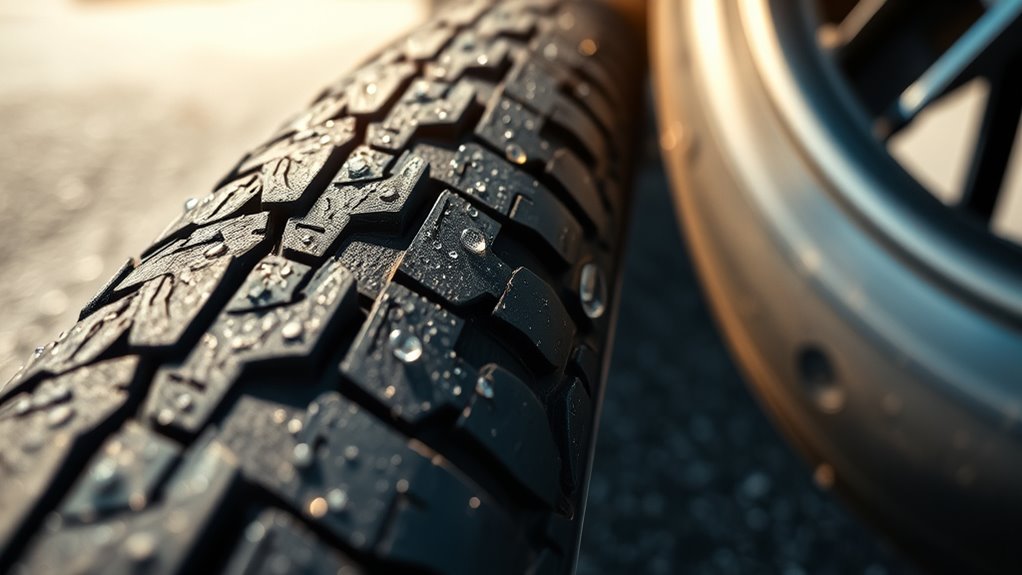
Have you ever wondered what keeps your car stable when you take a sharp turn? The answer lies in the complex interaction between your tires and the road, especially how the contact patch responds under lateral forces. When you steer into a corner, your tires don’t stay perfectly round; instead, they deform to grip the surface better. This tire deformation is essential for generating the lateral force needed to change your vehicle’s direction. The contact patch—the small area where your tire meets the road—bears the brunt of this force, adapting shape to maximize grip and stability.
As you turn, your tires experience lateral force, which pushes against the road surface. This force causes the tire’s sidewalls to bend and deform, changing the shape of the contact patch. Think of the tire’s contact patch as a flexible cushion, molding itself to match the road’s surface and the forces acting upon it. The deformation isn’t random; it’s a carefully balanced response that allows the tire to generate the necessary grip without losing traction. The more the tire deforms, the larger and more elongated the contact patch becomes, which can increase grip but also risks overloading the tire and reducing stability.
The tire’s ability to deform properly under lateral force depends heavily on its construction and materials. Softer compounds and flexible sidewalls allow for more deformation, which can improve grip during aggressive cornering. However, excessive deformation can lead to overheating, tire wear, and loss of control. Conversely, stiffer tires resist deformation, providing more precise handling but potentially reducing the contact patch’s size and the overall grip. Finding the right balance between tire deformation and lateral force is critical for optimal cornering performance.
Understanding how tire deformation influences the contact patch helps you grasp why certain tires perform better under specific conditions. During high-speed turns, the tires’ deformation and resulting contact patch are crucial for maintaining grip without sliding out. The lateral force acts as the driving factor that prompts tire deformation, which in turn shapes the contact patch to suit the demands of cornering. When you push your vehicle to its limits, it’s this delicate interplay—between tire deformation, lateral force, and contact patch—that determines whether you stay on the road or lose control.
In essence, your car’s cornering grip hinges on how well your tires adapt to lateral forces through deformation. The more effectively they mold the contact patch, the better your vehicle handles curves, providing stability and confidence. Recognizing this dynamic interaction helps you appreciate the engineering that keeps you safe and connected to the road when you’re navigating challenging turns. Additionally, the contact patch plays a vital role in ensuring that the force distribution remains balanced, which is essential for maintaining optimal grip during aggressive maneuvering.
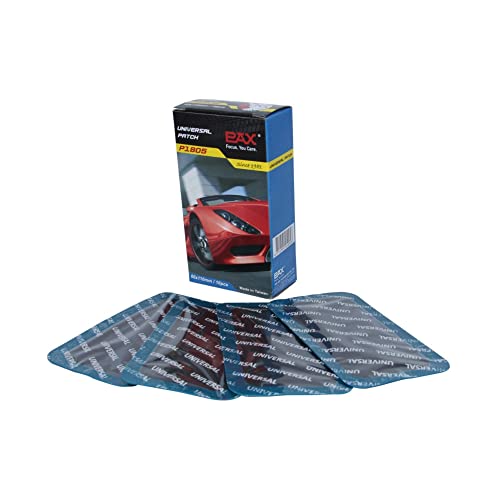
PAX 10 Pcs Heavy Duty Universal Patch, 60 x 110mm Large Rectangle Tire Repair Patches (Glue Not Included) for Car, Truck, Tractor, Radial and Bias Tires
- Professional Tire Repair: Creates high-strength, permanent bond
- Large Rectangle Size: 60x110mm for bigger punctures
- Replacement Patches Only: Glue not included, 10-pack
As an affiliate, we earn on qualifying purchases.
As an affiliate, we earn on qualifying purchases.
Frequently Asked Questions
How Does Tire Pressure Affect Contact Patch Size?
When you adjust your tire pressure, it changes the contact patch size, influencing grip. Lower pressure increases the contact patch, providing better traction but causing uneven tire wear and flattening the tread pattern faster. Higher pressure reduces the contact patch, making the tire less grip-efficient and potentially causing a harsher ride. Proper pressure balances contact patch size, tire wear, and tread pattern, ensuring ideal cornering grip and longer-lasting tires.
What Role Does Tire Temperature Play in Grip?
Imagine a rubber band stretched tight—tire temperature influences your grip by affecting tire compound and rubber deformation. When your tires heat up, the rubber becomes more pliable, increasing grip, much like a well-warmed bowstring. Conversely, cold tires harden, reducing contact patch effectiveness. Keeping your tires at ideal temperature ensures maximum contact, translating to better handling and safety on every turn.
How Do Different Road Surfaces Influence Contact Patch Contact?
Different road surfaces influence your contact patch based on their texture and grip level. A rough asphalt increases grip with a larger contact patch, while smooth surfaces reduce it. Tread pattern and rubber compound also matter; aggressive treads channel water on wet roads, enhancing contact, while softer rubber compounds conform better to irregular surfaces. So, your tire’s design and the road surface work together to optimize contact and grip.
Can Wheel Alignment Impact Contact Patch Efficiency?
Yes, wheel alignment substantially impacts your contact patch efficiency. Proper alignment ensures your tire tread meets the road evenly, optimizing grip during cornering. When suspension geometry is correct, it maintains consistent contact patch shape and size, preventing uneven wear and improving handling. Misalignment causes uneven tire contact, reducing grip and stability. Regularly checking and adjusting your wheel alignment helps maximize contact patch performance, ensuring safer, more responsive driving.
How Does Vehicle Weight Distribution Affect Cornering Grip?
You might be surprised to learn that a 60/40 weight distribution can considerably improve your vehicle’s cornering grip. When you corner, weight transfer shifts more load onto the outside tires, enhancing contact patch efficiency. Proper suspension tuning helps manage this weight transfer, ensuring ideal grip. By balancing weight distribution and fine-tuning your suspension, you get better traction, stability, and control during turns, making your driving experience safer and more responsive.
Conclusion
Remember, a well-maintained contact patch is your secret weapon on the road. By understanding how grip works and keeping your tires in top shape, you can corner with confidence and control. Don’t forget, “A chain is only as strong as its weakest link,” so pay attention to every detail. When you respect the science behind contact patches, you’re not just driving—you’re mastering the art of safe, confident cornering.