
To balance at zero speed on your bike, focus on keeping your weight centered over the bottom bracket and maintain a relaxed yet controlled posture. Use small, subtle movements with your hips and handlebars to counteract tilting, while keeping your elbows bent and stable. Engage your core for added stability, and practice on flat surfaces before tackling uneven terrain. Mastering these techniques will improve your control and confidence—more helpful tips await you if you continue exploring.
Key Takeaways
- Maintain a centered weight over the bottom bracket with level or slightly angled pedals.
- Use small, controlled movements of hips and handlebars to counter tilt and stay balanced.
- Keep elbows bent and relaxed, engaging core muscles for stability.
- Focus on a fixed point ahead to help maintain equilibrium and prevent wobbling.
- Practice regularly on flat, then uneven terrain to develop muscle memory and finesse.

Have you ever wondered how cyclists stay balanced without moving forward? It’s a skill that can seem almost magical at first, but once you understand the fundamentals, it becomes an essential part of your riding repertoire. Whether you’re mountain biking on tricky trails or maneuvering urban obstacles, mastering the trackstand allows you to pause confidently without losing control. The secret lies in a combination of balance techniques and body positioning that keep you steady at zero speed.
When you perform a trackstand, you’re essentially balancing on your bike without pedaling or moving forward. This requires a keen sense of balance and precise control over your bike’s contact points with the ground. In mountain biking, this skill becomes even more valuable, especially when you encounter technical features like rocks, roots, or tight switchbacks. By incorporating specific balance techniques, you can hold your position longer and prepare for the next move. The key is to keep your weight centered over the bottom bracket, slightly shifting your hips and handlebars to counteract any tilting. Small, subtle movements are your friends here; too much wobbling or overcorrecting can cause you to lose your balance.
Your body position plays a vital role in maintaining stability. Keep your elbows bent and relaxed, providing a flexible connection to your handlebars. Engage your core muscles to stabilize your upper body, which helps you react quickly to any shifts. Your pedals should be level or slightly angled, never crossing or uneven, as this gives you a stable base. As you practice, you’ll notice that focusing on a fixed point ahead helps your brain maintain equilibrium, reducing unnecessary movements. Using your legs as shock absorbers and making slight adjustments with your hips allows you to stay upright even on uneven terrain. Additionally, understanding climate control principles can help you optimize your riding conditions by choosing suitable gear and timing for different weather scenarios.
Maintain stability by keeping elbows relaxed, engaging your core, and focusing on a fixed point ahead.
Practicing a trackstand regularly builds muscle memory and confidence. Start on flat ground with a smooth surface, gradually increasing difficulty by trying it on uneven or inclined terrain. In mountain biking, mastering balance techniques for the trackstand can make a significant difference when you need to pause momentarily without losing momentum. It’s a skill that combines finesse, control, and patience, and once you get the hang of it, you’ll find yourself stopping and starting with more ease and stability. Keep practicing, stay relaxed, and remember that each small adjustment brings you closer to effortless balance at zero speed.
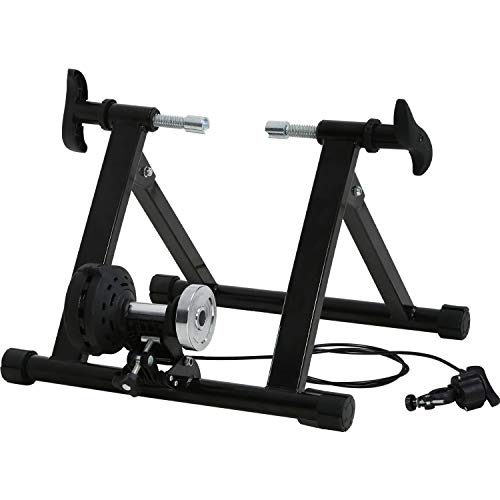
Bike Trainer Stand for Indoor Riding, Bicycle Exercise Training Stand with Magnetic Flywheel,Noise Reduction,5Resistance Settings Stationary Bike Resistance for Road
- Easy to Assemble: Assembles in 15 minutes with minimal parts
- Five Resistance Levels: Adjustable for flat, sandy, or uphill riding
- Compact and Portable: Folds for easy storage and transport
As an affiliate, we earn on qualifying purchases.
As an affiliate, we earn on qualifying purchases.
Frequently Asked Questions
What Are the Best Bikes for Practicing Trackstands?
You should choose bikes with a sturdy bike frame and good tire grip for practicing trackstands. A lightweight frame helps you balance easily, while tires with strong grip prevent slipping. Fixie bikes or single speeds are ideal because they have fewer components to distract you. Look for a bike with responsive handling and reliable traction, so you can focus on maintaining your balance without worrying about stability issues.
How Can I Improve My Balance During a Trackstand?
Sure, because balancing on a bike at zero speed is just like solving world peace, right? To improve your balance, focus on your core strength—strong abs keep you stable. Also, refine your pedal positioning; keep your pedals level and adjust your weight accordingly. Practice patiently, and remember, the key isn’t just in riding but in mastering the tiny, unnoticed adjustments that make balance second nature.
Are There Specific Shoes That Help With Trackstanding?
Yes, choosing shoes with good shoe grip and sole flexibility can help you stay balanced during a trackstand. Look for shoes with a sticky rubber sole for better grip, preventing slips. Flexible soles allow more natural foot movement, giving you better control at zero speed. Opt for cycling shoes designed for indoor or flat pedal riding, as they often combine these features, making it easier to maintain balance and improve your trackstanding skills.
How Long Should I Practice Daily to Master a Trackstand?
You should practice daily for about 15-30 minutes to master a trackstand. Think of it as planting seeds; consistency is key. Focus on gradual progression, gradually increasing your balance time as you improve. Don’t rush—patience helps your skills grow steadily. With regular practice, you’ll find yourself balancing effortlessly, transforming a tricky skill into second nature. Remember, persistence turns practice into mastery.
Can Trackstanding Be Useful for Mountain Biking or BMX?
Yes, trackstanding can be useful for mountain biking and BMX. It helps you develop better bike control, balance, and precise maneuvering, which are essential for steering tricky trails or tight BMX courses. Incorporating trackstand practice into your routine improves your mountain bike techniques and BMX skills, making you more confident and agile. Spend a few minutes daily practicing; over time, you’ll notice increased stability and smoother handling in various riding situations.
Conclusion
Mastering the trackstand gently reminds you that sometimes, staying still offers the best way forward. It’s about finding balance in moments of stillness, even when the world keeps moving. Embrace the pause, the subtle art of holding your position, and trust that sometimes, not going anywhere is the true progress. With patience and practice, you’ll discover that the quietest stance can be your greatest strength, guiding you smoothly through any ride.