The best mountain bike helmet for most riders is the Giro Fixture MIPS II, which pairs a proven rotational-impact liner with a wide 54–61 cm fit range and a visor built for real singletrack. Riders wanting the same safety concept at a friendlier price should look at the original Giro Fixture MIPS, while e-bike commuters and high-speed trail riders will appreciate the KINGBIKE NTA-8776 with its NTA-certified shell and camera mount. The main tradeoff in this category is between certified impact protection and budget pricing: many sub-$50 options offer adjustable visors and comfortable padding, but only a few carry MIPS or Dutch NTA 8776 certification. Coverage and fit systems matter more than weight for most trail riders, though long-ride comfort pushes lighter shells up the list. Read on for the full breakdown of all 14 helmets and which one fits your riding style.

Get sports gear delivered free — and shop member deals
- Fast, free delivery on millions of items
- Access to Prime Big Deal Days deals on October 6–7
- Prime Video, Amazon Music and more included
Complete the kit


Key Takeaways
- Only the two Giro Fixture MIPS models in this lineup include a rotational-impact (MIPS) liner, which is why they take the top spots despite budget helmets offering more visor adjustability.
- The KINGBIKE NTA-8776 and BATFOX NTA 8776 are the only helmets here certified to the Dutch NTA e-bike standard, making them the picks for Class 3 e-bike and high-speed downhill riders.
- Budget helmets like the BUCKLOS, Favoto, and OUWOR cluster around the same feature set — adjustable visor, dial fit, rear LED lamp — so fit range and padding quality are what actually separate them.
- Fit range varies sharply: Giro covers 54–61 cm in one shell, while BUCKLOS only fits 59–61 cm heads, meaning buyers with smaller heads have far fewer viable options in this group.
- Five of the 14 helmets come from BATFOX alone, and they differ mainly in visor type and mount options rather than protection level, so choosing between them comes down to accessories, not safety.




| mountain bike helmet | Brand | Model | Ventilation | Weight |
|---|---|---|---|---|
| BATFOX NTA 8776 E-Bike and Mou | BATFOX | MA057 | 17 vents | — |
| BUCKLOS Adult Mountain Bike He | BUCKLOS | L-006 | 23 openings | 267 g |
| Giro Fixture MIPS Adult Bike H | — | — | — | — |
| AURVEE Adult Mountain Bike Hel | AURVEE | 071 | 16 vents | Under 300 g |
| BATFOX Mountain Bike Helmet wi | BATFOX | LA303 | 18 vents with internal channeling | — |
| KINGBIKE NTA-8776 Mountain Bik | KINGBIKE | MA066 | — | 390 grams |
| Giro Fixture MIPS II Bike Helm | Giro | Fixture MIPS II | — | — |
| Schwinn Thrasher Adult Bike He | — | — | Approximately 21 vents | — |
| ANY PASS Adult Mountain Bike H | ANY PASS | WJ-015 | — | 330 g |
| Favoto Adult Mountain Bike Hel | Favoto | B025 | — | 335 g (11.8 oz) |
| OUWOR Adult and Youth Bike Hel | OUWOR | W-029 | 14 vents | 0.44 kg |
| Favoto Mountain Bike Helmet wi | — | — | — | 335 g (11.8 oz) |
| BATFOX Mountain Bike Helmet fo | BATFOX | LA303 | 18 vents with internal channels | — |
| BATFOX Adult and Youth Bike He | BATFOX | LA302 | 18 channels | Approximately 390–400 g |
More Details on Our Top Picks
BATFOX NTA 8776 E-Bike and Mountain Bike Helmet for Adults and Youth
This option earns the top spot because it is NTA 8776 certified, the Dutch standard built specifically for the higher speeds and heavier impacts of e-bike riding. No other helmet in this lineup carries that credential, which makes it the most versatile pick for riders who mix trail time with commuter e-bike use. Compared with the BATFOX Mountain Bike Helmet with Visor, this model trades a couple of vents (17 versus 18) for broader certification coverage, a tradeoff most riders should take willingly. The detachable visor and adjustable dial make it practical for varied conditions, and three size options cover both adults and youth. The one real frustration is that the M and L size ranges overlap at 57–58 cm, so sizing between the two takes some care.
Pros:- NTA 8776 certification for e-bike-level impact protection, alongside CPSC, CE, and EN1078
- 17 vents keep airflow respectable despite the reinforced construction
- Three sizes with adjustable fit cover adults and youth
- Detachable visor handles sun glare and rain
Cons:- M and L size ranges overlap, making size selection ambiguous for mid-range head circumferences
- Slightly heavier construction than trail-only helmets like the BUCKLOS, since it meets the tougher e-bike standard
Best for: E-bike riders and mixed-use cyclists who want a helmet certified for both standard bicycling and higher-speed pedelec riding
Not ideal for: Riders who ride only on roads at low speed and want the absolute lightest, most ventilated lid — the NTA-rated build adds structure that pure trail riders may not need
- Brand:BATFOX
- Model:MA057
- Certifications:NTA 8776, CPSC, CE, EN1078
- Shell:Polycarbonate with EPS foam liner
- Ventilation:17 vents
- Sizes:S: 51–54 cm; M: 55–58 cm; L: 57–61 cm
- Visor:Detachable
- Warranty:1 year
Our verdict“Buy this if you ride an e-bike or want maximum certification coverage across mixed terrain; skip it only if you need a featherweight trail-only helmet.”
BUCKLOS Adult Mountain Bike Helmet with Visor, 59–61 cm
With 23 ventilation openings, this model out-breathes everything else here — the AURVEE manages 16 vents and the BATFOX NTA model 17 — which matters most on long, slow climbs where heat builds faster than speed. At 267 g, it is also the lightest pick in this batch, and the removable washable lining addresses the sweat-soaked-padding problem that cheaper helmets ignore. Compared with the AURVEE below, you give up size flexibility: this comes in a single 59–61 cm range only, so smaller heads are simply out of luck. The one-hand adjustment dial is a nice touch for on-trail tweaks. Riders choosing between this and the Giro Fixture MIPS are choosing maximum airflow over rotational-impact technology, and that is a genuine tradeoff, not a free win.
Pros:- Class-leading 23 ventilation openings for hot climbs
- Lightest helmet in this batch at 267 g
- One-hand adjustment dial for easy mid-ride fitting
- Removable, washable lining keeps the helmet fresh over time
Cons:- Single size range (59–61 cm) excludes most riders with smaller heads
- No rotational-impact protection system like the MIPS in the Giro Fixture
Best for: Hot-climate trail riders and enduro climbers with larger heads (59–61 cm) who prioritize airflow and low weight above all else
Not ideal for: Riders with head circumferences under 59 cm, or anyone who wants MIPS-style rotational protection — this helmet offers neither the sizing nor the safety tech
- Brand:BUCKLOS
- Model:L-006
- Size:59–61 cm head circumference
- Weight:267 g
- Ventilation:23 openings
- Materials:Polycarbonate shell, EPS foam liner
- Visor:Detachable
- Adjustment:One-hand dial
Our verdict“This pick makes the most sense for big-headed riders in hot climates who value cooling and weight over advanced impact tech.”
Giro Fixture MIPS Adult Bike Helmet, Matte Black/Grey, 54–61 cm
This is the only helmet in this batch with an integrated MIPS system, a low-friction layer designed to reduce rotational forces during angled impacts — the most common crash type on loose singletrack. Compared with the Giro Fixture MIPS II elsewhere in this roundup, this version represents the more accessible entry into rotational protection. The Roc Loc Sport fit system with a 7 cm adjustment range is a step above the generic dials on the BATFOX models, and the universal 54–61 cm range means one helmet fits most households. The honest tradeoffs: the reflective details only work when a car’s headlights hit them, and universal sizing, while convenient, can feel less secure than a dedicated size on riders at the extremes of the range. For safety-focused buyers, those are acceptable compromises.
Pros:- Integrated MIPS system addresses rotational forces in angled crashes
- Roc Loc Sport fit system offers a wide 7 cm adjustment range
- Reflective details add a low-light visibility margin the BATFOX LA303 lacks
- Universal 54–61 cm fit suits shared household use
Cons:- Reflective details require an external light source to function, so they are no substitute for active lights
- Universal sizing may not deliver a dialed fit for very small or very large heads
Best for: Trail riders and families who want proven rotational-impact protection and a single helmet that fits multiple head sizes
Not ideal for: Riders whose heads sit at the far edges of the 54–61 cm range — universal fit systems are compromise fits, and the visor is less substantial than the BATFOX LA303’s large visor
- Color:Matte Black/Grey
- Fit:Universal adult fit
- Size:54–61 cm
- Fit system:Roc Loc Sport, 7 cm adjustment range
- Safety system:Integrated MIPS
- Visibility:Reflective details
Our verdict“This model is better suited than any other pick here for riders who put crash protection first and want MIPS-backed peace of mind on technical trails.”
AURVEE Adult Mountain Bike Helmet with Removable Visor
This model takes the value slot because it delivers the core mountain bike helmet package — CPSC-compliant in-mold construction with extended rear and side coverage, three sizes, and washable pads — without anything you pay extra for and do not use. Compared with the BATFOX NTA 8776, it lacks e-bike certification and MIPS, but for standard trail riding on a budget those are extras, not essentials. Against the BUCKLOS, it offers far better size coverage (S through L versus a single large range), which is exactly what most buyers actually need. At under 300 g with 16 vents, it sits mid-pack on weight and cooling — respectable but not class-leading. The overlapping size ranges between S/M and M/L mean you should measure your head before ordering rather than guessing, and the brand is newer, so long-term durability is less proven than Giro’s.
Pros:- CPSC-compliant in-mold construction with extended rear and side coverage
- Three size options give most head shapes a workable fit
- Under 300 g with 16 vents balances weight and airflow
- Removable visor and washable pads add practical daily-use value
Cons:- Size ranges overlap, so careful measuring is needed before purchase
- Newer brand with a shorter track record than established makers like Giro
Best for: Budget-conscious new trail riders who want extended coverage and correct sizing without paying for MIPS or e-bike certifications
Not ideal for: E-bike riders or crash-conscious riders who want rotational protection — for them, the BATFOX NTA model or Giro Fixture MIPS are worth the extra spend
- Brand:AURVEE
- Model:071
- Sizes:S: 52–56 cm; M: 55–58 cm; L: 58–61 cm
- Weight:Under 300 g
- Ventilation:16 vents
- Materials:EPS foam core, PC outer shell
- Safety standard:U.S. CPSC
- Warranty:1 year
Our verdict“The smart pick for riders who want honest, compliant coverage at a lower price and do not need premium safety tech.”
BATFOX Mountain Bike Helmet with Visor
The standout feature here is the XL option at 61–63 cm — a size range almost nobody else in this roundup offers, since even the generous Giro Fixture tops out at 61 cm. For big-headed riders who usually have to squeeze into a large, that alone justifies the pick. The helmet backs it up with 18 vents and internal channeling, which moves air through the shell rather than just letting holes exist, plus triple certification (CPSC, ASTM F1447, CE). Compared with its sibling, the BATFOX NTA 8776, this model skips the e-bike rating but gains the ASTM trail standard and a larger visor for sun coverage. Two honest gaps: no published weight, so gram-counters are buying blind, and there is no reflective or lighting feature, which the Giro Fixture MIPS at least partially addresses.
Pros:- XL size (61–63 cm) fills a gap almost no other helmet here covers
- Triple safety certification: CPSC, ASTM F1447, and CE
- 18 vents with internal channeling for structured airflow
- Large visor offers more sun coverage than typical detachable visors
Cons:- No published weight, making it impossible to verify against lighter picks like the BUCKLOS
- No reflective details or light mount for low-light visibility
Best for: Riders with head circumferences of 61–63 cm who struggle to find helmets that fit, plus trail riders who want a large visor for sunny, exposed terrain
Not ideal for: Weight-obsessed riders — the lack of a published weight makes comparison hard — and anyone who commutes at dusk, since there is no visibility feature
- Brand:BATFOX
- Model:LA303
- Helmet type:Mountain bike helmet
- Shell material:Polycarbonate
- Liner:Impact-absorbing EPS foam
- Ventilation:18 vents with internal channeling
- Sizes:M (54–58 cm), L (58–61 cm), XL (61–63 cm)
- Safety standards:CPSC, ASTM F1447, CE
- Visor:Large fixed visor
Our verdict“This option stands out for larger-headed riders who have been squeezed by universal-fit helmets and want a certified trail lid with serious sun coverage.”
KINGBIKE NTA-8776 Mountain Bike Helmet with Adjustable Visor & Camera Mount
What separates this KINGBIKE from the rest of this lineup is its NTA-8776 certification, a Dutch e-bike standard that tests impact protection at speeds up to 28 mph. No other helmet here carries it, including the similarly lightweight ANY PASS model, which only meets standard CPSC testing. If you ride a Class 3 e-bike or regularly descend fast fire roads, that extra testing ceiling is the whole story. The under-visor camera mount is a genuine trail feature too — it lets you film POV footage without the wobble of strap-mounted rigs. The tradeoff is size coverage: just Medium and Large, so riders outside those ranges need to look elsewhere, and the visor adjustment instructions are confusing enough that some buyers will fumble the setup before getting it right.
Pros:- NTA-8776 certification tests protection at speeds up to 28 mph
- Built-in action camera mount positioned under the visor for stable POV footage
- Only 390g with 17 wind tunnel vents for cool climbing
- 3-position adjustable visor and single-handed rear dial fit system
Cons:- Only two sizes available, leaving smaller or larger heads without an option
- Visor positioning instructions are confusing and frustrating to follow
Best for: Class 3 e-bike and high-speed riders who want impact protection tested above standard bicycle speeds
Not ideal for: Riders who never exceed 20 mph — the premium certification adds little, and the Giro Fixture MIPS II offers rotational protection for less complexity
- Brand:KINGBIKE
- Model:MA066
- Certification:NTA-8776, US and EU safety standards
- Weight:390 grams
- Vents:17
- Visor Positions:3-position adjustable
- Camera Mount:Action camera compatible
- Sizes:Medium (53-56cm), Large (57-61cm)
- Shell / Core:Polycarbonate shell, EPS foam
Our verdict“The pick for fast e-bike riders and trail videographers who need certified protection above ordinary bicycle speeds.”
Giro Fixture MIPS II Bike Helmet, Matte Dark Sage, Universal Adult (54–61 cm)
The Fixture MIPS II is the only helmet in this batch with a genuine MIPS liner, a low-friction layer designed to reduce rotational forces during angled impacts — the most common crash type on loose singletrack. Neither the Schwinn Thrasher nor the Favoto offers anything equivalent, and that technology is why this model earns its spot despite unremarkable vent counts. Giro’s Roc Loc Sport dial with 7 cm of adjustment range makes fit tuning genuinely one-handed, which cheaper dials in this roundup don’t manage as smoothly. The honest weakness is the universal shell shape: riders with rounder or narrower heads may find pressure points that a two-size system like ANY PASS’s would solve, and the reflective details only work when a headlight hits them — they’re a supplement, not a lighting solution.
Pros:- Integrated MIPS liner reduces rotational forces in angled impacts
- Roc Loc Sport dial offers 7 cm of one-handed adjustment range
- Lightweight construction with airflow-focused ventilation
- Reflective details add low-light visibility
Cons:- Universal sizing may create pressure points on rounder or narrower heads
- Reflective details are passive and invisible without an external light source
Best for: Trail riders who prioritize proven rotational-impact technology and trusted brand fit engineering over a visor
Not ideal for: Riders who want a visor for sun and branch protection — this model has none, unlike nearly every other helmet here
- Brand:Giro
- Model:Fixture MIPS II
- Fit:Universal adult, 54–61 cm
- Fit System:Roc Loc Sport, one-handed, 7 cm range
- Safety System:Integrated MIPS
- Color:Matte Dark Sage
- Visibility:Reflective details
Our verdict“The safest-brained pick for riders who want MIPS technology and a dialed fit system from an established brand.”
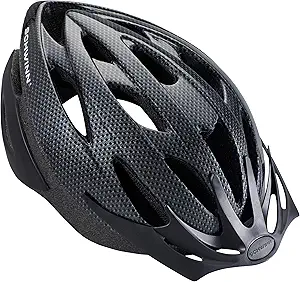
Schwinn Thrasher Adult Bike Helmet, 58–62 cm
The Thrasher plays a different role than everything else here: it’s the no-frills entry point for riders testing whether mountain biking sticks. Compared with the ANY PASS, it skips premium touches — no MIPS, no camera mount, no CE certification — but it covers the basics with a CPSC-compliant shell, adjustable dial, and a removable visor. The removable washable padding matters more than it sounds for beginners, since sweat-soaked pads are the fastest way to make a cheap helmet feel gross. Where it falls short is fit range: the 58–62 cm band excludes most smaller adults and teenagers, and there’s no MIPS liner like the Giro Fixture MIPS II offers, so rotational protection is off the table entirely. Even the vent count is inconsistently documented, which hints at how basic the spec sheet is.
Pros:- Meets the U.S. CPSC bicycle helmet safety standard
- Adjustable dial, side straps, and chin strap allow fit customization
- Removable washable padding keeps the helmet fresh
- Removable visor adds sun and debris protection
Cons:- Sizing covers only 58–62 cm, excluding smaller heads
- No rotational-impact protection like MIPS-equipped rivals
Best for: New riders aged 14 and up with larger heads who want a safe, washable starter helmet for casual trail and path riding
Not ideal for: Smaller-headed riders or anyone riding aggressive trails — the 58–62 cm range and lack of rotational protection are real limits
- Head Circumference:58–62 cm
- Recommended Age:14 years and older
- Construction:Microshell
- Fit System:Adjustable dial, side straps, chin strap
- Ventilation:Approximately 21 vents
- Visor:Removable
- Safety Standard:U.S. CPSC
Our verdict“A sensible, safety-certified starter helmet for larger-headed casual riders who aren’t ready to invest in premium features.”
ANY PASS Adult Mountain Bike Helmet – Ultra Comfort, Super Lightweight with Adjustable Fit and Removable Sun Visor
At 330 grams, the ANY PASS is the lightest helmet in this batch — noticeably lighter than the KINGBIKE at 390g and a touch under the Favoto’s 335g. On long climbs and all-day rides, that weight difference shows up as less neck fatigue. It also carries a 2-year warranty, double what KINGBIKE or Favoto offer, which signals the brand stands behind the build. The 17-vent layout and washable pads make it comfortable for mixed trail and commuting use, and the two-size system (54–58 cm and 57–61 cm) actually fits more head shapes than the Schwinn Thrasher’s single large range. The compromises are familiar budget-tier ones: CPSC-only certification means no higher-speed e-bike rating, and the detachable visor is easy to lose once it’s off the helmet — a small annoyance, but a real one for anyone who swaps it between rides.
Pros:- Lightest helmet in this lineup at just 330 g
- 17 ventilation vents keep airflow strong on climbs
- Two-size fit system covers 54–61 cm heads
- 2-year warranty doubles most competitors’ coverage
Cons:- Only CPSC certified, with no higher-speed e-bike standard
- Detachable visor is easy to misplace when removed
Best for: All-day trail riders and bike commuters who want the lightest helmet in this group with everyday comfort features
Not ideal for: Fast e-bike riders — without NTA-8776 certification like the KINGBIKE, it isn’t rated for higher-speed impacts
- Brand:ANY PASS
- Model:WJ-015
- Weight:330 g
- Sizes:M (54–58 cm) / L (57–61 cm)
- Vents:17
- Safety Standard:U.S. CPSC
- Construction:PC outer shell, high-density EPS core
- Warranty:2 years
Our verdict“The lightest, most comfortable do-it-all choice for riders who log long hours in the saddle at normal bicycle speeds.”
Favoto Adult Mountain Bike Helmet with Visor
The Favoto earns its place through small conveniences that add up on the trail: a magnetic buckle that fastens one-handed even with gloves on, an included elastic cord for stowing glasses, and a dual-shell PC construction with 20 mm EPS foam — thicker impact absorption than most rivals here. Where the Giro Fixture MIPS II invests in rotational protection, the Favoto invests in day-to-day usability, and riders who fumble chin buckles every ride will appreciate the difference immediately. It claims both CPSC and CE certification, though the biggest red flag is transparency: no sizing or fit range is published at all. That’s a real problem when every competitor in this roundup — including the ANY PASS with its two clear size bands — tells you exactly which heads it fits. Buy this only if you can try it or return it easily.
Pros:- Magnetic buckle allows true one-handed fastening, even gloved
- 20 mm EPS foam offers thicker impact absorption than most rivals
- Elastic cord secures sunglasses when not worn
- Dual-shell PC construction with removable visor
Cons:- No sizing or head-circumference information published, making fit a guessing game
- No rotational-impact technology like MIPS
Best for: Glove-wearing trail riders who value one-handed magnetic buckling and built-in glasses storage over certified rotational protection
Not ideal for: Online buyers who need certainty — with no published size range, the fit is a gamble compared with clearly sized rivals
- Brand:Favoto
- Model:B025
- Weight:335 g (11.8 oz)
- Shell:Dual-shell PC
- EPS Foam Thickness:20 mm
- Buckle:Magnetic, one-handed
- Visor:Removable
- Included:Helmet, glasses strap, magnetic buckle, removable visor
- Safety Standards:CPSC and CE (manufacturer stated)
- Warranty:1 year
Our verdict“A convenience-first helmet for riders who prioritize the magnetic buckle and glasses storage — provided they can confirm the fit first.”
OUWOR Adult and Youth Bike Helmet with Adjustable Visor
What sets the OUWOR W-029 apart from everything else in this lineup is what comes in the box: a carrying bag plus a spare set of pad liners, which is handy for riders who sweat heavily or want to freshen the interior after a season of use. Compared with the Favoto Mountain Bike Helmet, which offers no extra liners, this option makes more sense for everyday commuters who transport their helmet in a pack. The three-position detachable visor is genuinely useful — angled low for sunny road stretches, removed entirely for night rides. Tradeoffs are real, though: at 0.44 kg it is the heaviest helmet in this batch, and only two size splits mean riders between the listed ranges may struggle to get a snug fit.
Pros:- Includes carrying bag and a full spare set of pad liners
- Three-position visor adapts to sun angle or removal for night riding
- 14 vents keep airflow reasonable for its weight class
- Rear dial plus adjustable chin straps allow a dialed-in fit
Cons:- Heaviest helmet in this batch at 0.44 kg
- Only two size options leave gaps for in-between head sizes
Best for: Commuters and multi-sport family riders who transport their helmet often and want spare padding on hand
Not ideal for: Weight-conscious trail riders — at 440 g it is noticeably heavier than the 335 g Favoto, and the limited size range complicates fit
- Brand:OUWOR
- Model:W-029
- Sizes:Medium: 55–58 cm; Large: 59–61 cm
- Materials:Polycarbonate shell with EPS foam
- Weight:0.44 kg
- Ventilation:14 vents
- Visor:Detachable, three-position adjustable
- Safety Standard:U.S. CPSC (age 5 and older)
Our verdict“Buy this if you want a versatile, accessorized helmet for mixed riding; skip it if grams matter on long climbs.”
Favoto Mountain Bike Helmet with Visor for Adults
At 335 g, the Favoto is the lightest helmet in this batch, roughly 100 g lighter than the OUWOR and lighter than either BATFOX model — a difference you feel on sustained climbs and all-day trail sessions. Its 20 mm EPS foam layer is thicker than typical, and the dual-shell PC construction wraps more of the foam in protective plastic than the single-shell budget options here. The standout convenience feature is the magnetic buckle, which can be fastened one-handed — a genuine upgrade over the standard pinch buckles on the BATFOX LA303 and LA302. The rear elastic cord for stashing cycling glasses is a nice touch for descents. The tradeoff: there is no documented track record of real-world performance, and it lacks the removable, washable padding the BATFOX models include.
Pros:- Lightest helmet in this batch at 335 g
- One-handed magnetic buckle is faster than standard pinch buckles
- 20 mm EPS foam and dual-shell construction for impact absorption
- Rear elastic cord secures cycling glasses on descents
Cons:- Limited real-world performance history compared with established brands like Giro
- Padding is not removable or washable unlike the BATFOX models
Best for: Cross-country and trail riders who prioritize low weight and quick one-handed buckle operation
Not ideal for: Riders who want proven long-term durability data or removable washable padding for heavy sweat use
- Weight:335 g (11.8 oz)
- EPS Foam Thickness:20 mm
- Shell:Dual-shell polycarbonate
- Buckle:Magnetic, one-handed
- Additional Feature:Rear elastic cord for cycling glasses
- Safety Standards:CPSC and CE
Our verdict“The pick for gram-counting trail riders who value speed and convenience over washable interiors and brand pedigree.”
BATFOX Mountain Bike Helmet for Adults and Youth
The BATFOX LA303 earns its spot by being the only helmet in this batch that offers an XL size up to 63 cm — a genuine rarity, since the OUWOR and Favoto top out at 61 cm. Riders who usually find budget helmets painfully tight will appreciate that alone. It also carries the broadest certification set here: CPSC, ASTM F1447, and CE, giving it an edge over the Favoto and OUWOR on paper. With 18 vented channels versus the OUWOR’s 14, it should run cooler on long summer climbs. Like the BATFOX LA302, it has a dial fit system and removable, washable padding, so the choice between them comes down to sizing: the LA302 caps at 59 cm, while the LA303 covers everyone else. The main gaps: no published weight, and the largest visor here can obstruct upward vision when riding aggressively.
Pros:- Only helmet in this batch offering XL sizing up to 63 cm
- Triple certified to CPSC, ASTM F1447, and CE standards
- 18 vents with internal channels out-cool the 14-vent OUWOR
- Removable, washable padding and chin pad for hygiene
Cons:- No weight specification provided, making pre-purchase comparison difficult
- Oversized visor can block uphill sightlines in an aggressive riding position
Best for: Riders with larger heads (58–63 cm) who struggle to find certified helmets that fit without pressure points
Not ideal for: Riders with smaller heads under 54 cm, or weight-conscious riders who need a published weight before buying
- Brand:BATFOX
- Model:LA303
- Material:Polycarbonate shell with EPS foam liner
- Safety Standards:CPSC, ASTM F1447, CE
- Ventilation:18 vents with internal channels
- Fit System:Rear dial-adjustable
- Sizes:M (54–58 cm), L (58–61 cm), XL (61–63 cm)
- Padding:Removable, washable padding and chin pad
Our verdict“If standard sizes pinch your head, this is the inclusive-fit pick; smaller riders can get similar features from the LA302.”
BATFOX Adult and Youth Bike Helmet with Visor
The BATFOX LA302 makes the most sense for households buying one helmet model to share: its M size starts at 52 cm, small enough for teens, while the L extends to 59 cm for most adults — a wider effective range on the small end than the OUWOR or the BATFOX LA303, both of which start at 54–55 cm. It carries CPSC and CE EN1078 certification, 18 ventilation channels, a rear dial, and washable padding — the same core formula as the LA303 but aimed at smaller heads. The one-year warranty is a nice assurance the Favoto does not explicitly match. Tradeoffs: at roughly 390–400 g it sits toward the heavy end of this batch, and the imprecise weight listing hints at loose quality control. If your head measures above 59 cm, step up to the LA303 instead.
Pros:- Size range starting at 52 cm fits teens and smaller adults most helmets exclude
- Dual certified to CPSC and CE EN1078 standards
- Removable, washable padding simplifies shared use between riders
- Backed by a one-year warranty
Cons:- Heavier than the Favoto at roughly 390–400 g
- Inconsistent listed weight (390 g vs 400 g) suggests loose manufacturing tolerances
Best for: Families with teens and adults sharing gear, where a single 52–59 cm size range covers multiple riders
Not ideal for: Larger riders over 59 cm or weight-sensitive trail riders — the OUWOR-style heft is noticeable on long rides
- Brand:BATFOX
- Model:LA302
- Safety Standards:U.S. CPSC and E.U. CE EN1078
- Materials:Polycarbonate shell with EPS foam liner
- Weight:Approximately 390–400 g
- Ventilation:18 channels
- Size Range:M: 52–55 cm; L: 55–59 cm
- Fit System:Rear dial adjustment
- Warranty:1 year
Our verdict“A sensible shared-family helmet for smaller heads; bigger or weight-focused riders should look at the LA303 or Favoto.”

How We Picked
I evaluated each helmet against four criteria, weighted in this order: certification and impact protection, fit range and retention system, visor and trail-specific features, and value for the price tier. Helmets with MIPS or NTA 8776 certification ranked above uncertified shells because rotational-impact technology and e-bike speed ratings measurably change the protection equation, not just the spec sheet. I then looked at how many head sizes each shell actually fits — a helmet that only covers 59–61 cm serves a fraction of riders compared with a 54–61 cm universal design.
After safety and fit, I compared trail usability: visor adjustability (fixed visors lose points for riders who store goggles under them), camera mounts, ventilation channel count, and pad quality. Finally, I checked value within each tier, because a $35 helmet with a dial system and LED light can outperform a $60 helmet that skips those features. This weighting explains the ranking: certified Giro models lead, NTA-rated e-bike helmets fill the specialist slots, and budget helmets are ordered by fit range and feature completeness rather than brand familiarity.
| mountain bike helmet | Sizes |
|---|---|
| BATFOX NTA 8776 E-Bike and Mou | S: 51–54 cm; M: 55–58 cm; L: 57–61 cm |
| BUCKLOS Adult Mountain Bike He | — |
| Giro Fixture MIPS Adult Bike H | — |
| AURVEE Adult Mountain Bike Hel | S: 52–56 cm; M: 55–58 cm; L: 58–61 cm |
| BATFOX Mountain Bike Helmet wi | M (54–58 cm), L (58–61 cm), XL (61–63 cm) |
| KINGBIKE NTA-8776 Mountain Bik | Medium (53-56cm), Large (57-61cm) |
| Giro Fixture MIPS II Bike Helm | — |
| Schwinn Thrasher Adult Bike He | — |
| ANY PASS Adult Mountain Bike H | M (54–58 cm) / L (57–61 cm) |
| Favoto Adult Mountain Bike Hel | — |
| OUWOR Adult and Youth Bike Hel | Medium: 55–58 cm; Large: 59–61 cm |
| Favoto Mountain Bike Helmet wi | — |
| BATFOX Mountain Bike Helmet fo | M (54–58 cm), L (58–61 cm), XL (61–63 cm) |
| BATFOX Adult and Youth Bike He | — |
Factors to Consider When Choosing Mountain Bike Helmets
Before settling on one of the 14 helmets above, it helps to understand what actually separates a safe, comfortable trail helmet from a disappointing one. These are the factors that shaped my ranking and the ones most buyers get wrong.Certification: MIPS and NTA 8776 Are Not Marketing Fluff
A CPSC sticker is the legal minimum in the US, but it only covers straight-line impacts. MIPS liners address the rotational forces generated when you hit the ground at an angle — which describes almost every real mountain bike crash. The Dutch NTA 8776 standard goes further, requiring extra coverage at the temples and rear plus higher-impact testing, and it was written specifically for e-bike speeds. A common mistake is treating these certifications as upsells; if you ride fast descents, technical terrain, or a Class 3 e-bike, they are the single biggest safety upgrade you can buy. Riders on gentle gravel paths at low speed can reasonably save money here, but trail riders should not. Only two helmets in this lineup carry MIPS, which is exactly why they rank first and second.
Fit Range: Check the Centimeter Range Before Anything Else
Helmet sizing labels like “adult” mean almost nothing — the printed centimeter range is what matters, and you should measure your head circumference above the eyebrows before ordering. A helmet like the Giro Fixture spans 54–61 cm, fitting most adults and many teens, while the BUCKLOS covers only 59–61 cm, which excludes most women and smaller riders entirely. An ill-fitting helmet cannot protect you properly: too large and it shifts in a crash, too small and it presses headaches into long rides. Dial-based retention systems tolerate a wider range within a shell than strip-pad systems, which is why I favored them in the ranking. Also remember that padding compresses over months, so a helmet that barely fits on day one will be loose within a season.
Visor Design: Adjustable Beats Removable, Removable Beats Fixed
On singletrack, the visor is not decoration — it blocks low sun, deflects branches, and shields your eyes from mud spray. An adjustable visor can be raised to stash goggles underneath or dropped for descending, which is why the KINGBIKE outranks fixed-visor competitors. Removable visors like the AURVEE’s offer flexibility for riders who also use the helmet on the road, but you lose the ability to reposition mid-ride. Fixed visors, common on the cheapest models, force a compromise: high enough to see under, low enough to matter. If you never ride with goggles and mostly cruise flow trails, visor type matters far less than ventilation, and you can deprioritize it.
Ventilation and Weight: The Long-Ride Comfort Equation
Ventilation matters more than most buyers expect because mountain climbing generates far more heat than road riding at steady speed. Look for deep internal channels that connect front intakes to rear exhausts, not just surface holes — two helmets with the same vent count can feel completely different in July. Weight compounds this: a heavier helmet with a poor strap design causes neck fatigue on three-hour rides even if it feels fine in the parking lot. Inshell-molded construction (the standard on the Giros) tends to be both lighter and better vented than glued-shell budget builds. The tradeoff is that more vents mean less foam between your head and the ground, which is another reason certified impact design beats raw vent count.
E-Bike Riders Need to Buy Differently
If you ride a Class 3 e-bike or an e-MTB, standard bicycle helmets are technically rated for lower speeds than you travel. The NTA 8776 certification exists precisely for this gap, and in this lineup only the KINGBIKE and the BATFOX NTA model carry it. Beyond certification, e-bikers should prioritize extended rear coverage, a bright color way, and a rear light mount — the budget helmets in this guide with built-in LED lamps punch above their price for commuting. A camera mount is also genuinely useful for e-bike riders in traffic, both for capturing rides and documenting incidents. Do not assume a motorcycle-style look means motorcycle-level protection, though; the shell geometry still follows bicycle helmet rules unless the label says otherwise.
When to Spend More — and When Not To
The honest threshold in this category is simple: under about $40 you are buying comfort features, and above it you start buying measurable protection technology. If you ride once a month on smooth paths, a well-fitting budget helmet with a dial system is a perfectly rational choice — an uncomfortable expensive helmet you never wear protects you less than a cheap one you wear every ride. But if you ride weekly or hit real descents, the jump to a MIPS-equipped helmet is the best money-per-risk-reduced in cycling. Also budget for replacement: any helmet involved in a crash, or any helmet older than five years with heavy use, should be retired regardless of how it looks. The mistake I see most often is overspending on aesthetics while ignoring fit range — a mismatched size nullifies every premium feature you paid for.
Frequently Asked Questions
Is MIPS worth the extra money over a standard mountain bike helmet?
For regular trail riders, yes. MIPS is a low-friction liner inside the helmet that allows your head to rotate slightly during an angled impact, reducing the rotational forces linked to concussions. Since most mountain bike crashes involve hitting the ground at an angle rather than perfectly flat, this technology addresses the crash type you are most likely to experience. In this roundup, the two Giro Fixture models are the only MIPS options, and their higher ranking reflects that. Casual riders on smooth paths at low speed can reasonably skip it, but anyone riding technical terrain weekly should treat MIPS as a floor requirement, not a luxury.
Can I use a regular mountain bike helmet on a fast e-bike?
You can legally, but you are working outside the helmet’s tested speed range if you ride a Class 3 e-bike (28 mph assist). Standard CPSC bicycle certification assumes lower impact energies, which is why the Dutch developed the NTA 8776 standard specifically for speed pedelecs — it requires more coverage and higher impact testing. In this lineup, the KINGBIKE NTA-8776 and the BATFOX NTA 8776 are the two helmets built to that standard. Beyond certification, e-bike riders benefit from extended rear coverage and better visibility features like light mounts. If your e-bike tops out at 20 mph, a quality standard helmet with a good fit is generally adequate.
Why does the same brand (BATFOX) appear four times — which one should I pick?
BATFOX dominates the budget segment by selling variations of the same basic shell rather than distinct helmets. The NTA 8776 version is the one worth singling out because it carries the e-bike certification the others lack. Among the rest, the differences come down to visor style, color ways, and included extras like tail lights, not protection level or fit range. My advice: pick the cheapest BATFOX variant that has the visor and accessory setup you want, and only step up to the NTA model if you ride a fast e-bike. If you want genuine safety differentiation at a similar price, the Giro Fixture line is the stronger choice.
How do I know if a helmet will fit before I can try it on?
Start by measuring your head circumference with a soft tape about one finger width above your eyebrows, then match it against the printed range — not the size name — on the product listing. A helmet with a 54–61 cm range like the Giro models will accommodate most adults, while something listed at 59–61 cm like the BUCKLOS only suits larger heads. Once it arrives, the helmet should sit level with roughly two finger-widths above your eyebrows, and the dial or ratchet system should let you snug it without pressure points. Shake your head hard side to side: minimal movement means the retention system is doing its job. If you are between sizes, choose the smaller shell and let the dial do the adjusting, since an oversized helmet shifts during impacts.
How often should I replace a mountain bike helmet?
Replace any helmet immediately after a crash, even if the shell looks intact, because the foam underneath compresses on impact and cannot protect you a second time. Beyond crashes, the general guideline is every five years for helmets used regularly, since UV exposure and sweat gradually degrade both the foam and the strap anchors. Check the retention dial and buckle periodically — a dial that slips or a buckle that no longer locks securely means the helmet is unsafe regardless of age. Also inspect the shell for cracks or areas where the outer plastic has separated from the foam, which signals the molded structure is compromised. Given how affordable solid options are in this roundup, there is no good reason to stretch an aging helmet’s lifespan.
Conclusion
Matching these 14 helmets to rider types is straightforward once the tradeoffs are clear. For the best overall pick, the Giro Fixture MIPS II stands out for combining rotational-impact protection, a universal 54–61 cm fit, and refined ventilation — it is the helmet I would put on the most heads. The best value goes to the original Giro Fixture MIPS, which keeps the safety technology at a lower price, while the KINGBIKE NTA-8776 takes the best premium/specialist slot for e-bike and high-speed riders who need the NTA certification and camera mount. For beginners and casual trail riders, the Schwinn Thrasher and OUWOR offer easy dial-fit systems and friendly pricing without overwhelming features. Riders on the tightest budget or needing larger head sizes should look at the BUCKLOS or Favoto models, keeping their narrower fit ranges in mind. Whatever you choose, a correctly sized, certified helmet you actually wear on every ride beats any premium spec left hanging on the garage wall.
NFL season / tailgating Picks
team gear
As an affiliate, we earn on qualifying purchases.