For mountain biking after dark, I’d choose a light for a useful trail beam and dependable mounting, not the biggest lumen number alone. My best overall pick is the Suruid Super Bright LED Bike Light, which is explicitly aimed at MTB and off-road riding; the 1200LM Wide Angle Bike Lights stand out for broader coverage, while the Ascher USB Rechargeable Bike Light Set is a simpler choice for easier rides and beginners. The main tradeoff is between brighter, wider illumination and the weight, battery demands, and mounting demands that can come with it. A front light may help you see the trail, while a rear light helps others spot you, but a set’s specifications do not by themselves confirm its trail suitability. Read on for the full comparison and advice on matching lights to your routes.

Get sports gear delivered free with Prime
- Fast, free delivery on millions of items
- Prime Video, Amazon Music and more included
- Member-only deals all year
Complete the kit


Key Takeaways
- Trail-specific positioning separates the most relevant picks: Suruid explicitly names MTB and off-road cycling, while many other listings use broad night-riding language.
- Lumen figures vary widely, but they are not a complete performance comparison: the 4,000-, 6,800-, 8,000-, and 10,000-lumen titles do not establish beam shape, runtime at high output, or real trail visibility.
- Wide-angle coverage may matter more on winding singletrack than a headline output figure: the 1200LM Wide Angle model calls out its beam spread, but buyers should still check battery life and mounting details.
- Front-and-rear sets make visibility easier to assemble: most of this lineup includes both lights, while a powerful headlight-only option may call for a separate rear light.
- Several models have similar names or repeated configurations: the two Ascher listings both describe four modes, so compare the exact included parts and specifications rather than relying on title differences.




| bike lights for mountain biking | Water resistance | Weight | Power source | Maximum light output |
|---|---|---|---|---|
| DARKBEAM Bike Headlight Rechar | IPX5 | 2.51 ounces | Battery powered | 4000 lumens |
| USB Rechargeable Bike Lights S | Water resistant | 3.2 ounces | Battery powered | 550 lumens |
| Bike Lights Front and Back Set | Waterproof | 35 grams per light | Battery powered | — |
| Bike Light Set | IPX5 | — | — | 8000 lumens |
| Victoper 10 LED Bike Light Set | IP65 | 1 ounce | Battery powered | 500 lumens |
| Ascher Ultra Bright USB Rechar | Water resistant | 0.39 kg | USB-rechargeable battery | 300 lumens |
| Zewdov Bike Lights for Night R | IP65 | 27 g | — | — |
| 2026 New 1200LM Wide Angle Bik | IP65 | — | — | — |
| Victoper Bike Light Set | IPX4 | 4 oz | Battery powered | 150 lumens |
| Suruid Super Bright LED Bike L | IPX4 | 0.3 kg | Battery powered; USB rechargeable | — |
| Zewdov High Lumen Super Bright | IP65 | — | — | — |
| Bike Lights for Night Riding | IPX5 | 0.42 kg | Rechargeable battery | 10,000 lumens |
| Ascher Ultra Bright USB Rechar | IPX4 | — | USB-rechargeable batteries | 300 lumens |
| Cuvccn Bike Lights Set | IPX6 | 77 g | — | — |
| 2026 Upgrade 6800 Lumen Bike L | IPX6 | 0.33 kg | Rechargeable battery | — |
More Details on Our Top Picks
DARKBEAM Bike Headlight Rechargeable USB-C 4000LM
The DARKBEAM 4000-lumen headlight is the strongest middle ground here for riders who need trail illumination without the bulk implied by the 8000-lumen Bike Light Set. Its stated output is better suited to revealing a wider, darker path than the 550-lumen commuter set, while six modes give riders options for changing pace or conserving battery. The aluminum body and IPX5 rating add practical protection against wet rides, and the listed weight is only 2.51 ounces. The package also includes a red taillight, though its brightness options may feel limited beside the powerful front lamp. Runtime is listed as varying from four to eight hours, and the handlebar-only mount leaves helmet-light users looking elsewhere. I’d choose it for general night trail riding, not for riders who need a verified long-duration setup.
Pros:- Stated 4000-lumen output offers more headlight capacity than the 550-lumen commuter set.
- Six modes provide choices for changing trail and visibility conditions.
- IPX5 protection and an aluminum body suit wet-weather riding.
- Listed weight is 2.51 ounces, lighter than the large-battery 8000-lumen set.
Cons:- Four-to-eight-hour runtime varies by mode, which may not suit extended night rides.
- Handlebar mounting only; no helmet mount is included.
- The included taillight may feel underpowered compared with the headlight.
Best for: Mountain bikers who want a bright handlebar beam, a basic rear light, and several modes without carrying the larger 8000-lumen set.
Not ideal for: Riders who need a helmet-mounted beam, a clearly specified long runtime, or a high-output rear light.
- Maximum light output:4000 lumens
- Lighting modes:6
- Water resistance:IPX5
- Mount:Handlebar
- Weight:2.51 ounces
- Material:Aluminum
- Power source:Battery powered
- Approximate runtime:4–8 hours, depending on mode
Our verdict“Choose the DARKBEAM for a bright, relatively light handlebar setup for night trails, but skip it if you need helmet mounting or dependable all-night runtime.”
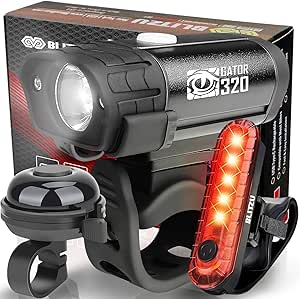
USB Rechargeable Bike Lights Set with Bell, LED Bicycle Front and Rear Lights
This set makes more sense for a beginner riding familiar paths at dusk than for someone pushing into fast, technical descents. Its 550-lumen maximum is well below the DARKBEAM’s 4000 lumens and the 8000-lumen set, so it offers less headroom for spotting trail features at speed. That lower output can still suit low-speed, well-lit routes, while the included bell and rear light make it a practical everyday bundle. Tool-free installation and USB recharging also keep setup simple. The tradeoff is clear: the product is described for commuting and casual riding, not aggressive off-road use, and the mounts can loosen if not tightened properly. I’d pick it for a rider building a basic kit, not as my choice for dark singletrack.
Pros:- Includes front and rear lights plus a bell in one set.
- Tool-free mounting makes setup approachable for newer riders.
- USB rechargeable for routine use.
- Water-resistant construction is suited to ordinary wet-weather rides.
Cons:- Maximum 550-lumen output is modest for demanding mountain-bike trails.
- The product is not designed for aggressive downhill or off-road riding.
- Mounts may loosen if they are not secured carefully.
Best for: New mountain bikers who ride mellow, familiar trails near dusk and also want a bell and lights for everyday cycling.
Not ideal for: Riders tackling unlit singletrack, technical descents, or fast night rides that call for stronger forward illumination.
- Maximum light output:550 lumens
- Lighting settings:4
- Water resistance:Water resistant
- Mount:Handlebar
- Weight:3.2 ounces
- Material:Aluminum
- Power source:Battery powered
- Included accessories:Rear light and bell
Our verdict“Pick this set for mellow rides and everyday cycling, but choose a brighter trail-focused light for technical night riding.”
Bike Lights Front and Back Set for Night Riding
At 35 grams per light, this front-and-rear set is the easiest choice here to carry as a compact backup or fit to a bike used for short, slower rides. Its 300-lumen front light is less capable for seeing rough trail features than the DARKBEAM, and it falls well short of the 8000-lumen set for riders covering dark ground at speed. The rear light’s stated 100-lumen output adds visibility from behind, while silicone-strap, tool-free mounting makes swapping lights between bikes straightforward. The description mentions multiple modes and memory, but the specs list one setting, so mode options are not clearly established. Non-detachable batteries also mean charging the lights themselves, rather than swapping in a spare. I’d treat this as a lightweight visibility set, not a primary technical-trail system.
Pros:- Each light weighs just 35 grams.
- Front and rear outputs are specified at 300 and 100 lumens.
- Silicone straps allow tool-free installation and easy bike swaps.
- Waterproof construction suits rides in wet conditions.
Cons:- The 300-lumen front light is limited for seeing technical trail features at speed.
- The battery is non-detachable, so riders cannot carry and swap a spare.
- Mode information is inconsistent: the description mentions multiple modes, while the specs list one setting.
Best for: Riders who prioritize minimal carried weight, easy strap-on installation, and lights for short rides or backup use.
Not ideal for: Mountain bikers who need a powerful beam for fast, technical trails or want replaceable batteries for long outings.
- Front light output:300 lumens
- Rear light output:100 lumens
- Weight:35 grams per light
- Water resistance:Waterproof
- Mount:Handlebar mount
- Material:Plastic
- Power source:Battery powered
- Charging:USB
Our verdict“Choose this lightweight set for short, low-speed rides or backup visibility, not as your main light for demanding night trails.”
Bike Light Set, 8000 Lumens Headlight and Taillight for Night Cycling
For riders who spend long stretches on unlit trails, this is the most ambitious setup in the group: the 8000-lumen headlight, 5800mAh battery, and LCD battery display are aimed at sustained night riding rather than quick commutes. Compared with the DARKBEAM’s 4000-lumen maximum, it offers a higher stated output and a larger battery, while its 13 modes give more ways to tailor the beam. The listed runtime reaches up to 16 hours, though actual duration depends on mode; the battery’s capacity also brings a weight penalty that the product description flags. A taillight and power-bank function add utility, but the output may be excessive for casual or daytime riders. I’d choose this for extended, genuinely dark rides, not for anyone prioritizing the lightest cockpit.
Pros:- Stated 8000-lumen maximum exceeds the DARKBEAM’s 4000-lumen output.
- 5800mAh battery and listed runtime of up to 16 hours suit longer outings.
- LCD display provides battery-status information while riding.
- Includes a taillight and USB power-bank function.
Cons:- The larger battery adds weight, which can be unwelcome on rough trails.
- Maximum output may be unnecessary for casual riding and can reduce runtime when used.
- Handlebar mounting does not provide a helmet-mounted beam.
Best for: Mountain bikers planning extended night rides on unlit trails who value high stated output, battery-status information, and a large battery.
Not ideal for: Casual riders, daytime cyclists, or weight-conscious trail riders who do not need a large battery and very high output.
- Maximum light output:8000 lumens
- Battery capacity:5800mAh
- Lighting modes:13
- Water resistance:IPX5
- Mount:Handlebar
- Material:Aluminum
- Maximum stated runtime:Up to 16 hours
- Charging time:Approximately 3 hours
Our verdict“Choose this high-output set for long, dark trail rides when battery capacity matters more than keeping the bike’s front end light.”
Victoper 10 LED Bike Light Set with 8+9 Modes, USB Rechargeable Waterproof Bicycle Front and Rear Lights
The Victoper set stands out for riders who want a small, adaptable front-and-rear kit rather than the sheer output of the 8000-lumen headlight. Its 500-lumen maximum is a more modest fit for mountain biking: useful for visibility and slower routes, but less suited to fast riding on unfamiliar, technical trails than the DARKBEAM’s 4000-lumen headlight. The eight front and nine rear modes offer plenty of signaling choices, although frequent mode changes may feel fiddly on the trail. IP65 protection and an aluminum build are appealing for wet, rough conditions, and the listed one-ounce weight keeps the kit easy to carry. Battery runtime is not specified, so I would not rely on it as the only light for a long night ride.
Pros:- Eight front modes and nine rear modes offer varied lighting choices.
- IP65 water resistance and aluminum construction suit wet-weather use.
- Listed weight is only one ounce.
- Front and rear lights provide a compact two-light setup.
Cons:- Maximum 500-lumen output is far below the DARKBEAM and 8000-lumen set for illuminating dark trails.
- Battery runtime is not specified.
- Numerous modes may take extra attention to cycle through while riding.
Best for: Riders wanting a very light, waterproof front-and-rear set with many mode choices for short rides, backup use, or visibility.
Not ideal for: Night-trail riders who need a strong beam to read technical terrain or require a clearly stated battery runtime for long outings.
- Maximum light output:500 lumens
- Front light modes:8
- Rear light modes:9
- Water resistance:IP65
- Mount:Brake mount
- Weight:1 ounce
- Material:Aluminum
- Power source:Battery powered
Our verdict“Choose the Victoper for a lightweight, mode-rich visibility set, but select a brighter light with stated runtime for serious night mountain biking.”
Ascher Ultra Bright USB Rechargeable Bike Light Set, Front Headlight and Back Taillight with 4 Light Modes
I’d pick this 300-lumen front-and-rear set for riders who want a straightforward visibility upgrade for familiar trails and the ride to the trailhead. Its tool-free mounts and four lighting modes keep setup simple, while the included taillight adds a rear-facing signal that a standalone headlight cannot provide. Compared with the Zewdov Q5, Ascher offers a higher stated front-light output, but Zewdov is much lighter and provides specific runtime and charging-time figures. Neither set is a substitute for a dedicated high-output trail light when fast descents or unlit technical terrain demand a long, powerful beam. The Ascher’s water-resistant construction is useful in changeable weather, though its battery may run down faster on high mode and the mounts may loosen over time. I’d treat it as a practical general-purpose set, not a hard-charging night-riding system.
Pros:- 300-lumen maximum output is higher than the Zewdov Q5’s stated 250-lumen headlight output.
- Includes both a front headlight and a rear taillight.
- Tool-free adjustable mounts make installation straightforward.
- Four lighting modes include flashing options for visibility.
Cons:- Battery life may be limited when using the brightest mode.
- Mounts may loosen over time, which can be troublesome on rough trails.
- Water-resistant construction is not specified with an IP rating.
Best for: Mountain bikers who mostly ride familiar, moderate trails and want an easy-to-install front-and-rear set for visibility and occasional after-dark use.
Not ideal for: Riders tackling fast, technical descents in darkness who need sustained, high-output trail illumination or detailed battery-runtime figures.
- Maximum light output:300 lumens
- Lighting modes:4
- Power source:USB-rechargeable battery
- Water resistance:Water resistant
- Mounting:Handlebar and seat mounts
- Weight:0.39 kg
- Materials:Aluminum, plastic, and silicone
Our verdict“Choose the Ascher set for uncomplicated front-and-rear visibility on moderate rides, but pick a more powerful dedicated headlight for demanding night trails.”
Zewdov Bike Lights for Night Riding, Rechargeable Front and Back
The 27-gram weight makes the Zewdov Q5 a sensible choice for riders who want lights they can leave in a pack or move between a mountain bike, scooter, and backpack. Its front light is rated at 250 lumens, with separate front and rear modes that support visibility without adding much bulk. Compared with the heavier Ascher set, Zewdov is easier to carry and lists a clear charging time and runtime range; Ascher, however, claims a higher maximum output. For mountain biking, that distinction matters: the Q5 fits secondary use, familiar paths, or dusk rides better than it fits fast riding on dark, technical trails. Its IP65 rating offers stronger stated protection from water and dust than the Ascher’s unspecified water resistance, but it must not be immersed, and the exposed USB port needs careful handling.
Pros:- At 27 g, the set is exceptionally light to carry or move between bikes.
- IP65 rating provides specified dust and water protection.
- USB charging time is listed as 1–1.5 hours.
- Separate front and rear modes offer several visibility options.
Cons:- The 250-lumen headlight is less powerful on paper than the Ascher’s 300-lumen light.
- Not designed to be immersed in water.
- The USB port requires careful handling, and runtime varies by mode.
Best for: Riders who want a compact, lightweight front-and-rear set for dusk rides, familiar trails, or carrying as a backup on longer outings.
Not ideal for: Mountain bikers who need a powerful primary beam for unlit technical trails or routinely ride through conditions where the lights could be submerged.
- Model:Q5
- Light output:250 lumens front; 50 lumens rear
- Water resistance:IP65
- Charging time:1–1.5 hours
- Working time:3–16 hours
- Charging:USB rechargeable
- Weight:27 g
- Materials:Polycarbonate
Our verdict“Choose the Zewdov Q5 when low weight and quick charging matter more than maximum trail illumination.”
2026 New 1200LM Wide Angle Bike Lights for Night Riding, 3+5 Modes & IP65 Waterproof Bicycle Lights Front and Rear, Long-Lasting USB Rechargeable for Towing Hitch Lights
This set’s defining feature is its 1200-lumen front light with a 270-degree beam, giving it a broader visibility focus than the compact Zewdov Q5 or basic Ascher set. That wider spread can help riders stay visible from the side and see more around the bike, while the rear light adds five modes for signaling. The IP65 rating and quick-release brackets suit outdoor use, and dual USB-C ports simplify charging if you already carry compatible cables. The tradeoff is that the stated front runtime reaches only up to six hours, with actual endurance dependent on mode. Its plastic construction and reported concerns about bracket security also matter on rough trails, where a shifting light can spoil beam placement. I’d favor it for mixed rides and broad visibility, rather than assuming the headline output guarantees a secure, long-lasting setup on technical descents.
Pros:- 1200-lumen front output is substantially higher than the Ascher and Zewdov sets’ stated outputs.
- 270-degree beam spreads visibility beyond a narrow forward path.
- IP65 water resistance and quick-release brackets support outdoor use.
- Dual USB-C ports provide a modern charging connection.
Cons:- Front runtime is listed as up to six hours and will vary by mode.
- Mounting brackets may feel less secure on rough mountain-bike terrain.
- Plastic construction may be less reassuring than an aluminum-bodied light.
Best for: Riders who want a broad front beam, a rear light, and USB-C charging for mixed trail, road, and outdoor use.
Not ideal for: Riders prioritizing a proven secure mount or long high-output runtime for extended, rough night rides.
- Front light output:1200 lumens
- Beam angle:270 degrees
- Battery capacity:2600 mAh front; 1200 mAh rear
- Water resistance:IP65
- Modes:3 front modes; 5 rear modes
- Battery life:Up to 6 hours front; up to 430 hours rear
- Charging:Dual USB-C ports
- Material:Plastic
Our verdict“Pick this set for broad visibility and higher stated output, but look elsewhere if secure mounting and long high-mode runtime are your main priorities.”
Victoper Bike Light Set – Super Bright USB Rechargeable Front and Rear Lights with 6+4 Modes, Waterproof, for Road and Mountain Night Riding
The Victoper set offers six front modes and four rear modes, giving riders more ways to balance steady illumination and flashing visibility than the four-mode Ascher set. That variety can be useful when a bike moves between trails, roads, and shared paths, but the stated 150-lumen maximum is modest beside the 1200-lumen wide-angle set or the 1800-lumen Suruid headlight. For mountain biking, I’d view Victoper as a visibility set for lit approaches, familiar routes, or backup use—not as the main beam for fast riding in dark woods. Its IPX4 rating indicates splash resistance, while its portable, flashlight-like design offers some flexibility. The listing does not provide battery-life details, and the lights mount to the handlebar, so riders seeking a specifically described seat-mounted rear fixture or predictable long-ride endurance should compare alternatives carefully.
Pros:- Six front and four rear settings provide varied steady and flashing options.
- Includes both front and rear lights.
- Portable design can also be used as a flashlight.
- IPX4 water resistance offers protection against splashes.
Cons:- 150-lumen maximum output is lower than the Ascher, 1200-lumen, and Suruid options.
- Battery-life details are not specified.
- Handlebar-only mounting limits placement flexibility.
Best for: Casual mountain bikers who ride familiar or partly lit routes and value multiple signaling modes in a compact front-and-rear set.
Not ideal for: Riders tackling unlit technical trails, seeking a high-output primary headlight, or needing specified battery runtime and flexible mounting positions.
- Maximum light output:150 lumens
- Settings:10 total; 6 front and 4 rear
- Water resistance:IPX4
- Power source:Battery powered
- Mounting:Handlebar mount
- Weight:4 oz
- Dimensions:4.17 × 1.89 × 1.04 in
Our verdict“Choose Victoper for mode variety and basic visibility on familiar routes, not for illuminating demanding, unlit mountain-bike trails.”
Suruid Super Bright LED Bike Light, USB Rechargeable Bicycle Headlight, Waterproof, Daytime Running Light, MTB Off-Road Cycling Commuting
With a stated 1800-lumen output and aluminum housing, the Suruid is the strongest single-headlight choice in this group on paper. That makes it a better fit for riders seeking a brighter forward beam for off-road use than the 150-lumen Victoper set or the 300-lumen Ascher front light. Its five settings and quick-release handlebar mount add flexibility, while the metal body offers a sturdier feel than the plastic-bodied 1200-lumen wide-angle set. The main limitation is that this is a front light only; it does not include the rear light supplied with Ascher, Zewdov, and Victoper. Water protection is listed as IPX4, so it should not be treated as submersible or as offering stronger ingress protection than the IP65 Zewdov and wide-angle set. Battery-life details are also absent, which makes it harder to plan for extended night rides.
Pros:- 1800-lumen stated output is the highest among these five products.
- Aluminum construction offers a sturdier body than the plastic 1200-lumen set.
- Five settings provide options for different riding conditions.
- Quick-release handlebar mount makes removal convenient.
Cons:- Front light only; a rear light must be purchased separately.
- Battery-life details are not specified.
- IPX4 protection is limited to splash resistance compared with the IP65 sets.
Best for: Mountain bikers seeking a high-output, aluminum-bodied handlebar headlight for off-road riding and willing to source a rear light separately.
Not ideal for: Riders who want a complete front-and-rear kit, verified long-run battery performance, or stronger stated water protection than IPX4.
- Light output:1800 lumens
- Lighting settings:5
- Water resistance:IPX4
- Power source:Battery powered; USB rechargeable
- Mounting:Handlebar mount
- Weight:0.3 kg
- Dimensions:5.94 × 1.61 × 1.18 in
- Material:Aluminum
Our verdict“Choose the Suruid when a high-output front beam and aluminum body matter most, and add a separate rear light for complete bike visibility.”
Zewdov High Lumen Super Bright Bike Lights for Night Riding, Adjustable Modes Bicycle Lights Front and Rear, IP65 Waterproof & Rechargeable Bike Headlight and Taillight Set for Cycling Electronics
The Zewdov pairs a 1000-lumen headlight with a rear light, giving mountain bikers a more balanced visibility setup than a headlight-only focus. Its IP65 protection and stated 5-foot drop resistance suit damp, bumpy rides better than the Ascher set, which is rated IPX4 and produces 300 lumens. The tradeoff is that Zewdov’s eight headlight and seven taillight modes may take some getting used to, and the headlight runs for up to four hours, so frequent high-output use can be limiting on long night rides. USB-C charging and quick charging times make it practical between outings, but riders who need exceptionally high output should compare it with the 10,000-lumen B09MW38SNM option.
Pros:- 1000-lumen headlight offers more trail illumination than the 300-lumen Ascher set.
- Includes a rear taillight for visibility from behind.
- IP65 water protection and stated 5-foot drop resistance suit rougher conditions.
- USB-C charging takes about two hours for the headlight and one hour for the taillight.
Cons:- Headlight runtime of up to four hours may not suit extended high-output rides.
- Eight front and seven rear modes can make operation less straightforward.
- No beam shape or handlebar compatibility details are provided.
Best for: Mountain bikers who want a weather-resistant front-and-rear set for shorter night rides and varied trail conditions.
Not ideal for: Riders planning long, remote rides at high brightness, since the headlight runtime is listed at up to four hours and the battery is not described as swappable.
- Headlight output:1000 lumens
- Battery capacity:2000 mAh headlight; 350 mAh taillight
- Runtime:Up to 4 hours headlight; up to 50 hours taillight
- Charging time:2 hours headlight; 1 hour taillight
- Water resistance:IP65
- Modes:8 headlight modes; 7 taillight modes
- Drop resistance:5 feet
- Charging connection:USB-C
Our verdict“Choose the Zewdov for a weather-resistant, front-and-rear setup on shorter trail rides, but look elsewhere for long high-brightness outings.”
Bike Lights for Night Riding – 10,000 Lumen LED Headlight with Rechargeable Battery and Taillights
This set is the high-output choice in this group, with a claimed 10,000-lumen headlight, a digital display, and included rear lights. That output claim sets it apart from the Zewdov’s 1000-lumen headlight, though the listing does not specify beam pattern or runtime by brightness level—details that matter when choosing a light for technical singletrack. Its IPX5 water resistance is suited to wet-weather riding, while the aluminum body adds a more substantial build than the Ascher’s mixed aluminum, plastic, and silicone construction. At 0.42 kg, it is also the heaviest listed option here, and its built-in battery is non-removable. I’d favor it for riders prioritizing strong stated output, not those seeking a light, easily serviced setup for remote rides.
Pros:- Claims up to 10,000 lumens, the highest stated output among these five products.
- Digital display gives the rider an at-a-glance status feature.
- Includes rear taillights as well as the front headlight.
- IPX5 water resistance and an aluminum body are suited to outdoor use.
Cons:- At 0.42 kg, it is heavier than the Cuvccn set at 77 g.
- The built-in battery is non-removable and not user-replaceable.
- The listing does not specify runtime by brightness level or describe the beam pattern.
Best for: Experienced night riders seeking a high-output headlight with a digital display and rear lights for dark trails or mixed outdoor use.
Not ideal for: Weight-conscious riders and people doing remote, multi-day rides who want to carry a spare or replace the battery themselves.
- Maximum light output:10,000 lumens
- Water resistance:IPX5
- Settings:5
- Runtime:Up to 30+ hours (as listed)
- Weight:0.42 kg
- Dimensions:4.13 × 1.7 × 1.3 inches
- Mounting:Handlebar mount
- Body material:Aluminum
- Power source:Rechargeable battery
Our verdict“Pick this set if maximum claimed output matters more than low weight or battery serviceability.”
Ascher Ultra Bright USB Rechargeable Bike Light Set, Front Headlight and Rear Taillight with 4 Modes
The Ascher is the straightforward entry in this group: a 300-lumen front light, a rear taillight, and four modes keep the setup simpler than the Cuvccn’s 12-mode front light or Zewdov’s combined 15 modes. Tool-free mounting on the handlebar and seat post also suits riders who want to remove the lights between rides. For mountain biking, its limits are clear: 300 lumens is better suited to being seen or riding familiar, already-lit paths than illuminating fast, technical trails in darkness. Its IPX4 water resistance is less protective than the IPX6 Cuvccn, and the listing gives no specific runtime. This is the easiest pick to understand, but riders who regularly tackle unlit singletrack should choose a brighter, more weather-resistant option.
Pros:- Four modes make operation simpler than the Cuvccn’s 12 front-light modes.
- Includes both a front headlight and rear taillight.
- Tool-free handlebar and seat-post mounting makes removal convenient.
- USB-rechargeable batteries avoid disposable cells.
Cons:- 300-lumen maximum output is limited for fast riding on dark mountain trails.
- IPX4 water resistance is lower than the IPX6 rating on the Cuvccn.
- No specific runtime is provided, making ride planning less certain.
Best for: New mountain bikers who need a simple rechargeable front-and-rear set for dusk rides, familiar trails, or visibility around other trail users.
Not ideal for: Riders descending technical, unlit trails at night or riding in heavy rain, where more output and stronger water protection are preferable.
- Maximum light output:300 lumens
- Battery capacity:2000 mAh front; 330 mAh rear
- Water resistance:IPX4
- Settings:4
- Power source:USB-rechargeable batteries
- Mounting:Handlebar and seat post
- Materials:Aluminum, plastic, and silicone
- Configuration:Front headlight and rear taillight
Our verdict“Choose the Ascher for uncomplicated dusk visibility, not for lighting demanding trails after dark.”
Cuvccn Bike Lights Set – Super Bright, Rechargeable, Waterproof Front and Back Bicycle Lights with Multiple Modes
At a listed 77 g, the Cuvccn set is the lightest clearly specified option here, making it appealing to riders who dislike a heavy handlebar setup. Its 400-lumen output is modest beside the Zewdov’s 1000 lumens and far below the 10,000-lumen claim on the B09MW38SNM, so I’d treat it as a visibility and modest path-lighting choice rather than a solution for fast, technical descents. The IPX6 rating gives it stronger stated water protection than the Ascher, while its long listed runtimes favor steady, lower-intensity use. There are 12 front-light modes, which add options but can complicate quick adjustments on the trail. The handlebar mounting detail may also mean extra hardware is needed for some bike setups.
Pros:- Listed weight of 77 g keeps the setup light compared with the 0.42 kg B09MW38SNM.
- IPX6 water resistance offers stronger stated protection than the Ascher’s IPX4 rating.
- Includes front and rear lights with multiple visibility modes.
- Listed runtimes reach up to 58 hours for the front and 25 hours for the rear.
Cons:- 400 lumens is limited for illuminating demanding mountain-bike trails.
- Twelve front-light modes may be cumbersome to cycle through while riding.
- Handlebar mounting may require additional accessories for other mounting positions.
Best for: Weight-conscious riders who want a compact front-and-rear light set for slower night rides, commuting to trails, or backup visibility.
Not ideal for: Mountain bikers who need a powerful beam to read rough, unlit terrain at speed or who prefer a minimal mode selection.
- Brightness:400 lumens
- Battery capacity:1100 mAh front; 350 mAh rear
- Battery life:Up to 58 hours front; up to 25 hours rear
- Charging time:2.5 hours
- Water resistance:IPX6
- Modes:12, including steady and flashing modes
- Weight:77 g
- Dimensions:1.97 × 1.57 × 1.18 inches
- Mounting:Handlebar
Our verdict“Pick the Cuvccn when low weight and weather protection matter more than strong trail illumination.”
2026 Upgrade 6800 Lumen Bike Light for Night Riding, 6 LED, 5+5 Modes
The 2026 Upgrade puts its emphasis on a wide 270-degree illumination angle and a claimed 6800-lumen output, a different approach from the more modest Cuvccn and Ascher sets. For mountain biking, broad coverage can help riders see more of the trail surroundings, but the listing does not specify a beam pattern or how output changes across its 72-plus-hour runtime claim. Its 360-degree rotatable bracket gives more aiming flexibility than the fixed mounting details supplied for the Zewdov. The drawbacks are practical: at 0.33 kg, it adds noticeable weight to the bike, and the 5+5 mode system may be fiddly to operate. The product data also does not clarify whether a rear light is included, so riders needing front-and-rear visibility should verify the package before choosing it.
Pros:- Claims 6800 lumens with a wide 270-degree illumination angle.
- Rotatable bracket allows flexible aiming.
- IPX6 water resistance and shockproof construction are suited to rough outdoor use.
- Lists runtime of more than 72 hours.
Cons:- At 0.33 kg, it is heavier than the 77 g Cuvccn set.
- The 5+5 modes may make quick operation less intuitive.
- The listing does not clarify output-specific runtime or whether a rear taillight is included.
Best for: Riders prioritizing broad, adjustable forward illumination for night rides and willing to accept a heavier light.
Not ideal for: Weight-sensitive trail riders or buyers who require a confirmed rear taillight and clearly documented runtime at high output.
- Claimed output:6800 lumens
- Illumination angle:270 degrees
- Modes:5+5
- Runtime:72+ hours (as listed)
- Water resistance:IPX6
- Weight:0.33 kg
- Material:Aluminum alloy
- Power source:Rechargeable battery
- Mount:360-degree rotatable bracket
Our verdict“Choose this model for adjustable wide-area lighting if weight is secondary and you have confirmed the included light configuration.”

How We Picked
I compared the 15 listings by the details that matter on mountain-bike routes: whether the product is presented for off-road use, the stated output and beam coverage, front and rear light inclusion, mode options, waterproof claims, charging type, and any available information about mounting and battery life. I gave more weight to trail relevance and usable evidence than to a large lumen figure on its own. A bright rating is harder to interpret without runtime at that setting, beam pattern, and a secure handlebar mount.
The order favors options with a clearer match to off-road riding and useful details for judging coverage or versatility, then separates general-purpose sets and simpler options by how much the listing lets a rider evaluate fit. The supplied product titles do not provide verified runtime figures, beam tests, mount construction details, or independent performance data, so I do not treat those as confirmed advantages. I rank similar listings cautiously and recommend checking the exact listing for current specifications before choosing.
| bike lights for mountain biking | Water resistance | Material | Power source |
|---|---|---|---|
| DARKBEAM Bike Headlight Rechar | IPX5 | Aluminum | Battery powered |
| USB Rechargeable Bike Lights S | Water resistant | Aluminum | Battery powered |
| Bike Lights Front and Back Set | Waterproof | Plastic | Battery powered |
| Bike Light Set | IPX5 | Aluminum | — |
| Victoper 10 LED Bike Light Set | IP65 | Aluminum | Battery powered |
| Ascher Ultra Bright USB Rechar | Water resistant | — | USB-rechargeable battery |
| Zewdov Bike Lights for Night R | IP65 | — | — |
| 2026 New 1200LM Wide Angle Bik | IP65 | Plastic | — |
| Victoper Bike Light Set | IPX4 | — | Battery powered |
| Suruid Super Bright LED Bike L | IPX4 | Aluminum | Battery powered; USB rechargeable |
| Zewdov High Lumen Super Bright | IP65 | — | — |
| Bike Lights for Night Riding | IPX5 | — | Rechargeable battery |
| Ascher Ultra Bright USB Rechar | IPX4 | — | USB-rechargeable batteries |
| Cuvccn Bike Lights Set | IPX6 | — | — |
| 2026 Upgrade 6800 Lumen Bike L | IPX6 | Aluminum alloy | Rechargeable battery |
Factors to Consider When Choosing Bike Lights For Mountain Biking
Choosing bike lights for mountain biking means matching the setup to the trail, ride length, and whether you need to see obstacles or mainly be seen. These broader checks can prevent a bright-looking set from being a poor fit once the route gets rough or the ride runs long.
Match the beam to the trail
On smooth, open paths, a focused beam may give you enough forward visibility; winding singletrack benefits from useful light across the trail edges as well. A high lumen claim does not tell you whether the beam creates a bright hotspot with dim areas around it. Look for a beam pattern or explicit wide-coverage description, and check whether the light can be aimed without shifting on rough ground. Avoid pointing a powerful beam directly into another rider’s eyes on shared trails. If possible, compare beam photos or independent tests rather than selecting by output figure alone.
Plan for runtime, not just maximum output
Maximum brightness may be available only for a limited period, so the runtime at the setting you expect to use matters more than a single peak-output claim. Estimate your longest ride, then leave a reserve for slower sections, delays, and colder conditions. A light that needs frequent charging can be a poor match for longer rides even if its headline output is high. Check whether the maker lists runtime by mode and how the battery recharges. If that information is missing, treat the battery performance as uncertain rather than assuming the largest number means the best all-night choice.
Decide whether you need one light or two
A handlebar light illuminates the path from the bike, while a rear light helps other trail users notice you from behind. A front-and-rear set is convenient, but the rear unit does not replace a strong trail-facing beam. For technical descents, some riders may prefer a second front light mounted on a helmet so illumination follows their line of sight; that adds weight and another battery to manage. On busy shared routes or roads between trails, rear visibility becomes more useful. Choose the arrangement around where you ride, rather than assuming every bundled set covers every need.
Check how the light attaches to your bike
Rough trails put more stress on a light mount than a smooth commute does. Check what handlebar diameters the mount fits, whether it uses a strap or a more rigid attachment, and whether the lamp can be aimed securely. A quick-release mount can make charging and theft prevention easier, but a loose fit can let the beam move during bumps. If you use a helmet-mounted light, confirm that the design is compatible with your helmet and does not interfere with vents or straps. Do not assume a light is trail-ready just because its title mentions mountain biking.
Read weather claims carefully
Water-resistance labels can help when rides include rain, spray, or muddy conditions, but they do not make every component immune to water damage. Check the stated rating and the maker’s instructions for charging-port covers, cleaning, and storage. Never charge a wet light, and let it dry before connecting a cable. Mud can also cover a lens and reduce the beam, so a smooth surface that is easy to wipe clean has practical value. For frequent wet-weather riding, prioritize clearly documented protection over vague claims of waterproofing.
Pay for information and support, not just a bigger number
A higher-output model may be worth choosing when you ride fast, encounter very dark trails, or need wider coverage, but only if its runtime, mount, and charging details suit your use. For occasional rides on familiar paths, a simpler set can be more sensible if it has a secure fit and enough light for the route. Compare what is included, such as a rear light, charging cable, and mounting hardware, and check how the manufacturer handles replacement parts or battery issues. Listings with sparse specifications leave more uncertainty, even when their titles sound powerful. Set your priorities before comparing headline figures so you do not pay for output you will rarely use.
Frequently Asked Questions
Is a 4,000-lumen bike light enough for mountain biking?
The number alone cannot answer that, since the beam shape, sustained output, and runtime matter too. A well-directed beam with useful spill can be more helpful on a trail than a brighter light with uneven coverage. Check whether the listed output is tied to a mode and how long that mode lasts. If the listing does not explain those details, treat the figure as a claim to compare cautiously, not a guarantee of trail performance. Your speed, route darkness, and whether you use a helmet light also affect how much output you need.
Should I buy a front-and-rear set or a stronger front light?
Choose based on the problem you need to solve: seeing the trail or being visible to others. Technical, dark trails place more demand on the front beam, while riding near roads or other trail users makes a rear light useful. A bundled set saves the effort of sourcing two lights separately, but its front unit may not match a dedicated trail light’s coverage or runtime. Some riders use a strong bar light and add a rear light separately. Check what is included before assuming a headlight listing also comes with a taillight.
Do I need a helmet light as well as a handlebar light?
A helmet light is not required for every ride, but it can illuminate the direction you look on tight turns or technical sections. A handlebar light gives a steadier beam tied to the bike’s direction and can be easier to operate on long rides. Using both can create more flexible coverage, though it adds weight, charging, and another mount to manage. Make sure any helmet light fits your helmet securely and does not obstruct straps or vents. For simpler routes, start with a suitable bar light and add a helmet unit only if the trail demands it.
How should I compare lights when runtime is missing from the listing?
Missing runtime makes it hard to judge whether a light can handle your usual ride, especially at its brightest setting. Check the manufacturer’s specifications for runtime by mode and look for clear battery and charging information. If those details remain unavailable, avoid treating a high lumen claim as evidence of long-lasting output. Consider a model with more transparent specifications, or carry a backup light for rides where losing illumination would leave you stranded. Recharge the light before each ride rather than relying on an unverified battery estimate.
Can I use these mountain-bike lights on roads between trails?
Many of these listings include rear lights or describe general night riding, so they may suit mixed routes, but the product titles do not establish compliance with local road rules. Check the beam’s aim and avoid directing a high-output front light into oncoming traffic. Confirm that the rear light is visible from the angles and distance relevant to your route. Local requirements for lights can vary, so check the rules where you ride. If road sections are frequent, prioritize a controlled beam and clear rear visibility alongside off-road coverage.
Conclusion
For a broad starting point, I’d choose the Suruid Super Bright LED Bike Light as best overall because its listing specifically names MTB and off-road cycling. The 1200LM Wide Angle Bike Lights are my pick for riders prioritizing wider stated coverage, while the Ascher Ultra Bright USB Rechargeable Bike Light Set is the best beginner-friendly direction among these listings for a straightforward front-and-rear setup. For best value, compare the Victoper 6+4 Mode Set and other bundled lights by included components, charging, and usable specifications rather than assuming a lower-cost or higher-lumen title tells the whole story. I would reserve the 10,000-lumen and other high-output listings for riders who can verify runtime, beam pattern, and mounting details; that is the premium-style choice only when those details support the ride. If your specific need is a simple general-purpose pair, consider the USB Rechargeable Bike Lights Set with Bell, but verify its trail coverage before taking it onto fast, technical routes.