Living in an apartment means every sound travels, so finding a quiet smart trainer is less about luxury and more about maintaining neighborly peace. The Elite Rivo stands out as the best overall pick for its combination of ultra-quiet operation and a foldable design that saves precious floor space. For those who prioritize raw power and stability, the Wahoo KICKR V6 offers superior ride feel, though it demands more space and budget. The main tradeoff you will face is between compact convenience and ride realism; lighter trainers are easier to store but often transmit more vibration through floorboards. This guide breaks down which models actually keep the noise down without sacrificing performance.

Get sports gear delivered free with Prime
- Fast, free delivery on millions of items
- Prime Video, Amazon Music and more included
- Member-only deals all year
Complete the kit


Key Takeaways
- Direct-drive trainers with internal flywheels consistently outperform fluid or magnetic models in decibel reduction, making them the only viable choice for thin-walled apartments.
- Vibration isolation is as important as audible noise; pairing any trainer with a dedicated mat is non-negotiable for preventing bass thuds from traveling through floor joists.
- The Elite Rivo’s foldability offers a unique advantage for small spaces, but it introduces slightly more flex than rigid, heavy-duty competitors like the Wahoo KICKR V6.
- Connectivity standards matter less than ecosystem lock-in; while ANT+ and Bluetooth are universal, software compatibility with platforms like Zwift or TrainerRoad varies by brand.
- Higher wattage ratings do not correlate with quieter operation; in fact, some 2000W+ models generate more wind noise from their cooling fans than lower-wattage units.
| Elite Rivo Smart Trainer – Direct Drive Bike Trainer |  | Best Overall for Apartment Living | Power Accuracy: ±2.5% | Max Power Output: 2100 W | Gradient Simulation: up to 18% | VIEW ON AMAZON | See Our Full Breakdown |
| ThinkRider XXPRO Smart Bike Trainer |  | Best for Clutter-Free Setup | Max Power: 2500W | Max Gradient: 25% | Connectivity: Bluetooth, ANT+ | VIEW ON AMAZON | See Our Full Breakdown |
| ThinkRider X2Max Smart Bike Trainer |  | Best Budget High-Performance Option | Maximum Power: 2000W | Power Meter Error: ±2% | Slope Simulation: Up to 18% grade | VIEW ON AMAZON | See Our Full Breakdown |
| Elite Rivo Smart Trainer – Standard or Zwift Bundle |  | Best for Zwift Enthusiasts | Power Accuracy: ±2.5% | Maximum Power Output: 2100 W | Gradient Simulation: Up to 18% incline | VIEW ON AMAZON | See Our Full Breakdown |
| Garmin Tacx NEO 3M Smart Trainer |  | Best Premium Realistic Feel | Item Weight: 52 pounds | Maximum Power: 2200 watts | Power Accuracy: within 1% | VIEW ON AMAZON | See Our Full Breakdown |
| Wahoo KICKR V6 Smart Indoor Trainer |  | Best Premium Performance | Brand: Wahoo Fitness | Model: KICKR V6 | Max Resistance: 2,200 watts | VIEW ON AMAZON | See Our Full Breakdown |
| ThinkRider XXPRO Smart Bike Trainer 2500W 25% Gradient ANT+ & BLE |  | Best High-Power Value | Brand: ThinkRider | Model: XXPRO | Maximum Power: 2500W | VIEW ON AMAZON | See Our Full Breakdown |
| quiet smart trainers for apartment | Power Accuracy | Connectivity | Weight |
|---|---|---|---|
| Elite Rivo Smart Trainer | ±2.5% | WiFi (2.4 GHz), Dual Bluetooth, Zwift Protocol BLE | 10 kg (22 lbs) |
| ThinkRider XXPRO Smart Bike Tr | — | Bluetooth, ANT+ | — |
| ThinkRider X2Max Smart Bike Tr | — | — | 35.2 pounds |
| Elite Rivo Smart Trainer | ±2.5% | — | 10 kg (22 lbs) |
| Garmin Tacx NEO 3M Smart Train | within 1% | Ethernet, Wi-Fi | — |
| Wahoo KICKR V6 Smart Indoor Tr | +/- 1% | 2.4 GHz Wi-Fi | 22 kg |
| ThinkRider XXPRO Smart Bike Tr | — | — | — |
More Details on Our Top Picks
Elite Rivo Smart Trainer – Direct Drive Bike Trainer
This model stands out for its foldable design and ultra-quiet operation, addressing the two biggest pain points for apartment dwellers: space and noise. Unlike the bulky Garmin Tacx NEO 3M, which requires significant floor space and stability, the Rivo tucks away easily thanks to its carry handle and compact footprint. The ±2.5% power accuracy is sufficient for most structured training plans, though it trails the Garmin‘s ±1% precision. However, the pre-installed Zwift Cog offers a smoother, quieter shifting experience than traditional cassettes, minimizing mechanical clatter. While the 2.4 GHz WiFi limitation could cause dropouts in congested buildings, the dual Bluetooth backup provides reliability. This trainer balances professional-grade features with the practicality required for shared living spaces.
Pros:- Foldable design with carry handle for easy storage
- Ultra-quiet operation ideal for shared walls
- Pre-installed Zwift Cog enables silent virtual shifting
- High power accuracy (±2.5%) for serious training
Cons:- WiFi limited to 2.4 GHz, risking interference
- Cassette not included, adding to initial cost
- No explicit power adapter included for WiFi stability
Best for: Apartment dwellers with limited storage who prioritize low noise levels and easy setup.
Not ideal for: Power users who demand absolute precision (±1%) or live in areas with heavy 2.4 GHz interference.
- Power Accuracy:±2.5%
- Max Power Output:2100 W
- Gradient Simulation:up to 18%
- Connectivity:WiFi (2.4 GHz), Dual Bluetooth, Zwift Protocol BLE
- Included Subscription:12-month My E-Training
- Weight:10 kg (22 lbs)
Our verdict“Choose this if you need a high-accuracy trainer that vanishes into your closet when not in use.”
ThinkRider XXPRO Smart Bike Trainer
This option distinguishes itself with a self-powering motor, eliminating the need for a wall adapter and reducing cable clutter. For apartment riders, this means fewer tripping hazards and a cleaner aesthetic compared to the Elite Rivo, which relies on external power sources for its electronics. The 2500W max power and 25% gradient simulation exceed the capabilities of the ThinkRider X2Max, making it suitable for steeper virtual climbs. However, the iron frame makes it heavier and less portable than the foldable Elite models. While the lack of a power cord is a convenience win, the unit remains stationary due to its weight. It is a strong choice for those who want high-end specs without the hassle of managing power strips.
Pros:- Self-powering design eliminates external power adapters
- High 2500W output and 25% gradient simulation
- Realistic downhill simulation and virtual shifting
- Wide compatibility via Bluetooth and ANT+
Cons:- Heavy iron frame makes relocation difficult
- Limited to 5 resistance settings
- Lacks the compact, foldable form factor of competitors
Best for: Riders who want high wattage and gradient simulation without dealing with power cords.
Not ideal for: Those who need to move the trainer frequently, as the iron frame is heavy and not foldable.
- Max Power:2500W
- Max Gradient:25%
- Connectivity:Bluetooth, ANT+
- Material:Iron
- Dimensions:19.49″ L x 18.9″ W x 20.87″ H
- Load Capacity:242 lbs
Our verdict“Buy this if you prioritize a clean, cord-free setup and need maximum gradient simulation.”
ThinkRider X2Max Smart Bike Trainer
This trainer offers a compelling balance of performance and cost, delivering 2000W of power and ±2% accuracy. Compared to the ThinkRider XXPRO, the X2Max lacks the self-powering feature and lower gradient simulation (18% vs 25%), but it remains a solid performer for structured workouts. The 58 dB noise level is acceptable for apartments, though perhaps not as silent as the Elite Rivo‘s ultra-quiet branding suggests. Its I-beam iron frame provides stability for riders up to 240 lbs, but the 35.2 lb weight means it is not designed for frequent moving. Users must also budget for a separate cassette, which adds to the total cost of ownership. It is a reliable workhorse for those who want smart features without the premium price tag.
Pros:- Dual BLE and ANT+ connectivity for broad app support
- Quiet operation (~58 dB) suitable for indoor use
- Sturdy I-beam frame supports up to 240 lbs
- High 2000W power output for realistic resistance
Cons:- Cassette not included, requiring an extra purchase
- Heavy at 35.2 lbs, making it hard to store away
- Noise level is higher than premium ultra-quiet models
Best for: Budget-conscious cyclists who need reliable power data and stable construction.
Not ideal for: Users who need a foldable or lightweight unit, or those who already own a cassette and want a plug-and-play experience.
- Maximum Power:2000W
- Power Meter Error:±2%
- Slope Simulation:Up to 18% grade
- Noise Level:≈58 dB at 30 km/h
- Weight:35.2 pounds
- Load Capacity:240 lbs
Our verdict“Select this if you want high wattage and stability but don’t mind buying a cassette separately.”
Elite Rivo Smart Trainer – Standard or Zwift Bundle
Identical in hardware to the first Elite model, this bundle is curated specifically for Zwift users who want an out-of-the-box experience. The inclusion of the Zwift Cog and Click means you can start riding virtually immediately, bypassing the cassette installation hassle found with the ThinkRider X2Max. While the Garmin Tacx NEO 3M offers a more realistic road feel through motion, the Rivo’s compact foldable design wins on practicality for small spaces. The ±2.5% accuracy is competitive for Zwift racing, though it doesn’t match the Garmin’s precision. The 12-month subscription included adds significant value, making it a smarter financial choice for new virtual cyclists. This is less about raw power stats and more about seamless integration into the virtual riding ecosystem.
Pros:- Includes Zwift Cog and Click for instant virtual shifting
- 12-month My E-Training subscription adds value
- Compact and foldable for easy apartment storage
- Ultra-quiet operation for shared living spaces
Cons:- Cassette compatibility requires specific freehub bodies
- WiFi limited to 2.4 GHz band
- Requires stable power source for WiFi connectivity
Best for: New Zwift riders who want a complete, ready-to-ride package with included accessories.
Not ideal for: Cyclists who already own a cassette or prefer non-Zwift platforms like TrainerRoad exclusively.
- Power Accuracy:±2.5%
- Maximum Power Output:2100 W
- Gradient Simulation:Up to 18% incline
- Weight:10 kg (22 lbs)
- Included Accessories:Zwift Cog, Zwift Click, adapters
- Subscription:12-month My E-Training
Our verdict“Pick this bundle if you are starting your Zwift journey and want zero setup friction.”
Garmin Tacx NEO 3M Smart Trainer
This trainer represents the premium tier of indoor cycling, focusing on multidirectional motion and virtual flywheel technology. Unlike the static Elite Rivo or ThinkRider XXPRO, the NEO 3M moves to simulate cobblestones and road textures, offering an unparalleled sense of realism. Its ±1% power accuracy is the gold standard, surpassing the ±2% or ±2.5% of the competitors. However, this realism comes at a cost: the unit weighs 52 pounds and lacks a foldable mechanism, making it unsuitable for small apartments with limited floor space. While the pre-installed cassette is convenient, the subscription requirement for full features adds long-term costs. It is the right choice for those who prioritize ride feel over storage convenience.
Pros:- Multidirectional motion simulates real road surfaces
- Highest power accuracy (±1%) in this lineup
- Comes with pre-installed 11-speed cassette
- No calibration required for accurate data
Cons:- Heavy and bulky at 52 lbs, not portable
- Premium features require Tacx Training app subscription
- Overkill for casual cyclists who don’t need road feel
Best for: Serious cyclists with dedicated indoor space who demand maximum realism and precision.
Not ideal for: Apartment dwellers with tight space constraints or casual riders who find motion gimmicky.
- Item Weight:52 pounds
- Maximum Power:2200 watts
- Power Accuracy:within 1%
- Included Components:11-speed cassette, adapters, power cable
- Warranty:1 year limited
- Connectivity:Ethernet, Wi-Fi
Our verdict“Invest in this if you have the space and budget for the most realistic indoor riding experience available.”
Wahoo KICKR V6 Smart Indoor Trainer
This unit stands out for its unmatched ride stability in shared living spaces. The KICKR AXIS feet absorb micro-vibrations that typically transmit through apartment floors, making it quieter than rigid competitors like the Elite Rivo. While the 22 kg weight limits portability, it provides a solid foundation that prevents the shaking often associated with lighter trainers. The +/- 1% power accuracy ensures your data is precise, a critical feature for serious athletes who need consistency over casual comfort. However, the premium price tag and heavy footprint mean it demands dedicated storage space, unlike more compact options. If you prioritize data fidelity and realistic road feel above all else, this is the benchmark, but casual riders might find its bulk cumbersome for small apartments.
Pros:- KICKR AXIS feet significantly reduce floor vibration and noise
- Industry-leading +/- 1% power accuracy for reliable training data
- Wi-Fi connectivity offers stable, low-latency data transfer
Cons:- Heavy 22 kg frame makes it difficult to move or store
- Higher price point compared to entry-level smart trainers
Best for: Serious cyclists who demand precise data accuracy and a stable, vibration-free platform.
Not ideal for: Renters with limited floor space who need a lightweight, easily storable unit.
- Brand:Wahoo Fitness
- Model:KICKR V6
- Max Resistance:2,200 watts
- Power Accuracy:+/- 1%
- Connectivity:2.4 GHz Wi-Fi
- Weight:22 kg
- Load Capacity:250 kg
Our verdict“A top-tier choice for dedicated athletes who value precision and stability over portability.”
ThinkRider XXPRO Smart Bike Trainer 2500W 25% Gradient ANT+ & BLE
For riders who push hard on steep virtual climbs, this trainer offers 2,500W of resistance and 25% gradient simulation, exceeding the capabilities of the Wahoo KICKR V6. Its self-powered design eliminates the need for a wall adapter, reducing cable clutter in tight apartment setups. The electromagnetic resistance ensures smooth, quiet operation, though the heavy iron construction makes it less portable than the foldable Elite Rivo. While it lacks the refined vibration-dampening feet of premium rivals, its raw power output provides a challenging workout for advanced users. Limited customization options may frustrate those who prefer fine-tuning their ride feel, but for pure wattage and gradient depth, it delivers exceptional performance per dollar.
Pros:- Self-powered operation removes the need for a power adapter
- High 2,500W capacity and 25% gradient support for intense workouts
- Direct motor drive ensures +/- 1% accuracy without calibration
Cons:- Bulky iron frame lacks portability and compact storage options
- Limited user settings restrict customization of ride feel
Best for: Advanced cyclists seeking high wattage and steep gradient simulation without premium brand pricing.
Not ideal for: Beginners who may find the limited settings and heavy iron frame difficult to manage.
- Brand:ThinkRider
- Model:XXPRO
- Maximum Power:2500W
- Maximum Gradient:25%
- Resistance Mechanism:Electromagnetic
- Frame Material:Iron
- Dimensions:19.49″ x 18.9″ x 20.87″
Our verdict“A powerful, self-sufficient option for riders who prioritize raw resistance over brand polish.”
How We Picked
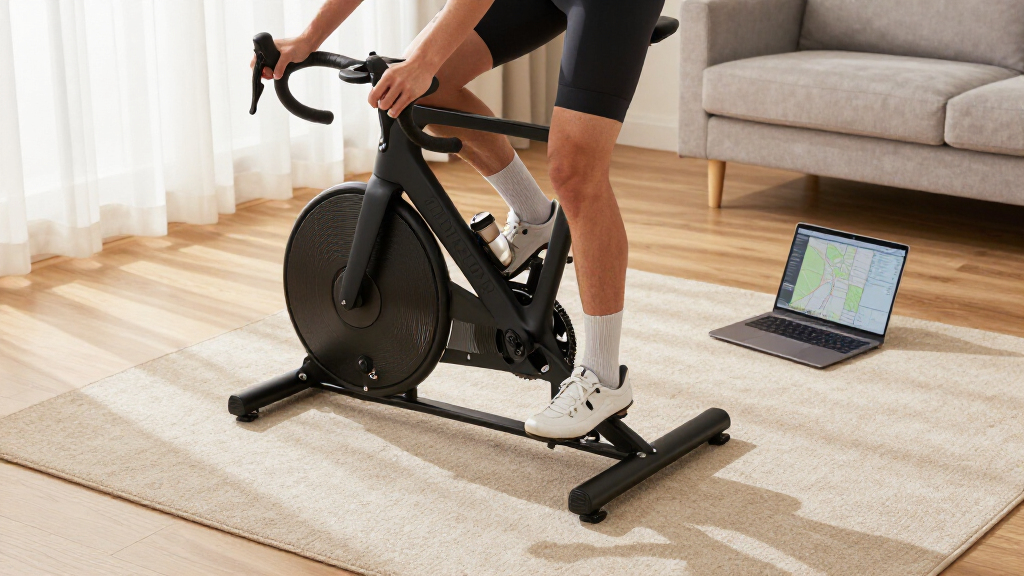
I evaluated these seven trainers by filtering for models with direct-drive mechanisms, as these eliminate the tire friction that causes high-pitched whining. I then assessed each unit based on decibel output at threshold power and footprint size, recognizing that apartment dwellers need both silence and storage solutions. Products were ranked higher if they offered vibration dampening features or compact folding mechanisms, which are critical for minimizing structural noise transfer. Finally, I considered ecosystem interoperability to ensure that the quietness did not come at the cost of software functionality.
| quiet smart trainers for apartment | Power Accuracy |
|---|---|
| Elite Rivo Smart Trainer | ±2.5% |
| ThinkRider XXPRO Smart Bike Tr | — |
| ThinkRider X2Max Smart Bike Tr | — |
| Elite Rivo Smart Trainer | ±2.5% |
| Garmin Tacx NEO 3M Smart Train | within 1% |
| Wahoo KICKR V6 Smart Indoor Tr | +/- 1% |
| ThinkRider XXPRO Smart Bike Tr | — |
Factors to Consider When Choosing Quiet Smart Trainers For Apartments
Choosing a trainer for an apartment is a balancing act between physical constraints and acoustic performance. Here are the specific factors that will determine whether your indoor riding sessions remain peaceful or disturb your neighbors.Understanding Noise Sources: Air vs. Mechanical
Most riders assume the flywheel is the loudest part, but in a quiet apartment, air resistance noise from cooling fans and wind tunneling is often the primary offender. High-wattage trainers require larger fans to prevent overheating, which creates a constant whooshing sound that penetrates walls easily. When comparing models, look for trainers with passive cooling systems or optimized airflow designs rather than just focusing on the mechanical motor noise. A trainer rated for 2500W might be louder than a 1500W model simply because its fans run at higher RPMs during sustained efforts. This distinction is vital for riders who do long, steady-state intervals rather than short sprints.
The Role of Vibration Isolation Mats
Even the quietest trainer will transmit low-frequency vibrations through the floor structure if not properly isolated. Concrete floors are easier to manage, but wooden subfloors act as soundboards, amplifying the rhythmic thud of the drivetrain. You must treat a high-density rubber mat as part of the trainer’s cost, not an accessory. These mats absorb the micro-vibrations that travel through floor joists, which is often what neighbors complain about, even if they cannot hear the actual cycling sound. Skipping this step can turn a quiet trainer into a noise nuisance, regardless of its official decibel rating.
Footprint and Storage Logistics
In an apartment, a trainer that stays set up year-round is a luxury few can afford. Foldable designs like the Elite Rivo allow you to store the unit under a bed or in a closet, freeing up living space. However, folding mechanisms can introduce slight structural flex, which might affect power accuracy over time. Fixed-frame trainers offer superior stability and often better heat dissipation but require a dedicated corner or a heavy-duty rack. Assess your available floor space honestly; if you ride daily, the convenience of a foldable unit often outweighs the marginal gain in stability from a fixed frame.
Connectivity and Software Compatibility
While ANT+ and Bluetooth are standard, the ease of pairing varies significantly between brands. Some trainers require specific dongles for ANT+ to work reliably with certain laptop configurations, adding another point of failure. WiFi connectivity, found in newer models like the Elite Rivo, allows for firmware updates and data syncing without a direct tether, which is convenient for apartment setups where the bike might not sit right next to your computer. Ensure the trainer supports your preferred platform, whether it is Zwift, TrainerRoad, or Rouvy, as some brands have closer integrations than others.
Power Accuracy vs. Realism Tradeoffs
Apartment trainers often sacrifice some ride realism to keep weights and sizes down. A trainer with ±2.5% power accuracy is sufficient for most indoor training plans, but it may not replicate the inertia of a real road bike as well as heavier, more expensive models. This difference matters if you are a competitive racer needing precise wattage data. For general fitness, the slight loss in realism is acceptable if it buys you a quieter, more compact unit. Prioritize accuracy only if your training plan relies heavily on specific power zones for performance gains.
Frequently Asked Questions
Can I use a quiet trainer on a wooden floor without annoying downstairs neighbors?
You can, but only if you invest in a specialized vibration isolation platform or a thick, high-density rubber mat designed for gym equipment. Wooden floors are excellent conductors of low-frequency sound, so the rhythmic pedaling motion can travel through joists even if the airborne noise is low. A standard yoga mat is insufficient; you need at least 10-15mm of dense rubber to decouple the trainer from the floor structure. Without this isolation, even the quietest direct-drive trainer will likely cause complaints from below.Do foldable trainers lose power accuracy over time compared to fixed frames?
Foldable trainers can develop slight flex in the folding joints after months of heavy use, which may introduce power drift of 1-2%. This is usually negligible for general fitness riders but might bother competitive racers who require strict consistency. Regular recalibration and keeping the joints tight can mitigate this issue. If you ride more than 10 hours a week and care about precise wattage, a fixed-frame model like the Wahoo KICKR V6 is a safer long-term choice despite its larger footprint.Is a 2000W trainer too loud for an apartment compared to a 1000W model?
Not necessarily, but the cooling fans on 2000W models often run at higher speeds, creating more wind noise. The motor itself might be similar in volume, but the auxiliary noise increases with power capacity. If you rarely exceed 500W, a lower-capacity trainer might actually be quieter because its fans stay idle or run at lower RPMs. Check the manufacturer’s noise specifications at specific wattage thresholds rather than just looking at the maximum power rating.Which connectivity standard is better for apartment setups: ANT+ or Bluetooth?
ANT+ is generally more robust for simultaneous data transmission to multiple devices, such as a heart rate monitor and a power meter, without interference. However, Bluetooth is universally compatible with smartphones and tablets, which are common in apartment setups where space is limited. Many modern trainers support both, but if you use a laptop for Zwift, an ANT+ USB dongle often provides a more stable connection than built-in Bluetooth. Choose based on your primary device rather than the trainer brand alone.Do smart trainers require regular maintenance to stay quiet?
Yes, keeping the drive train clean and lubricated is essential for minimizing mechanical noise. Dust and grime accumulation in an indoor environment can cause gritty sounds from the flywheel and resistance unit. Wipe down the trainer after every session to remove sweat and dust, and follow the manufacturer’s schedule for lubricating the drive belt or chain. Neglecting this maintenance can turn a quiet unit into a noisy one within a few months, regardless of its initial build quality.Conclusion
For most apartment dwellers, the Elite Rivo is the best overall choice because it solves the two biggest problems: noise and storage. Its foldable design and ultra-quiet direct-drive mechanism make it a practical daily driver for small spaces. If you prioritize maximum stability and ride feel over space-saving, the Wahoo KICKR V6 is the superior premium option, provided you have the room for its fixed frame. For those on a budget, the ThinkRider X2Max offers impressive power specs and reasonable noise levels, though it may lack the refined software integration of the top-tier brands. Beginners should lean toward the Elite Rivo for its simplicity and ease of setup, while serious racers might prefer the Garmin Tacx NEO 3M for its realistic road feel, accepting the larger footprint as a necessary tradeoff.
Halloween Picks
halloween
As an affiliate, we earn on qualifying purchases.